Tag Archives: Royal Navy

Lieutenant-Commander Martin Nasmith VC and HM Submarine E11

Lieutenant-Commander Martin Nasmith was captain of the submarine HMS E11 at the outbreak of WWI. In October 1914 E11 was one of three British submarines that tried to enter the Baltic Sea. The other two succeeded, but E11 was delayed by technical problems. On 19 October she mistook a neutral Danish submarine for a German U-boat, but her torpedo attack fortunately missed. She was spotted by a seaplane whilst recharging her batteries on the surface the next day; destroyers searched for her all day. After trying but failing to get past the Germans patrols again the next day Nasmith headed back to base on 22 October.[1]

On 17 December E11 was at southern end of a patrol line of British submarines in Helgoland Bight. Just after 7:00 am a number of German destroyers appeared, searching at high speed. An hour later large ships, which must have been returning from the German raid on the English north east coast, came into sight. Nasmith approached to 400 yards of one of them and fired a torpedo, but it ran too deep. He tried to get a shot on the third in the German line, but its zigzag course left it 500 yards away and heading straight for E11, forcing Nasmith to dive rapidly. This disturbed the boat’s trim, and she broke the surface when returning to periscope depth. She was able to escape. but the Germans made off at high speed.[2] On Christmas Day 1914 E11 rescued four of the airman who took part in the Cuxhaven Raid.

By May 1915 E11 was in the Dardanelles. On 17 May E14 returned from a successful patrol in the Sea of Marmara that earned her captain, Lieutenant-Commander Edward Boyle, the Victoria Cross and every member of her crew a medal. E11 was to head through the Straits to replace her the next day. The night before Boyle briefed Nasmith on the mines, nets and guns defending the straits.[3]

19 May: E11 set off at 1:10 am on 19 May, passing through the Allied destroyer line at 3:20 am and then diving. At 6:10 am she saw the Ottoman battle ships Targut Reis and Heredin Barbarossa, accompanied by several destroyers. The battleships withdrew and the destroyers fired on E11 whenever her periscope was raised. It was very easy to spot because of the speed that she was making and the light conditions. By 9:45 pm she was through the Straits. At 10:00 pm she surfaced in order to charge her batteries.[4]

20 May: She stayed on the surface, charging her batteries until 4:00 am, apart from 0:30 – 0:40 am, when a destroyer appeared, forcing her to dive. No merchant ships were seen during the day. Generally E11 stayed on the surface at night in order to charge her batteries. During the day she was on the surface if it was safe to do so.

21 May: At 11:30 am E11 stopped a small sailing vessel. Four chickens were taken; the scared but polite skipper declined payment. E11 used the vessel as a screen for the rest of the day: it was then very foggy.

22 May: Only warships were encountered and evaded. Attempts to radio the destroyer HMS Jed failed.

23 May: Course was altered towards Istanbul at 3:00 am. A transport was encountered at 4:50 am, whilst E11 was inspecting a sailing vessel. E11 dived to attack, but the transport spotted her and made off. At 5:50 am the 775 ton Ottoman gunboat Peleng-I Derya was seen anchored off Istanbul.[5] E11 dived, approached her and fired a torpedo into her. The gunboat sank, but first got off rifle fire and shots from her 6 pounder gun; one of the latter put E11’s forward periscope out of action.

24 May: Radio contact was made with Jed. Thereafter E11 and Jed were in regular contact.

At 10:30 am a smaller steamer was spotted heading west. E11 surfaced and ordered her to stop. The steamer tried to flee, but stopped after coming under rifle fire from E11. Her crew panicked and started to abandon ship. The panic was calmed by Silas Q. Swing, the war correspondent of the New York Sun. He said that the steamer was a passenger ship that was heading for Chanak and was not, as far he knew, carrying stores, before just making the last boat.

The steamer was in fact carrying a 6 inch gun, other gun mountings and a large amount of ammunition. After taking some souvenirs E11’s crew set a demolition charge, sinking the ship, which was the 480 ton naval auxiliary Naga.[6]

More smoke had by then been spotted. It was another steamer, similar to the Naga. E11 dived to attack, but was spotted. The target headed for Rodasto, with E11 pursuing on the surface. Large quantities of stores could be seen on the steamer’s deck. She berthed at Rodasto’s pier. E11 dived and approached, but ran aground 2,000 yards away as the water quickly became shallower. She fired a torpedo, which sank the steamer; she was the 512 ton SS Hunkar Iskelesi.[7] E11 then withdrew under rifle fire, which seemed to be aimed at her remaining periscope. It was hit but not damaged.

Another vessel was then observed. It was a small paddle steamer, which initially tried to flee. It stopped after coming under rifle fire, but then tried to ram E11 after realising that the submarine did not have any guns other than rifles. The paddle steamer, which was carrying horses, finally ran ashore. E11 approached, but came under fire from 50-100 cavalrymen. She fired a torpedo, but it missed; only the stern could be targeted and the shallow water made it impossible to close the range.

At 10:30 pm E11 headed towards Istanbul.

25 May: On the same day as U21 sank the battleship HMS Triumph E11 arrived at the Golden Horn. At 12:30 pm she fired torpedoes at two transports moored at the Arsenal Wharf. One hit and damaged the 3,559 ton SS Istanbul, which beached herself in shallow water, while the other, aimed at SS Kismet, circled back, forcing E11 to take evasive action, before escaping back to the Sea of Marmara.[8] The action was observed by the USS Scorpion, guard ship to the US Embassy. Her log noted that four torpedo boats fired on E11.[9]

26 May: The spare torpedoes were made ready. The rest of the day was spent bathing, repairing and mending clothes and resting.

27 May: An Ottoman battleship and two destroyers were seen at 1:30 am, but one of the destroyers forced E11 to dive as she was about to fire. A small steamer was observed at 5:00 pm, but not attacked after she fired on E11.

28 May: Smoke was spotted at 6:00 am. Half an hour later a convoy of one large and four small transports, escorted by a destroyer became visible. At 7:30 am a torpedo was fired at the largest transport, hitting and sinking the 474 ton SS Bandirma. Nasmith, conscious of the risk to E11’s periscope from Ottoman fire, dived his boat. He brought her back to periscope depth once safely clear, observing the destroyer searching for the submarine and the other transports continuing on their course.

At noon a steamship was seen approaching. A torpedo was fired, but no explosion was heard, although the target was seen to stop briefly. The torpedo was later found floating and hoisted back on board after Lieutenant Robert Browne had removed the firing pistol. Damage to the torpedo’s head showed that it had struck the ship, the 216 ton SS Dogan, without exploding.[10]

A small sailing vessel was stopped at 4:30 pm. She was not carrying any cargo and was allowed to continue after being relieved of various delicacies.

29 May: An attack on a store vessel at 7:00 am failed, with E11 breaking surface. Only two or three destroyers were seen during the rest of the day.

30 May: Day spent mainly in clearing the foul air in E11, cleaning her as far as possible and washing and bathing by the crew.

31 May: At 8:00 am a large ship of the German Rickmers Line was seen embarking troops at Panderma. At 9:20 am a torpedo was fired that hit her. She listed heavily to port, but her crew managed to beach her. The ship, the 3,431 ton SS Madeline Rickmers, was wrecked.[11]

1 June: A quiet day.

2 June: A destroyer was spotted at 8:10 am but E11 evaded her by diving. At 9:00 am E11 surfaced and headed to intercept a ship whose smoke had been observed just before diving. At 9:20 am E11 dived. She fired a torpedo 20 minutes later and the target, which was the 390 ton store SS Tecielli, sank in 3 minutes.[12]

At 12:30 pm the smoke of a small ship escorted by two destroyers was spotted. E11 dived at 1:15 pm. She fired a torpedo at the merchant ship at 2:15pm , but it passed under the target, which was the 400 ton SS Basangic.[13] The torpedo was found and floated back in to E11 via the stern torpedo tube after the firing pistol had been removed.

3 June: Smoke was seen at 3:00 pm. E11 dived and approached the vessel, which resembled a steam yacht. She was not closing the range quickly enough, so surfaced. When the range was down to 2,000 yards the enemy vessel turned and headed straight towards E11, which dived. The enemy had disappeared when E11 surfaced. A destroyer forced her to dive at 4:00 pm and remain submerged until midnight.

4 June: The only ship observed was a destroyer in the afternoon and evening, which was thought to be the one that had been hunting for E11 the day before.

5 June: The day was spent ventilating the boat, charging the batteries and bathing. Problems were found in one of the main motors and the intermediate shaft was cracked, so Jed was asked to give E11 permission to return to base.

6 June: A quiet Sunday of bathing, prayers, exercise and battery charging. A destroyer an some sailing vessels were seen in the afternoon. At 9:30 pm E11 headed slowly on the surface towards the north entrance to the Dardanelles.

7 June: E11 dived at 3:40 am and entered the Straits. At 6:30 am she passed Gallipoli at 90 feet. She examined all the anchorages, but found no battleships. A few small vessels and sailing ships were seen. The nest target was a troopship anchored off Moussa Bank. At noon a torpedo was fired at her. It struck, and the ship, which was the 3,590 ton SS Ceyhan, sank.[14]

E11 passed Nagara Point at 1:30 pm and Chanak 30 minutes later. A large mine became attached to the port foremost hydroplane at Chanak. At 4:00 pm E11 cleared the mine by surfacing stern first and heading astern at full speed. She was then met by the destroyer HMS Grampus, which escorted her to Port Mudros.

On 25 June the London Gazette printed the citation for the award of the Victoria Cross to Nasmith. Lieutenant Guy D’Oyly Hughes, his second in command, and Browne both received the Distinguished Service Cross and every petty officer and rating was awarded the Distinguished Service Medal. Nasmith’s citation, reproduced on Naval-History.net, said that:

 29206 – 25 JUNE 1915

Admiralty, 24th June, 1915.

The KING (is) pleased to approve of the grant of the Victoria Cross to Lieutenant-Commander Martin Eric Nasmith, Royal Navy, for the conspicuous bravery specified below:

For most conspicuous bravery in command of one of His Majesty’s Submarines while operating in the Sea of Marmora. In the face of great danger he succeeded in destroying one large Turkish gunboat, two transports, one ammunition ship and three storeships, in addition to driving one storeship ashore. When he had safely passed the most difficult part of his homeward journey he returned again to torpedo a Turkish transport.

The number of ships that E11 was credited with sinking ties in with the ships named by Nicholas Lambert in his footnotes to the Navy Records Society’s reprint of the report of E11’s patrol on which the above is based. Their total tonnage was 13,211 tons.

This was only the first of three patrols that Nasmith and the crew of E11 made in the Dardanelles. The other two will be the subject of later posts.


[1] J. S. Corbett, H. Newbolt, Naval Operations, 5 vols. (London: HMSO, 1938). vol. i, pp. 237-38.

[2] Ibid. vol. ii, pp. 45-46.

[3] Ibid. vol. iii, 32.

[4] This account of E11’s patrol is based on [142] ‘The First Sea of Marmora Patrol’ by HM Submarine E11, 19 May to 7 Hune 1915 by Lieutenant-Cammander Martin Nasmith, Lieutenant Guy d’Oyly Hughes and Lieutenant Robert Browne, document no. 142 in N. A. Lambert, ed. The Submarine Service, 1900-1918 (Aldershot: Ashgate for the Navy Records Society, 2001), pp. 301-13. Additional comments made by the editor are footnoted.

[5] Ibid. Footnote 1, p. 303.

[6] Ibid. Footnote 1, p. 305.

[7] Ibid. Footnote 2, p. 305.

[8] Ibid. Footnotes 1-3, p. 306.

[9] Ibid., p. 307.

[10] Ibid., pp. footnote 1, p. 309.

[11] Ibid. Footnote 1, p. 310.

[12] Ibid. Footnote 1, p. 311.

[13] Ibid. Footnote 2, p. 311.

[14] Ibid. Footnote 1, p. 313.
15 Comments

Filed under War History

U21 Sinks Two British Battleships in Three Days

Following the Allied landings on Gallipoli on 25 April 1915 a force of British and French pre-dreadnought battleships and cruisers gave fire support to the troops ashore. It was known that German U-boats were on their way to the Dardanelles.

The first to arrive was U21, captained by Kapitänleutnant Otto Hersing. He had been in command of her on 5 September 1914 when she sank HMS Pathfinder, the first time that a submarine had sunk a ship with a motor torpedo.

U21 had sailed from Germany on 25 April 1915. She was supposed to re-fuel from a ship on the way, but its oil was unsuitable; her tanks were almost empty when she reached the Austro-Hungarian port of Cattaro in the Adriatic on 13 May. On 5 May she was spotted by HM Torpedo Boat 92 near the island of Alborán in the western Mediterranean, but attempts by U21 to torpedo 92 and by 92 to ram U21 failed. The Germans also sent ten smaller submarines of the UB type by rail in sections to the Adriatic. Three had arrived and were being assembled when U21 reached Cattaro, now Kotor.[1]

Reports of the imminent arrival of U21 meant that on 17 May the number of battleships operating offshore was reduced from seven to four at Cape Helles and four to tow at Anzac Cove. Anti-submarine precautions were taken, including nets and destroyer patrols.[2]

U21 appeared at the Dardanelles on 25 May. Around 7:30 am the Grimsby trawler Minoru spotted her and alerted the destroyers by giving blasts on her siren. HMS Harpy made for U21, which seemed to be heading for the French battleship St Louis, but did not attack. The British Official History speculates that U21 may have made off because of the presence of Harpy, but also notes that she had orders to attack the ships off Anzac.[3]

Her periscope was spotted passed between the battleships HMS Swiftsure and Agamemnon; the former fired at her, but missed. Just after 10 am she fired a torpedo at the battleship HMS Vengeance, which evaded it. All available destroyers and trawlers were ordered to search for the submarine. Her periscope was spotted and fired on four times, and a destroyer passed over her, but she was too deep to be damaged. Since U21 was heading north the balloon ship HMS Manica and transports in that direction were ordered away. The battleship HMS Canopus, which was zigzagging and escorted by the destroyer HMS Ribble, spotted U21, but was not attacked.[4]

About 12:25 the destroyer HMS Chelmer, which was patrolling round the battleship HMS Triumph at 15 knots off Anzac, spotted the wash of U21’s periscope 500 yards off Triumph. Chelmer made for it and Triumph opened fire, but Triumph was quickly hit by a torpedo that had passed through her anti-torpedo nets as if they had been ‘a spider’s web.’[5]

Triumph’s watertight doors were all closed, but she capsized ten minutes after she had been hit. However, the order to abandon ship was given as soon as her list became dangerous, with the result that over 500 men were saved; only three officers and 70 men were lost, according to the Official History.[6] The large number of survivors was thanks to the ‘skilful handling of the Chelmer‘ by her captain, Lieutenant-Commander Hugh England.[7]

The sinking of Triumph resulted in the Allied battleships being withdrawn to Imbros, a protected harbour. However, the next day Vice Admiral Sir John de Robeck, the naval commander, decided that there should always be two off Helles, one of them in the Aegean and the other in the Dardanelles.[8]

On 26 May the French battleship Jauréguiberry spotted a periscope 100 yards away whilst off the entrance to the Dardanelles. She was in the process of turning and ran over the submarine. Some of her crew thought that she had rammed the submarine, but this was not the case.[9]

At 6:45 am on 27 May U21’s periscope appeared 400 yards from the battleship HMS Majestic. She fired on it, missing. Hersing fired a torpedo which went through a gap in the transports, passed through the nets and struck Majestic with what the British Official History called ‘a shot the best might envy.’[10] She capsized in nine minutes, but did not sink because the water was only nine fathoms deep. Instead, she rested on her foremast, with her keel exposed, leaving her ‘looking like a stranded whale.[11] All but 43 of her crew were saved.[12] The men lost on both battleships sunk by U21 are listed on naval-history.net.

The Allied battleships and cruisers were withdrawn to Imbros. They now provided fire support only when specifically requested by the army, with the day to day work being carried out by destroyers and monitors.[13]

The Official History noted that U21’s feats had ‘grave moral effects’, both positively for the Ottomans and negatively for the Allies.[14] There was also a considerable material impact, as supply arrangements were further complicated and ‘continuous battleship support for the army was no longer possible.[15]

Tim Travers, however, contends that naval fire was not accurate enough to deal with ‘precise targets like trenches, machine guns or enemy batteries.’[16] Henceforth, the Allied troops were dependent on shore based artillery. Many officers subsequently described this as being inadequate, but Travers suggests that they are comparing Allied artillery support at Gallipoli with the volumes of fire that they later experienced on the Western Front. He notes that ‘comments at the time often praised the artillery.’[17]

Hersing kept his boat in the area for two more days, before putting into an Ottoman coast station. He had difficulties entering the Straits because of a whirlpool, but reached Istanbul on 5 June with only half a ton of oil left to ‘scenes of great enthusiasm.’[18] He was later awarded Germany’s highest decoration, the Pour le Mérite. He and his boat survived the war.

[1] J. S. Corbett, H. Newbolt, Naval Operations, 5 vols. (London: HMSO, 1938). vol. ii, p. 384 and footnote 1.

[2] N. Steel, P. Hart, Defeat at Gallipoli (London: Papermac, 1995), p. 184.

[3] Corbett, Newbolt, Naval. vol. iii, p. 28.

[4] Ibid. vol. iii, p. 29.

[5] Ibid. vol. iii, p. 29.

[6] Ibid. vol. iii, pp. 29-30.

[7] Steel, Hart, Defeat, p. 185.

[8] Ibid.

[9] Corbett, Newbolt, Naval. vol. iii, p. 30.

[10] Ibid. vol. iii, p. 31.

[11] Ibid.

[12] Steel, Hart, Defeat, p. 185.

[13] Ibid., p. 186.

[14] Corbett, Newbolt, Naval. vol. iii, p. 31.

[15] Ibid. vol. iii, p. 30.

[16] T. Travers, Gallipoli, 1915 (Stroud: Tempus, 2001), p. 226.

[17] Ibid., p. 227.

[18] R. H. Gibson, M. Prendergast, The German Submarine War, 1914-1918. (London: Constable, 1931), p. 72.

7 Comments

Filed under War History

Admiral Fisher Resigns as First Sea Lord

On 13 May 1915 at a meeting at the Admiralty Field Marshall Lord Kitchener, the Secretary of State for War, criticised the Admiralty’s recent decision to recall the super dreadnought HMS Queen Elizabeth from the Dardanelles. He argued that this would damage Allied morale and boost that of the enemy.[1]

The report of The Dardanelles Commission, later set up to investigate the campaign, noted that ‘[i]t is difficult to say why Lord Kitchener should have attached to much importance to the retention of the Queen Elizabeth.’[2] Kitchener by then was dead. The results of naval gunfire support to the army had been disappointing and the removal of Queen Elizabeth was more than compensated for by the despatch of other ships, including monitors, to the Dardanelles.

In return, Admiral Lord Fisher, the First Sea Lord, threatened to resign if Queen Elizabeth remained. Winston Churchill, the First Lord of the Admiralty, backed Fisher, albeit reluctantly in the view of Major General Charles Callwell, the Director of Military Operations and Intelligence, who was present.[3]

The next day the War Council met. The Admiralty argued that it would not have agreed to a solely naval attack on the Dardanelles had it been aware that 100,000 soldiers would soon be available for an amphibious landing. The demands on the Royal Navy by the German U-boat offensive, the Allied Italian Naval Convention and the need to maintain the strength of the Grand Fleet meant that the campaign must now be a land one with naval support rather than the other way round.

The army, however, claimed that the presence of Queen Elizabeth and her 15 inch guns had been a major factor in its belief that it could see the fleet through to Istanbul. It could not see how a rapid victory could be achieved, but withdrawal was inconceivable at this stage. This left siege warfare as the only option, but it was unclear how many troops could be provided, given the demands of the Western Front and home defence.

Fisher had originally proposed a combined land and naval attack on the Dardanelles, which he hoped would have won a quick victory. He had been reluctant in his support for the naval only attack. He now feared that the ships that he had been constructing to use in operations in the northern waters would instead he sent to the Dardanelles.[4]

The War Council meeting left Fisher with the impression that more ships would be sent to the Dardanelles. He told Captain Thomas Crease, his Naval Assistant, that if operations in the Dardanelles were to continue ‘they should henceforth be directed on the naval side by somebody who believed in them.’[5]

On 15 May Fisher received a memo from Churchill that proposed sending far more naval reinforcements to the Dardanelles than the two men had agreed the evening before. Fisher had offered his resignation several times before, but this time he finally quit. He officially remained First Sea Lord until 22 May, but seems to have visited his office only once more, on 17 May to remove some personal items.[6]

The departure of Fisher, coupled with the revelation that the British Army lacked enough high explosive shells, led to the replacement of the Liberal Government with a Liberal/Conservative Coalition. It was certain that the Conservatives would insist that Churchill, who had left them to join the Liberals in 1904 over the issue of free trade, would be removed from the office of First Lord.

Fisher at first had a substantial degree of public support, with several newspapers, led by The Times, arguing that he should become First Lord. There were several precedents from the 18th and early 19th centuries for that position, a political rather than a military one, to be held by an Admiral.

However, Fisher made two mistakes on 17 May. Room 40, the Admiralty’s code-breakers, decoded signals indicating that the German High Seas Fleet was about to put to sea. Crease told Fisher that he should go to the Admiralty to supervise operations. but he refused to do so. Vice Admiral Sir Frederick Hamilton had to act as First Sea Lord. He was the Second Sea Lord, with responsibility for personnel and shore establishments, so was not sufficiently versed in operational matters to stand in for the First Sea Lord. As it happened, the High Seas Fleet was only covering mine laying operations and did not go far into the North Sea.

H. H. Asquith, the Prime Minister, said that ‘[s]trictly speaking, [Fisher] ought to be shot’ with King George V, who had supported Fisher until then, stating that his behaviour ‘was bound to have a deplorable, if not a disastrous effect upon the public, not only at home, but abroad.’[7]

Fisher’s second mistake was to say that he would stay as First Sea Lord subject to various conditions that no politician was likely to accept. He insisted that Churchill’s replacement should not be Arthur Balfour, the Conservative who did become First Lord. Fisher also wanted an increase in the responsibilities of the First Sea Lord at the expense of the First Lord and the other members of the Board of Admiralty.

Even then, it was not until 22 May that Asquith accepted Fisher’s resignation. A final attempt the day before to persuade him to stay failed because Fisher would not serve under Balfour. The Coalition took power on 25 May, with Balfour as First Lord. Churchill remained in the Cabinet as Chancellor of the Duchy of Lancaster, a job without ministerial responsibilities usually given to inexperienced ministers.

The new First Sea Lord was Admiral Sir Henry Jackson. As he was ‘almost unknown to the nation, the appointment elicited a lukewarm response.’[8] The outstanding candidate, Admiral Sir John Jellicoe, could not be spared from his current post as Commander-in-Chief of the Grand Fleet.

[1] A. J. Marder, From the Dreadnought to Scapa Flow; the Royal Navy in the Fisher Era, 1904-1919, 5 vols. (London: Oxford University Press, 1961-70). vol. ii, p. 276.

[2] PP, The Final Report of the Dardanelles Commission. (Part II–Conduct of Operations, &C.) with Appendix of Documents and Maps (1919), p. 23.

[3] Marder, From. vol. ii, pp. 276-77.

[4] This and the two previous paragraphs are based on J. S. Corbett, H. Newbolt, Naval Operations, 5 vols. (London: HMSO, 1938). vol. ii, pp. 408-10.

[5] Quoted in Marder, From. vol. ii, p. 277.

[6] The remainder of this post is based on Ibid. vol. ii, pp.279-91.

[7] Quotes from Ibid. vol. ii, p. 283.

[8] Ibid. vol. ii, p.291.

2 Comments

Filed under War History

The Royal Navy and the Gallipoli Land Campaign

Allied troops landed on the Gallipoli peninsula on 25 April 1915, two days later than originally planned because of bad weather.

All the troops, equipment and supplies had to be brought, and wounded evacuated, by sea. Warships provided fire support. Submarines raided Ottoman ships bringing reinforcements and supplies. The small Allied air force came from the Royal Naval Air Service. There was even a naval contribution to the land campaign: the Royal Naval Division.

In 1914 the RN found that it had more reservists than it needed to man its ships. It therefore formed the extra men and some Royal Marines into an infantry division. Some men also volunteered directly for the RND.

The RND was landed at Dunkirk on 20 September 1914 in order to help defend Antwerp. Some of its troops managed to return from Antwerp to the UK, arriving on 11 October; others were forced to flee into the Netherlands, where they were interned for the rest of the war.

The division’s infantry battalions were brought back up to strength before it was sent to Egypt in 1915. At this stage of the war it lacked the artillery and other supporting units of an army infantry division.

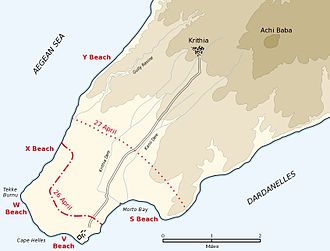
The invading force consisted of 30,000 Australians and New Zealanders, divided into two divisions; the 17,000 troops of the British 29th Division, made up of regulars who had been serving in remote colonial garrisons; the 10,000 men of the RND; and a 16,000 strong French division. The 29th would land at Cape Helles and the Anzacs 13 miles up the coast at a place now called Anzac Cove. The RND and the French would make diversionary landings at Bulair and Kum Kale on the Asiatic shore respectively. Preparations were slow because ships had been loaded in the wrong order for an invasion, meaning that they had to be unloaded and re-loaded at Alexandria.[1]

The fleet was commanded by Vice Admiral John de Robeck, who had taken over towards the end of the naval attack on the Dardanelles. His Chief of Staff was Commodore Roger Keyes, an aggressive officer who had previously commanded the RN’s submarines, including at the Battle of Helgoland Bight.

De Robeck’s fleet comprised one British dreadnought; 15 British and four French pre-dreadnought battleships; nine British, three French and one Russian cruisers; 24 British and five French destroyers; seven British, one Australian and four French submarines; a British seaplane carrier; and various minesweepers and other auxiliary craft. One each of the French pre-dreadnoughts and the French cruisers did not take part in the events of 25 April.[2]

Security for the operation was poor. Enemy agents in Athens learnt of preparations on the Greek Islands from the crews of Greek caiques; letters were sent by ordinary post from the United Kingdom to Egypt addressed to the ‘Constantinople Force, Egypt’; and there was open speculation in the Egyptian press.[3] Despite the large number of Allied troops in Egypt, it was officially neutral, so the British could not censor its newspapers.

Tim Travers highlights that the army and navy had different views of the invasion, which created confusion. The navy’s emphasis was on a combined attack on the Narrows, but the army believed that the navy’s role was to weaken the defences in order to permit the landing.[4]

A meeting of RN captains on 21 April decided to abandon the original concept of anchoring offshore in order to shell the beaches and approaches. Instead, the beaches would be bombarded before the landing, but the guns would then switch to the coastal ridges. Keyes rejected Captain Hughes Lockyer of the battleship HMS Implacable’s idea of firing on the beaches on the way in as he thought that the gun control system made it impossible to change the range and bearing quickly enough. The orders stated that ‘ships will cover the landings and support its advance.’[5]

This left captains with a fair degree of discretion. They were no longer required to anchor, but Lockyer said that Keyes’s comments meant that some were reluctant to move close to the shore. The casualties were heaviest at the beaches where the ships remained anchored offshore: V and W at Cape Helles. The landings at S and X at Helles and Anzac Cove benefitted from close naval support.[6]

The fifth beach at Helles, Y, was a late addition, intended to threaten any Ottoman retreat and reinforcements. The initial landing met little resistance, but the troops, lacking a clear objective, did not press on and were withdrawn the next day.[7]

W Beach was target of the 1st Lancashire Fusiliers plus 50 men of the Anson Battalion of the RND. They came ashore in cutters which were first towed by steam boats before being rowed the final part of the journey, which was slow because of an unexpectedly strong current. The boats had to come back to carry the second wave. Casualties amongst both the Fusiliers and the sailors were heavy, with some boats being reduced to two rather than six rowers.[8]

The beach was taken thank to the courage of the Lancashire Fusiliers, six of whom were awarded the Victoria Cross. However, their casualties were too heavy for them to link up with V Beach. This beach was later known as Lancashire Landing.[9]

After disembarking the men intended for W Beach, Implacable bombarded X Beach, with Lockyer taking her to within 450 yards of the shore. She and the light cruiser HMS Dublin were so close in that they came under rifle fire. The small number of men defending the beach were so overwhelmed by the bombardment that the 2nd Royal Fusiliers landed without casualties. Implacable helped to repel an Ottoman attack in the evening. This beach was later known as Implacable Beach.[10]

Captain Alexander Davidson of the battleship HMS Cornwallis was concerned about the small size of the landing force at S Beach, which consisted of two companies of the 2nd South Wales Borderers and a detachment of marines. He therefore augmented it with marines and sailors from his ship and also landed himself. The beach was taken with only 63 casualties. However, Davidson was supposed to move Cornwallis to V Beach once S was captured, but stayed longer in order to evacuate wounded and provide fire support.[11]

The first wave at V Beach consisted of three companies of the Dublin Fusiliers and 50 men of the Anson Battalion in boats each crewed by a midshipman and six seaman. They were followed by the rest of the 1st Royal Dublin Fusiliers, the 1st Royal Munster Fusiliers, half the 2nd Hampshires and 50 more men from the Anson Battalion on board the steamer River Clyde, captained by Commander Edward Unwin.[12]

The River Clyde was to be grounded. She would still be too far offshore for the men to land, so a steam hopper and three wooden lighters would provide a bridge for the troops to land from exits cut in her hull. However, problem with the steam hopper prevented the bridge being put into place.[13] The conversion of the River Clyde into a specialist landing ship was Unwin’s idea.[14]

Unwin and Able Seaman William Williams dived into the sea and managed to move two of the lighters into position with the help of Midshipman George Drewry, commanding the hopper. There was nothing that the lighters could be secured to, so Unwin and Williams used their own bodies to weigh it down. This allowed the Munsters to attempt to land, but most were killed or wounded. Some jumped into the water, but many of them, weighed down by heavy packs, drowned. Williams was also hit and Unwin had to release the line in order to stop him drowning.

Lieutenant John Morse and Midshipman Wilfred Malleson managed to restore a bridge of boats. An attempt to land smaller parties failed and the attack was halted.[15] The men would have got ashore more quickly had the hopper and lighters been able to form a bridge as planned, but casualties would still have been heavy.[16]

The few men who had made it ashore were able to shelter behind a sandbank. The naval fire support at V Beach was inadequate. The battleship HMS Albion stayed 1,400 yards offshore, too far to be useful without forward observers. Cornwallis was late arriving and also stayed too far offshore. Unwin was later very critical of Davidson, arguing that he should have been court martialled for lingering at the lightly defended S Beach.[17]

The cruiser HMS Euryalus did provide accurate fire support at V Beach, but she stayed further offshore than Implacable did at X Beach.[18]

It had not originally been intended to use French troops on 25 April, but it was decided that this was a waste, so they were landed at Kum Kale on the Asian shore. The objective was to prevent the Ottomans from bombarding the S Beach invasion force. Fire support was provided by the French battleship Henri IV, the British battleship HMS Prince George and the Russian cruiser Askold. Henri IV came close inshore to provide accurate fire support. The landing was successful, but the troops were withdrawn on 27 April as they could not advance further without reinforcements.[19]

The first part of the feint by the RND at Bulair was to begin just before dusk with men being rowed towards the shore. They would return to their ships without landing once darkness hid them from the Ottomans. A single platoon of the Hood Battalion would then land and light flares, fire rifles and give the impression that a real landing had taken place.

However, Lieutenant Commander Bernard Freyberg argued that this risked unnecessary casualties. A strong swimmer, he proposed that he should swim ashore alone and set off the flares. This was accepted. The movement of Ottoman reserves was delayed for while, but the original plan would have caused more problems.[20]

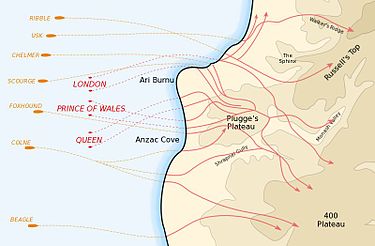
The final attack was by the Anzacs at Gaba Tepe, now called Anzac Cove. There was confusion over the intended landing spot and charts were poor. Some senior army officers claimed that the troops were landed a mile and a half to two miles too far north. Travers suggests that the choice of place was ‘quite flexible.’[21]

Peter Hart and Nigel Steel argue that the landing was no more than 500 yards away from the planned location. They note that the naval orders used 2,025 yard nautical miles rather than 1,760 yard statute miles.[22]

Lieutenant General Sir William Birdwood, the Anzac commander, and others later said that change in landing beach was beneficial. It took the Ottomans by surprise and steep cliffs protected the troops. However, Travers comments that the Anzacs were confused by landing at the wrong point and that the Ottomans reacted quickly. Units became mixed up, resulting in a loss of cohesion.[23]

Naval gunfire could give little help at first because the situation was unclear, the terrain was difficult and there was no observation. Most ships stayed too far out, but the right flanks was helped by the cruiser HMS Bacchante, which came in as close as the rocks allowed. She and the battleship HMS Triumph, unlike other ships at Anzac, adjusted their fire according to heliographic signals from ashore.[24]

Although the army was now ashore, the navy continued to play a vital role in the Gallipoli campaign. Ships provided fire support to the troops; supplies and reinforcements had to be brought and wounded evacuated 50 or 60 miles to bases on the islands of Lemnos, Mudros and Tenedos. Rear Admiral Rosslyn Wemyss, commanding at Mudros said that there in September there were always between 150-70 ships at Mudros, excluding small ships. The supply chain was threatened by German U-boats, which intelligence reports said correctly were on their way.[25]

Six Victoria Crosses were awarded to sailors for actions at V Beach on 25 April. Four went to Unwin, Williams, Drewry and Malleson. One went to Seaman George Samson, who worked on a lighter all day under fire, helping wounded and putting out lines, before being badly wounded by machine gun fire. The sixth was Sub Lieutenant Arthur Tisdall of the RND, who went to the aid of wounded men on the beach who were under fire. Only Williams’s award was posthumous, although Tisdall was killed on 6 May. Drewry received the Distinguished Service Order.

De Robeck’s despatch, including a list all Special Recommendation to men under his command, which did not include the RND, is listed on naval-history.net, as are all the RN recipients of gallantry awards and all RN men killed, including the RND.

[1] A. Moorehead, Gallipoli. (London: New English Library, 1963), pp. 107-11.

[2] J. S. Corbett, H. Newbolt, Naval Operations, 5 vols. (London: HMSO, 1938). vol. ii, pp. 310-12

[3] Moorehead, Gallipoli., p. 109.

[4] T. Travers, Gallipoli, 1915 (Stroud: Tempus, 2001), p. 56.

[5] Ibid., p. 63.

[6] Ibid., p. 64.

[7] Ibid., pp. 72-74.

[8] Corbett, Newbolt, Naval. vol. ii, pp. 330-32.

[9] N. Steel, P. Hart, Defeat at Gallipoli (London: Papermac, 1995), pp. 86-90, 96.

[10] Corbett, Newbolt, Naval. vol. ii, pp. 325-27.

[11] Travers, Gallipoli, pp. 61-62.

[12] Corbett, Newbolt, Naval. vol. ii, p. 332.

[13] Travers, Gallipoli, pp. 64-65.

[14] Steel, Hart, Defeat, p. 41.

[15] Ibid., pp. 90-96.

[16] Travers, Gallipoli, p. 65.

[17] Ibid., pp. 65-66.

[18] Ibid., pp. 71-72.

[19] Ibid., pp. 75-78.

[20] Steel, Hart, Defeat, pp. 78-80.

[21] Travers, Gallipoli, p. 85.

[22] Steel, Hart, Defeat.

[23] Travers, Gallipoli, p. 83.

[24] Ibid., pp. 89-90.

[25] P. G. Halpern, A Naval History of World War I (London: UCL Press, 1994), p. 116.

8 Comments

Filed under War History

The Global Naval War

The Royal Navy’s most famous action of March 1915 was its unsuccessful attempt to force the Dardanelles. Its most successful one was the sinking of the German light cruiser SMS Dresden on 14 March. However, in March 1915, as with every month of the war, it was involved in many other activities across the world.

The Ottoman Empire’s largest Mediterranean port, Smyrna (now Izmir), was bombarded on 5 March in an operation similar to the attack on the Dardanelles. The intention was to prevent it being used as a submarine base. The attacking force consisted of the battleships HMS Swiftsure and Triumph, detached from the Dardanelles, the cruiser HMS Euryalus (Vice Admiral Sir Richard Peirse’s flagship),  the Russian cruiser Askold, the seaplane carrier Aenne Rickmers and minesweepers.

Smyrna was defended by a battery of seven 9.4 inch guns and another of four 6 inch guns, plus minefields that were protected by light guns and searchlights. The action began on 5 March and soon became a smaller version of the Dardanelles. The minefields prevented the big ships from getting close enough to destroy the guns which stopped the minesweepers from clearing the minefields.

An attempt was made to persuade the local ruler, the Vali of Smyrna, to come to terms. He appeared to agree, but it was unclear whether or not the military would obey him, especially after British ships flying flags of truce were fired on.[1]

The attack was called off on 15 March because the battleships were recalled to the Dardanelles. Ironically, Smyrna could not be used as a submarine base because the Ottomans blocked it by scuttling five ships in order to defend it against the attack.[2]

In Africa the RN was engaged on both coasts. The United Kingdom’s main interest in the Cameroons was in capturing the wireless station and port of Duala, which might have been used to support cruiser operations. The French were more interested in obtaining territory. Duala was taken by a river based operation on 27 September 1914, during which the gunboat HMS Dwarf sank the German cutter Nachtigal. However, the Germans had not retreated far, meaning that a further advance was needed in order to make it secure.[3]

In March 1915 the naval force operating off the Cameroons and along its rivers consisted of the cruiser HMS Challenger, HMS Dwarf, the French cruiser Pothau and about 20 smaller craft. In late April Challenger was relieved by the cruiser HMS Astraea and the force strengthened by the cruiser HMS Sirius and the sloop HMS Rinaldo.[4]

Until the British victory at the Falkland Islands on 8 December 1914 RN forces in South Africa had to be kept concentrated. South African troops were convoyed by sea to the British enclave at Walvis Bay on 25 December.

By March the most important task for the RN’s South African station was the blockade of German East Africa (now Tanzania). The light cruiser SMS Königsberg was by then trapped in the Rufiji River.

The only German commerce raider at liberty in March was the armed merchant cruiser SMS Kronprinz Wilhelm, which would intern herself in Newport News on 8 April. However, the British did not learn until around 19 March the light cruiser SMS Karlsruhe had been destroyed by an accidental explosion on 4 November 1914.[5]

By March 1915 the main German threat to Allied commerce was from U-boats. Germany had declared that it would conduct unrestricted submarine warfare from 18 February. In February German U-boats sank nine Allied merchant ships with a total tonnage of 22,784 tons, including two of 4,286 tons on 15 February. Two (11,228 tons) were damaged. In March 30 ships (79,369 tons) were sunk or captured by German U-boats, with six (22,300 tons) being damaged. One of the ships in March sunk was the 5,948 tom armed merchant cruiser HMS Bayano.

These losses, although higher than previously inflicted by U-boats, were not huge because of the relatively small number of U-boats that Germany then possessed. It had 23 operational on 22 February, plus seven newly completed boats that were under sea trials. The need to refit, repair and resupply boats meant that there was an average of 5.6 and a maximum of 12 boats at sea on any one day between March and May 1915.[6]

The RN, like all navies lacked effective anti-submarine countermeasures in March 1915. Three U-boats were lost that month: U8 was trapped in nets and scuttled whilst under gunfire from the destroyers HMS Gurkha and Maori on 4 March; U12 was rammed by the destroyer HMS Ariel on 10 March; and U29 was being rammed by the battleship HMS Dreadnought on 18 March.

U29 remains the only submarine to have ever been sunk by a battleship. She was lost with all hands, including her captain, Kapitänleutnant Otto Weddigen. He had previously captained U9 when she sank three British cruisers on 22 September 1914 and another on 15 October.

The Admiralty issued orders that merchant ships that sighted a surfaced U-boat should head towards it in order to force it to dive. On 28 March Captain Charles Fryatt of the Great Eastern Railway packet Brussels escaped from U33 by this tactic.

The Brussels was captured by German destroyers on the night of 22-23 June 1916 and taken into Zeebrugge. Fryatt was tried as a franc-tireur on the basis that he was a civilian who had attempted to attack the German armed forces. He was executed on 27 July 1916, yet another German action that handed the Allies a propaganda victory for little or no military advantage. It was heavily criticised by the neutral Press: The New York Times called it ‘a deliberate murder.’[7]

British naval operations continued throughout the world, including blockading Germany, supplying the Western Front, patrolling and minesweeping.

On 24 March aircraft of the Royal Naval Air Service attempted to bomb the dockyards at Antwerp, where small U-boats of the UB coastal type were being assembled. Some aircraft had to abort because of technical problems and weather, but two, piloted by Squadron Commander I.T. Courtney and Flight-Lieutenant H. Rosher, bombed the target.[8]

This link names all British Empire sailors and marines who died in March 1915, whether from enemy action, illness or accident. The largest number were killed in the Dardanelles, followed by the crew of HMS Bayano. Most others died in the UK or home waters, but some died in Australia and Canada. Twelve were lost when the trawler Lord Airedale, taken into service as a minesweeper, foundered in a storm off the east coast of England on 18 March. The sea was dangerous, even when not undertaking dangerous war work such as minesweeping.


[1] J. S. Corbett, H. Newbolt, Naval Operations, 5 vols. (London: HMSO, 1938). vol. ii, pp. 195-200.

[2] P. G. Halpern, A Naval History of World War I (London: UCL Press, 1994), p. 114.

[3] H. Strachan, The First World War: Vol. 1, to Arms (Oxford: Oxford University Press, 2001), pp. 519-23.

[4] Corbett, Newbolt, Naval. vol. ii, pp. 281-84.

[5] Ibid. footnote 1, p. 240.

[6] V. E. Tarrant, The U-Boat Offensive, 1914-1945 (London: Arms and Armour, 1989), p. 7.

[7] Halpern, Naval, p. 296.

[8] W. A. Raleigh, H. A. Jones, The War in the Air: Being the Story of the Part Played in the Great War by the Royal Air Force, 7 vols. (Oxford: Clarendon Press, 1922). vol. ii, pp. 343-44.

Leave a comment

Filed under War History

The Naval Attack on the Dardanelles 1915 (2) The Attack

The previous entry in this series described the reasons why the British decided to launch a naval attack on the Dardanelles in February 1915.

The attack was to be led by Vice Admiral Sir Sackville Carden, who was then commanding RN forces in the Mediterranean. His force included the RN’s newest dreadnought, HMS Queen Elizabeth, which was the first battleship in the world to be fuelled entirely by oil and the first dreadnought to be armed with 15 inch guns. An accident reduced her speed to 15 knots, so the battlecruiser HMS Inflexible, which was originally intended to return to the Grand Fleet, stayed in order to give Carden a ship fast enough to bring SMS Goeben, the German battlecruiser now in Ottoman service, to action.

The other 12 British battleships in Carden’s force were all pre-dreadnoughts; some had been released from overseas stations after the British victory at the Falkland Islands and others were transferred from the Channel Fleet. They included HMS Agamemnon and Lord Nelson, which had been completed after HMS Dreadnought because the 12 inch gun turrets originally intended for them were fitted to Dreadnought in order to expedite her construction. The others were of the older Majestic, CanopusFormidableDuncan and Swiftsure classes. Carden also had four French pre-dreadnoughts, giving him a total of 18 capital ships, and the six seaplanes of the carrier HMS Ark Royal.

Carden had devised a seven stage plan:

  1. Destroy the forts at the entrance to the straits.
  2. Sweep the minefields and reduce the defences up to the Narrows.
  3. Destroy the forts defending the Narrows.
  4. Sweep the principal minefield at Kephez.
  5. Destroy the forts above the Narrows
  6. Enter the Sea of Marmara.
  7. Operate in the Sea of Marmara and patrol the Dardanelles.

Each attack on the forts would comprise three stages: a direct or indirect long range bombardment out of either range or bearing of the forts; a medium range bombardment by direct fire, including secondary armaments; and then a final bombardment at a range of 3-4,000 yards. Ships were to withdraw to long range if they came under fire: the largest Ottoman guns were thought to have a maximum range of 12,000 yards.[1]

Winston Churchill, the First Lord of the Admiralty, was urged by some staff officers to send the Royal Naval Division, an infantry force under the Admiralty’s control, to Carden. It had been formed at the start of the war from marines, naval reservists who were not needed at sea ships and wartime volunteers, and had fought in Belgium in 1914. At this stage of the war it lacked the supporting forces of an army infantry division. However, Churchill was willing to send only two battalions of Royal Marines to act as landing parties to destroy Ottoman guns.[2]

On 16 February it was decided to send the 29th Infantry Division, consisting mostly of regulars recalled from colonial garrisons, from the UK and the two divisions of the  Australian and New Zealand Army Corps from Egypt to Lemnos, the naval base of operations. However, Lord Kitchener, the Secretary of State for War, decided three days later that the 29th might be needed in France.[3]

This was the start of the military operation, but at this stage it was still expected that the fleet would force the Dardanelles. The troops were intended to demolish forts, destroy concealed howitzers, take the Gallipoli peninsula once the Ottomans had withdrawn and occupy Istanbul  if the expected revolution occurred.[4]

The naval attack began on 19 February. It showed that direct hits were required in order to knock out a heavy gun in a modern emplacement; indirect fire was not accurate enough to achieve such hits.[5]

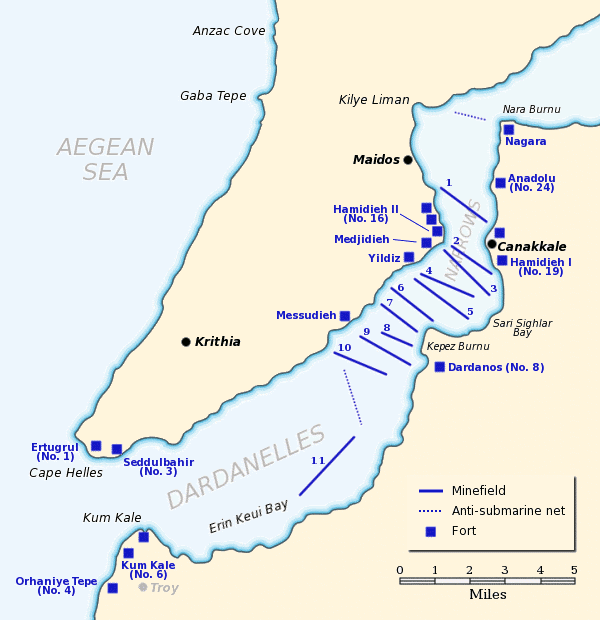
Source: "Dardanelles defences 1915" by Gsl - Own work. Licensed under Public Domain via Wikimedia Commons - http://commons.wikimedia.org/wiki/File:Dardanelles_defences_1915.png#/media/File:Dardanelles_defences_1915.png

Source: “Dardanelles defences 1915” by Gsl – Own work. Licensed under Public Domain via Wikimedia Commons – http://commons.wikimedia.org/wiki/File:Dardanelles_defences_1915.png#/media/File:Dardanelles_defences_1915.png

The attack resumed on 25 February after a period of bad weather. The forts on either side of the entrance were silenced. Attempts by marine landing parties on 26 February and 1 and 4 March to complete the destruction of the forts were only partly successful because the Ottomans had re-occupied them once the naval fire lifted.[6]

Lieutenant Commander Eric Robinson of HMS Triumph was awarded the Victoria Cross for his courage whilst leading one of the landing parties on 26 February.

Carden’s first stage of silencing the forts at the entrance to the Dardanelles had now been achieved. There were no minefields in the first half of the 14 miles to the Narrows, but the battleships could not proceed through the minefields in the second seven miles. The trawlers that were employed as minesweepers had a speed of only four to six knots when sweeping, which was halved because they were going against the current. The remaining Ottoman guns were unable to do serious damage to battleships, although some were hit, but their howitzers were deadly against the minesweepers. Carden decided to use the minesweepers at night, but the Ottomans had anticipated this and installed searchlights.[7]

The battleships were unable to find the concealed howitzers. Air reconnaissance failed because the seaplanes were vulnerable to ground fire if they flew low and could not see the guns if they stayed high enough to be safe. Carden also employed a slow approach in which he used only a few of his battleships each day.[8]

On 11 March the Admiralty sent Carden a telegram saying that:

‘Caution and deliberate methods were emphasised in your original instructions…If, however, success cannot be obtained without loss of ships and men, results to be gained are important enough to justify such a loss.’[9]

Carden replied two days later that he intended a last attempt at night sweeping that night, which failed. It was now realised that the searchlights made night sweeping impossible. The only remaining option was a daylight operation in which the battleships suppressed the guns in order to allow the minesweepers to operate safely. A plan using all 18 battleships for an attack on 18 March was produced on 15 March.

The next day Carden’s health gave way. Command was given to Rear Admiral John de Robeck, his second in command. The RN’s rules of seniority meant that it ought strictly have gone to Rear Admiral Rosslyn Wemyss, commanding the base at Mudros, but he agreed to work under the man on the spot.[10]

The fleet was divided into three divisions: the First of the four newest ships; the Second of eight British pre-dreadnoughts; and the Third of the four French battleships and two British ones. Observation would come from the air. Aerial reconnaissance and other sources indicated that the main forts were armed with 42 guns of 8 inches or more, including six 14 inch guns.

First Division (Acting Vice Admiral John De Robeck):

HMS Queen Elizabeth, Inflexible, Agamemnon and Lord Nelson.

Second Division (Commodore Arthur Hayes-Sadler)

HMS Ocean, Irresistible, Albion, Vengeance, Swiftsure, Majestic, Canopus and Cornwallis.

Third Division (Contre-amiral Émile Guépratte):

Suffren, Bouvet, Gaulois, Charlemagne, HMS Triumph and Prince George.

The First was to bombard the main forts from 14,000 yards. The two British ships of the Third would engage the mobile howitzers and field guns. The French ships would attack the principal forts from 8,000 yards, which was the closest that had been swept of mines, once the British ships had dominated them. Six ships of the Second would relieve the French after four hours; the other two would support the minesweepers at night.

The fleet entered the Straits at 10:30 am. It came under fire by 11:00 am, but was at the firing position by 11:30 am. Soon after noon enough damage had been done to allow the French ships to move in to begin firing from closer range. Agamemnon, Inflexible, Suffren and Gaulois were all damaged, but by 1:45 pm the Ottoman fire was tailing off. De Robeck called up the minesweepers and ordered the Third Division to relieve the French. Around 2:00 pm the Bouvet suffered two explosions, the second apparently from a magazine blowing up, and sank rapidly. Only 48 men were saved, with about 600 going down with her.

The action continued. The forts stopped firing periodically, but this was because the gunners had to clean their guns of dust thrown up by shells landing in front of their emplacements. Between 3:30 and 4:00 pm the battleships began to encounter mines, which they assumed were unmoored, floating ones.

About 4:05 pm Inflexible struck a mine. She was badly damaged, and it seemed for a while that she might sink. Around 10 minutes later Irresistible hit a moored mine. Most of her crew were taken off by the destroyer HMS Wear, with ten men staying on board to try and get a wire to Ocean, which was ordered to tow the disabled battleship. However, it was impossible to do so because of Irresistible’s list. Ocean was coming under heavy fire, and was ordered to abandon the attempt at 5:50 pm.

The attack was then abandoned, and the fleet ordered to withdraw. At 6:05 pm Ocean struck a mine. Her crew was taken off by destroyers. Destroyers were sent at night to try and tow the two battleships, but both had sunk.[11]

As well as the three battleships sunk, Inflexible, Suffren and Gaulois all required dockyard repair. British human losses on 18 March were not high considering the number of ships lost and damaged: naval-history.net lists 13 killed on Irresistible, 35 on Invincible, one on Ocean and one on Majestic, including five men who later died of wounds received that day, but excluding one who died that day of wounds received earlier; including him, 71 British marines and sailors had been killed earlier in the attack. Robert Massie says that 639 men were killed on the Bouvet and 61 in the rest of the fleet. Ottomans and Germans were killed and wounded.[12]

The mines that caused the losses had been laid on the night of 8 March by a small Ottoman ship called the Nusret. The minesweepers had swept the central area, finding no mines; they had then assumed that the sides must also be clear. The seaplanes had failed to spot them.[13]

It was intended at this stage to resume the attack. The pre-dreadnoughts HMS Queen and Implacable were already on their way and HMS Prince of Wales and London and the French Henri IV were sent to replace the ships lost on 18 March.[14]

Bad weather from 19 to 24 March prevented operations. De Robeck originally intended to continue with the naval attack but on the 22 March he told a conference of generals and admirals that the fleet could not get through without the support of the army. The army would not be ready until 14 April. Destroyers were being fitted as minesweepers, but would not be ready until about 2 or 3 April.[15]

Churchill asserted that the Ottomans were almost out of ammunition when the attack was called off, a claim repeated by some others, including the early 60s BBC documentary series The Great War. However, Naval Operations, the British Official History, says that the Ottomans had about 70 rounds per heavy gun, 130 per 6 inch gun and 150 for each of those defending the minefields. Forts had been damaged but few guns knocked out. Research by Tim Travers in the Turkish archives shows that the howitzers and other field guns also had plenty of ammunition.[16]

The defences of the minefields had suffered little damage, and Naval Operations argues that the chances of a battleship getting through all 350 mines undamaged was 15 to 1 against, meaning that the Allies could expect only one battleship to reach the Sea of Marmara if the minefields were not cleared. It believes that the confidence of the Ottoman General Staff that they could not be cleared ‘was probably justified.’[17]

The army landed at Cape Helles on 25 April. From then on, the Gallipoli Campaign was primarily a land one, with the navy confined to landing troops, transporting supplies and wounded, providing supporting fire and ultimately evacuating the army. It could not attempt to break through the Dardanelles until the army had taken the high ground, which it never managed to do.[18]


[1] J. S. Corbett, H. Newbolt, Naval Operations, 5 vols. (London: HMSO, 1938). vol. ii, pp. 140-44.

[2] A. J. Marder, From the Dreadnought to Scapa Flow; the Royal Navy in the Fisher Era, 1904-1919, 5 vols. (London: Oxford University Press, 1961-70). vol. ii, p. 232.

[3] T. Travers, Gallipoli, 1915 (Stroud: Tempus, 2001).

[4] Marder, From. vol. ii,. p. 233.

[5] Corbett, Newbolt, Naval. vol. ii, p. 149.

[6] Marder, From. vol. ii, p. 234.

[7] R. K. Massie, Castles of Steel: Britain, Germany, and the Winning of the Great War at Sea (London: Jonathan Cape, 2004), pp. 449-51.

[8] Travers, Gallipoli, pp. 26-27.

[9] Quoted in Marder, From. vol. ii, p.243

[10] Ibid., pp. 243-45.

[11] Corbett, Newbolt, Naval. vol. ii, pp. 213-28.

[12] Massie, Castles, pp. 463-4.

[13] Marder, From. vol. ii, p. 247.

[14] Corbett, Newbolt, Naval. vol. ii, p. 227.

[15] Travers, Gallipoli, pp. 38-40.

[16] Corbett, Newbolt, Naval. vol. ii, pp. 223-24; Travers, Gallipoli, pp. 36-37.

[17] Corbett, Newbolt, Naval. vol. ii, p. 224.

[18] Marder, From. vol. ii, p. 258.

4 Comments

Filed under War History

The Naval Attack on the Dardanelles 1915 (1) Planning

From late 1914 onwards there was a dispute over British military strategy. The ‘Westerners’, including most generals, saw the Western Front as the decisive theatre. However, the ‘Easterners’, mostly politicians or admirals, thought that stalemate on the Western Front could not be broken, so wanted to launch an offensive elsewhere, probably the Near East, where they hoped to knock the Ottoman Empire out of the war and persuade Italy and neutral Balkan countries to join the Allies.[1]

Admiral Lord Fisher, the First Sea Lord proposed a number of schemes, including attacks on Zeebrugge. Borkum, Cuxhaven and the Baltic.[2] On 3 January 1915 he gave Winston Churchill, the First Lord and thus his political superior, a plan that he and Lieutenant-Colonel Maurice Hankey, Secretary to the War Council, had devised for a major offensive against the Ottoman Empire. It involved attacks on Gallipoli and Istanbul: although then referred to as Constantinople in English, it has officially been called Istanbul since the Turks captured it in 1453.

It looked good on paper, but was impractical. It needed far more British troops than would have been released from France and assumed that Bulgaria and Greece, strong rivals and both neutral, would enter the war on the Allied side and co-operate.[3]

The day before, Grand Duke Nicholas of Russia had requested that the British carry out a ‘demonstration’ in order to distract the Ottomans who were attacking in the Caucasus; Lord Kitchener, the Secretary of State for War, told Churchill that the only place where such an action might succeed was the Dardanelles, but there were no troops available.[4]

By 4 January the Russians had forced the Ottomans to retreat from Sarikamish, but the British, apparently unaware of this, continued to look for ways to help their ally against the Ottomans.

Churchill was attracted by part of Fisher’s plan, which was for an attack by old battleships on the Dardanelles. He ignored Fisher’s requirement for the warships to be accompanied by troops, who would take the high ground along the Gallipoli side of the Dardanelles.[5]

The Royal Navy had always argued that warships could rarely attack forts successfully without support from land forces. Lord Nelson had argued that ‘any sailor who attacked a fort was a fool,’ and the former First Sea Lord Sir Arthur Wilson was the only senior officer of the early twentieth century who disagreed.[6]

On 3 November 1914 and Anglo-French squadron had bombarded the outer forts of the Dardanelles from 13,000 yards, damaging one of them. This led some to think that it might be possible to destroy them from a range at which they could not reply. However, it also alerted the Ottomans to the fact that they might be attacked. After the war, this was described as an ‘unforgivable error’ by Admiral Sir John Jellicoe and ‘an act of sheer lunacy’ by Admiral Sir Reginald Bacon.[7]

Hankey told Arthur Balfour, the former Conservative Prime Minister who would soon succeed Churchill as First Lord in a Coalition government, that:

‘from Lord Fisher downwards every naval officer in the Admiralty who is in the secret believes that the Navy cannot take the Dardanelles position without troops. The First Lord still professes to believe that they can do it with ships, but I have warned the Prime Minister that we cannot trust in this.’[8]

Balfour was one of the few that favoured an attack by only ships.[9] Churchill later admitted that he would not have gone ahead with a naval only attack had he known that 80-100,000 troops would be available by May. However, in January Kitchener had said that 150,000 men would be needed and few could be spared.[10]

Arthur Marder argues that in the end the ‘famed Churchillian impetuosity, eloquence and doggedness carried the day.’[11] Churchill argued, on the basis of the performance of German artillery against Belgian forts in 1914, that the Ottoman forts would not be able to resist the fire from 12 and 15 inch battleship guns. However, the Germans had forward observers to correct their fire, whilst the Allied ships would be firing on concealed positions from several miles away with no observers on shore. The Germans were also using howitzers with a higher angle of fire than battleship guns.

It had been hoped that seaplanes could act as spotters, but they found it difficult to take off unless the sea was very calm and could not fly high enough to safely and successfully spot the fire. The sea also affected the stability of the ships as gun platforms, another disadvantage compared with shore guns.

The risk from minefield was also ignored or under-estimated. The Ottoman shore batteries only needed to sink or force away the minesweepers, which were trawlers manned by peacetime fishermen who were members of the Royal Naval Reserve, to prevent the battleships from continuing.

Even if the battle fleet did manage to get past all the gun batteries, it was not clear what it was then supposed to do. It was apparently assumed that its appearance at Istanbul would cause a revolution, even though it would not have been accompanied by any land forces to occupy the city and its communications would be open to attack by any remaining forts.

Jellicoe later wrote in the margin of his copy of volume ii of Churchill’s The World Crisis:

‘Has anyone who wants to push battleships through the Dardanelles said what they propose they should do when through and how their communications are to be maintained and from what base are they to work?’[12]

Churchill assumed that the old battleships were of little value in the North Sea, so could be risked in this operation. However, before the Battle of Jutland, most British admirals thought that a major fleet action might cause such heavy losses amongst the dreadnoughts of both sides that the RN’s vast superiority in pre-dreadnought battleships would then become decisive.[13]

The next entry in this series will describe the actual attack.


[1] A. J. Marder, From the Dreadnought to Scapa Flow; the Royal Navy in the Fisher Era, 1904-1919, 5 vols. (London: Oxford University Press, 1961-70). vol. ii, p. 202.

[2] T. Travers, Gallipoli, 1915 (Stroud: Tempus, 2001), p. 20.

[3] Marder, From. vol. ii, p. 204.

[4] Travers, Gallipoli, pp. 19-20.

[5] Marder, From. vol. ii, pp. 204-5.

[6] Quoted in Ibid., p. 200.

[7] Quoted in Ibid., p. 201.

[8] Quoted in R. A. Hough, The Great War at Sea, 1914-1918 (Oxford: Oxford University Press, 1983), p. 153.

[9] Ibid.

[10] Marder, From, p. 212.

[11] Ibid., p. 213.

[12] Quoted in Hough, Great, p. 152.

[13] Marder, From, pp. 214-19.

4 Comments

Filed under War History

The Sinking of SMS Dresden 14 March 1915

The light cruiser SMS Dresden was the only German ship of Vizeadmiral Maximilian Graf von Spee’s East Asia Squadron to escape the Battle of the Falkland Islands on 8 December 1914. The British force that hunted for her initially comprised two battlecruisers and 10 cruisers, but was reduced to four cruisers and an armed merchant cruiser after about a fortnight.

Dresden managed to evade the British ships for three months, hiding in the many inlets and bays of Tierra del Fuego. She kept in touch with Puntas Arenas by motor boat. Mr Milward, the British consul there, wrote an accurate report about Dresden’s whereabouts. However, Rear Admiral Archibald Stoddart, commanding the Royal Navy’s South Atlantic and Pacific Stations, thought that Milward had been misled by a German plan to trick British ships into a remote area in order to permit Dresden to escape.[1]

The Naval Staff Monograph vol. xxv, a British Admiralty publication written post war for internal use, attributes the failure to find her as being because ‘the intelligence organisation, centred in London and Montevideo…proved defective.’[2]

The Admiralty was convinced that she was hiding on the almost inaccessible Last Hope Inlet, a notion that seems to have resulted from German disinformation. The light cruisers HMS Bristol and Glasgow were sent there to await the arrival of the armoured cruiser HMS Kent. This allowed Dresden to enter the Pacific on 14 February 1915.

Glasgow, Bristol and the armed merchant cruiser HMS Orama were ordered back to Last Hope Inlet on 3 March after a report that there had been a light cruiser there, although Captain John Luce of Glasgow realised that this was a sighting of his own ship on her previous visit.[3]

An intercepted signal then revealed the location of a rendezvous between the German collier Gotha and Dresden. Kent was ordered there on 7 March and spotted Dresden. She saw nothing that day, but waited. The next morning was foggy, but the fog lifted in the afternoon to reveal Dresden 12 miles away, Kent pursued her, but was still eight miles from her when night fell. Kent was too short of coal to continue the chase.[4]

Luce, whose ship was coaling at Coronel, had decided to search the island of Más a Fuera in the Juan Fernandez Islands with Glasgow and Orama. Bristol was under repair after damaging her rudder at Last Hope Inlet. An intercepted signal then revealed that Dresden was at Más a Tierra, the main island of the group. Kent was then ordered to join Glasgow and Orama there on 14 March.[5]

The British ships found Dresden in Cumberland Bay. She was under steam, showing that she was not interned but intended to flee. The British opened fire at 8,400 yards and Dresden appeared to lower her colours after three minutes, although Fritz Lüdecke, her captain, claimed that they had been shot away and were re-hoisted. The British ceased fire and the Germans sent a boat carrying a flag of truce. The officer in charge of it, Leutnant Wilhelm Canaris, claimed that Dresden had been interned, which Luce rejected.

Another boat then approached Glasgow. It was carrying the local marine governor, who was also the lighthouse keeper. He protested the British action, but admitted that he had no means of forcing Dresden to leave Chilean waters. Luce offered compensation for the damage done to Chilean property by the British fire. In the meantime, Lüdecke had scuttled his ship by blowing up her forward magazine.[6] Nine Germans were killed and fifteen wounded.[7]

The survivors were interned, but Canaris managed to get back to Germany. He captained a U-boat and later rose to the rank of Admiral, becoming head of the Abwehr, German military intelligence. He was executed near the end of World War II because he had conspired against Adolf Hitler.

Another survivor of Dresden was a pig: warships then sometimes carried animals in order to provide fresh meat. He was rescued from the sea by HMS Glasgow, whose crew adopted him as a mascot and named him Tirpitz after the German admiral. He later transferred to the Naval Gunnery School at Whale Island, Portsmouth, before being auctioned to raise money for the Red Cross. His head was mounted after his death and presented to the Imperial War Museum.

Both sides had breached Chilean neutrality, the Germans by staying for five days rather than 24 hours and the British by opening fire.[8] The Chileans protested to both. The British apologised quickly, but noted that Dresden was hiding in an area where Chile had no means of enforcing its neutrality. The Germans took six months to reply. The British Official History argues that this meant that the action ‘rather increased the sympathy of the Chileans for the Allied cause as against that of the Central Powers.’[9]

Dresden captured a total of 12,927 tons of Allied merchant shipping during her cruise. Her destruction meant that the only German surface raider still at sea was the armed merchant cruisers Kronprinz Wilhelm, which would be interned at Newport News in the USA on 11 April 1915. The armed merchant cruiser Prinz Eitel Friedrich had been interned in the same port on 10 March 1915.

However, the Allies did not yet know that the light cruiser SMS Karlsruhe had been destroyed by an accidental explosion on 4 November 1915. The light cruiser SMS Königsberg was blockaded in the Rufiji River in German East Africa, now Tanzania.


[1] J. S. Corbett, H. Newbolt, Naval Operations, 5 vols. (London: HMSO, 1938). vol ii, pp. 243-44.

[2] Naval Staff Monograph (Historical)  vol. xxv, ‘Review of German Cruiser Warfare 1914-1918’. p. 6.

[3] Ibid.

[4] Corbett, Newbolt, Naval. vol. ii, pp. 248-49.

[5] Naval Staff vol. xxv. p. 6; Corbett, Newbolt, Naval. vol. ii, p. 249

[6] Corbett, Newbolt, Naval. vol. ii, pp. 249-51 and footnote on p. 250.

[7] R. K. Massie, Castles of Steel: Britain, Germany, and the Winning of the Great War at Sea (London: Jonathan Cape, 2004), p. 285.

[8] P. G. Halpern, A Naval History of World War I (London: UCL Press, 1994), p. 100.

[9] Corbett, Newbolt, Naval. vol. ii, p. 251.

4 Comments

Filed under War History

The Battle of Lake Champlain 11 September 1814

The American victory at the Battle of Lake Champlain, sometimes called the Battle of Plattsburg, on 11 September 1814 was the most decisive naval victory of the War of 1812.

In September 1814 11,000 British and Canadian troops under Lieutenant General Sir George Prevost invaded New York State. Prevost’s men were a mixture of veteran units recently arrived from the Peninsular War, British soldiers already in Canada and Canadians. His intention was to march along the western bank of Lake Champlain. The lakeside town of Plattsburg was defended by fewer than 2,000 effectives under Brigadier-General Alexander Macomb.[1]

The British plan required naval control of Lake Champlain. Both sides strengthened their squadrons in August, with the brig USS Eagle being launched on 16 August and the frigate HMS Confiance nine days later.

The following table shows that the British had two ships more than the Americans, with a greater total tonnage and more sailors, although the British ships may have carried fewer men than their official complements. The total broadsides fired by the two squadrons were very similar, but the British had a significant advantage at long range. Confiance was much bigger than any other vessel on either side, so the advantage would swing towards the Americans if they could put her out of action.

Displacement Broadside, tons
Name Tons Crew Total Long Short
USS Saratoga 734 240 414 96 318
USS Eagle 500 150 264 72 192
USS Ticonderoga 350 112 180 94 96
USS Preble 80 30 36 36 0
6 American gunboats totalling 420 246 252 144 108
4 American gunboats totalling 160 104 48 48
14 American vessels totalling 2244 882 1194 490 714
HMS Confiance 1200 325 480 384 96
HMS Linnet 350 125 96 96 0
HMS Chubb 112 50 96 6 90
HMS Finch 110 50 84 12 72
5 British gunboats totalling 350 205 254 108 146
7 British gunboats totalling 280 182 182 54 128
16 British ships totalling 2402 937 1192 660 532
Source: T. Roosevelt, The Naval War of 1812. 2 vols. (New York, NY: Charles Scribner’s Sons, 1900-2), vol. Ii, pp. 117-20. The original gives the broadside of the 5 larger British gunboats as being 12 tons from long guns and 72 from short guns. This is presumably a typo, being both improbably low and the same as HMS Finch in the row above. The correct figure has been calculated from Roosevelt’s totals.

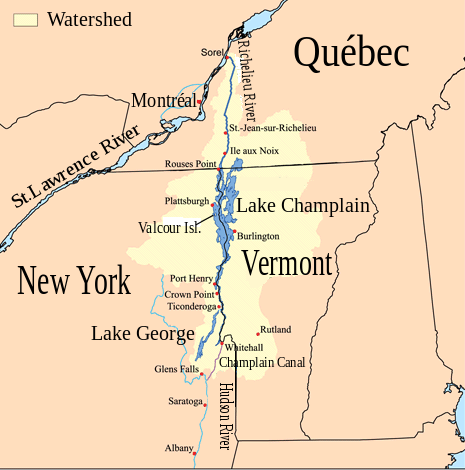
Lake Champlain is long and narrow with the wind normally blowing either north or south and a northward current.

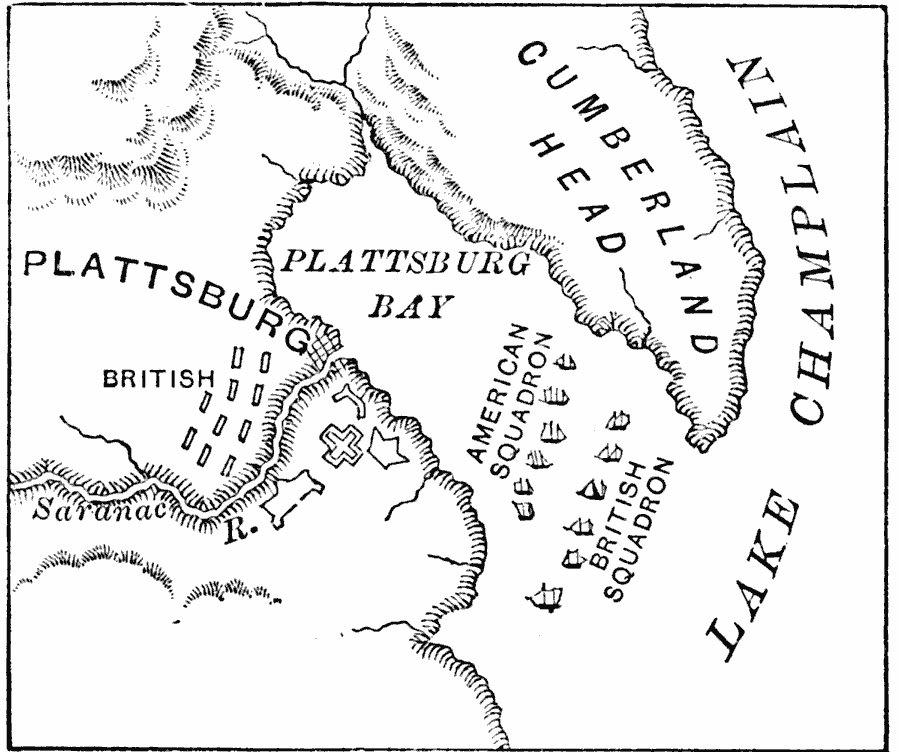
Master Commandant [equivalent to a modern Commander] Thomas Macdonough, the American naval commander, anchored his ships in a line in Plattsburg Bay, which meant that the British would have to engage at short range, negating their advantage at long range. The northern end of his line was so close to Cumberland Head that the British could not turn it. A shoal prevented the British from attacking his southern flank.

The order of the American line from the north was the USS Eagle, flanked by two gunboats on each side, Macdonough’s flagship the USS Saratoga, three gunboats, the USS Ticonderoga, three gunboats and finally the USS Preble. The anchors of the four largest American ships had springs attached to them, enabling them to swing in wide arcs whilst remaining anchored. The USS Saratoga, had kedge anchors off her bows, which would allow her to turn round. The positioning of the gunboats prevented the British from attacking the American line from both side, as Lord Nelson had done to the French at the Nile.

Captain George Downie’s British squadron sailed at daybreak and sailed down the lake with the wind almost aft. HMS Chubb and Linnet engaged the Eagle, Downie’s flagship HMS Confiance the USS Saratoga and HMS Finch and the gunboats the rear of the American line.

Downie held HMS Confiance’s fire until everything was ready, with the result that her first broadside was devastating. Half of the USS Saratoga’s crew were thrown off their feet, although many of them were not seriously hurt. However, the American ship replied and Downie was soon killed. Both ships had many guns put out of action, some by enemy fire, others because their inexperienced crews overloaded them.

HMS Chubb was badly damaged by the USS Eagle and the leading American gunboats, drifted away and was captured. HMS Linnet concentrated on the USS Eagle, which was also receiving some of HMS Confiance’s fire. Damage to one of the USS Eagle’s springs meant that she could no longer fire on HMS Linnet, so she cut her other cable, sailed south and anchored in a position where she could fire on HMS Confiance. HMS Linnet then fired on the American gunboats and drove them off, before raking the USS Saratoga’s bows.

Theodore Roosevelt notes that the American would now have lost the battle ‘had not Macdonough’s foresight provided the means of retrieving it.’[2] He ordered the anchor astern of the USS Saratoga to be let go and had her hauled round far enough to allow her undamaged port batteries to come into action.

HMS Confiance had been anchored by springs on her unengaged starboard side. These could not be shot away as had those of the USS Eagle, but did not allow her to turn in order to bring her unengaged batteries into action. With over half her crew casualties, most of the guns on her engaged side out of action and her masts and sails badly damaged, she was forced to strike her colours about two hours after she opened fire.

HMS Linnet could not withdraw because of the damage to her masts and sails, but kept on fighting in the hope that the British gunboats would come to her aid. They did not, and she was forced strike her colours about two and a half hours after the battle began. HMS Finch had already been crippled by the USS Ticonderoga and forced aground. The British gunboats withdrew, possibly taking a shot accidentally fired from HMS Confiance by the Americans after her capture, as a signal to do so.

Roosevelt estimates that over 300 British and about 200 Americans were killed and wounded in the battle. Macdonough reported 52 killed and 58 wounded, but this excludes about 90 lightly wounded who did not have to go to hospital. The Americans took 180 dead and wounded from HMS Confiance, 50 from HMS Linnet and 40 from4 HMS Chubb and Finch. There were 55 shot holes in the USS Saratoga and 105 in HMS Confiance. Macdonough allowed the captured British officers to keep their swords because of the gallant fight that they had put up.[3]

Lake Champlain was the United States Navy’s greatest victory of the War of 1812. The frigate actions were all won by the stronger side. Macdonough was faced by a squadron that was much stronger than his at long range and roughly equal at short range. He placed his squadron in such a way as to force the British to fight at short range and to give him an advantage. Roosevelt describes him as ‘the greatest figure in [US} naval history’ before the American Civil War.’[4]

Alfred Mahan blames Prevost for the British defeat, arguing that he should have taken Plattsburg before the naval action.[5] The American shore batteries of the fortress could not fire on the British squadron without risking hitting the American one. However, if there had been British guns on the shore Macdonough’s position would have been untenable. He would have had to have moved his squadron further out into the lake, where the British superiority in long range gunnery ought to have proved decisive.

Prevost, however, thought that a joint attack on land and water  had to be made. His orders to Downie, according to Mahan, ‘used language indefensible to itself, tending to goad a sensitive man into action contrary to his better judgement.’[6] The land attack was called off once it became clear that the British had lost the naval action.

The result of the Battle of Lake Champlain was that the British invasion of the USA was halted. because it was impossible to advance on land without control of the lake. Peace negotiations had started in Ghent the month before, and the British would have been able to obtain better terms had they held a significant amount of US territory.

[1] T. Roosevelt, The Naval War of 1812, 2 vols. (New York, NY: Charles Scribner’s Sons, 1900-2). vol. ii, pp. 113-14.

[2] Ibid., pp. 137-38.

[3] Ibid., pp. 140-41. and footnote 2,

[4] Ibid., p. 143.

[5] A. T. Mahan, Sea Power in Its Relations to the War of 1812, 2 vols. (London: Samson Low, Marston, 1905). vol. ii, p. 201.

[6] Ibid., p. 201.

2 Comments

Filed under War History

The Naval Blockades: (2) Germany

During the First World War both the United Kingdom and Germany attempted to carry out naval blockades of the other. Each country used actions by the other to justify escalations by the other. The Germans laid unanchored, floating mines in the North Sea early in the war. International law said that such mines had to become inoperable after an hour. It was not feasible to do so, but this gave the UK an opportunity to argue that it was Germany that had first broken international law.

The UK then tightened its blockade beyond what was permitted by the 1909 Declaration of London. On 5 November the Admiralty announced that the whole of the North Sea was a war zone, warning that ships entering from the north would do so at their own risk. The official reason for this was the German minefields, but the real one was to force neutral ships heading into the North Sea to go through the English Channel, making it easier to search them for contraband.

On 4 February 1915 Germany announced that the waters round the United Kingdom of Great Britain and Ireland would be a war zone from 18 February. It justified this by reference to the British declaration of 5 November. All hostile merchant ships in this area would be destroyed without warning. The safety of neutral ships could not be guaranteed because British ships had been flying neutral colours. U-boat captains were ordered that their first duty was the safety of their boat, so they should not take risks to find out if a ship was really neutral.[1]

In 1914 the most important successes of German U-boats had been against warships. This continued in 1915, with U24 sinking the pre-dreadnought battleship HMS Formidable in the early hours of the year.

It was extremely difficult for submarines to comply with the rules of cruiser warfare, which required raiders to stop and search enemy merchant ships. Merchant ships could be sunk or captured only if their cargoes contained either war materials (absolute contraband) or items such as food or fuel that had peaceful uses but were intended for the enemy’s military (conditional contraband).

The safety of the crews of merchant ships that were sunk had to be ensured. Submarines had no space for prisoners and no spare men to act as prize crews for captured ships, so could comply with this only if the sinking occurred close to land.

One man had predicted before the war that submarines would sink merchant ships without warning. This was the British Admiral Lord Fisher, who by February 1915 was in his second spell as First Sea Lord. In late 1913 he had written a paper arguing that the invention of the submarine meant that the main threat to the UK was having its food and oil supplies cut off by submarine attacks on its merchant shipping

Winston Churchill, the First Lord of the Admiralty, and Admiral Prince Louis Battenberg, then the First Sea Lord, both refused to believe that any country would use its submarines in such a way. They thought that Fisher’s view that it would be done weakened his arguments about the risk of submarine attack on the UK’s food and oil supplies.[2]

Only four British merchant vessels had been sunk by U-boats before 30 January. In each case the Germans had given the crew time to abandon ship and no lives were lost.[3]

The most controversial incident had come on 26 October when Kapitänleutnant Rudolf Schneider’s U24 torpedoed but did not sink the 4,590 ton French steamer Amiral Ganteaume. She was carrying 2,500 Belgian refugees, 40 of whom were killed. However, Schneider may have thought that she was a troop ship. Whether he did or not, the incident showed the potential political and diplomatic implications of submarine warfare against merchant shipping.[4]

In the Irish Sea on 30 January U21, which had sunk the cruiser HMS Pathfinder in September, the first moving warship ever to be sunk by a submarine, stopped, searched and sank three British merchantmen after allowing their crews time to take to their boats. On the same day, however,  U20 torpedoed and sank three British merchant ships off Le Havre without warning. The crews of the Tokomaru and Ikaria all survived, but all that was found of the 21 man crew of the Oriole was two lifebuoys discovered near Rye on 6 February.[5]

Before the war Kapitänleutnant Ulrich Blum of the Kaiserliche Marine, the German navy, had estimated that 222 U-boats would be needed to successfully carry out a war against British commerce under international law, far more than Germany possessed in early 1915.[6]

The KM began the war with 24 operational U-boats, plus four older ones that were used for training and 16 under construction. By 22 February 13 more had been completed, but one of the new boats and six of the pre-war ones had been lost. Seven newly completed boats were under sea trials, leaving the KM theoretically with 23 to attack British trade. The need to refit, repair and resupply meant that there was an average of 5.6 and a maximum of 12 boats at sea on any one day between March and May 1915.

After the German capture of the Belgian coast gave them bases much closer to the UK, they had begun to build smaller UB and UC coastal submarines. The latter were minelayers, which initially were armed only with mines, although later ones also had torpedo tubes and guns. They were supposed to take four months to build compared with 18 for an ocean going boat, but UB1 was constructed in 75 days. By mid July 1915 17 UBs and 15 UCs had been completed, but the first six UBs were not operational until the latter part of April and UC1 not until early June. [7]

The U-boat war against British trade would eventually cause great problems for the UK, but Germany had too few submarines when it first launched its offensive. However, British counter-measures were also inadequate at first.

The Germans had lost a high proportion of their submarines so far in the war, but two had been rammed by warships whilst on the surface, four had struck mines and the seventh had been sunk by another U-boat on the surface after failing to respond to a challenge. The method that British warships possessed of sinking submerged submarines was the towing of explosive sweeps.

The British had laid a minefield across the Dover Straits in an attempt to stop U-boats entering the English Channel, but 4,000 out of just over 7,000 mines laid between 2 October 1914 and 16 February 1915 drifted or sank to the bottom because the weights holding them in position were too light.[8] The British also laid nets and organised patrols of small, armed ships, but the U-boats were able to pass through the Dover Straits.

The orders issued to U-boat captains on 18 February were that they should attack all hostile ships except hospital ships, unless clearly acting as troopships, and Belgian Relief ships. Neutrals should be spared. However, they were told that ‘if, in spite of the exercise of great care , mistakes should be made, the commanding officers will not be held responsible.’[9]

However, the first ship to be attacked in the new campaign was the Norwegian Belridge, which was carrying a cargo of oil from New Orleans to Amsterdam for the Dutch government. She was torpedoed on 19 February, but managed to make a British port. The Germans apologised and paid compensation.[10]


[1] P. G. Halpern, A Naval History of World War I (London: UCL Press, 1994), pp. 293-94.

[2] R. H. Gibson, M. Prendergast, The German Submarine War, 1914-1918. (London: Constable, 1931), p. 24.

[3] C. E. Fayle, Seaborne Trade., 3 vols. (London: HMSO, 1920). vol. i, pp.358, 365-66.

[4] Halpern, Naval, p. 292.

[5] Fayle, Seaborne. vol. i, pp. 366-68.

[6] Halpern, Naval, p. 291.

[7] V. E. Tarrant, The U-Boat Offensive, 1914-1945 (London: Arms and Armour, 1989), p. 7.

[8] Ibid., p. 17.

[9] Gibson, Prendergast, German, p. 31.

[10] Fayle, Seaborne. vol. ii, p. 12

2 Comments

Filed under War History