Tag Archives: Great War

First Successful Use of Depth Charges on 22 March 1916

Q-ships, apparently innocuous merchant vessels with heavy but concealed armaments, were used by the British to combat U-boats. Submarines often surfaced to sink small merchant ship with their deck guns in order to conserve their torpedoes for more attractive. One of the Q-ships was HMS Farnborough, captained by Lieutenant-Commander Gordon Campbell, which was armed with five 12 pounders, two 6 pounders, a Maxim machine gun, rifles and depth charges.[1] She had originally been the collier Loderer. Her crew as a Q-ship was 11 officers and 56 men, compared with six officers and 25 men as a collier.[2]

On 22 March Farnborough was off the coast of Kerry when SM U68 (Kapitänleutnant Ludwig Güntzel) fired a torpedo that missed her. The U-boat surfaced and fired a shot across the bows of what appeared to be a collier. The crew apparently abandoned ship, but the gun crews had remained behind.

U68 closed to 800 yards and opened fire. The collier then raised the white ensign and opened fire. U68 was hit but managed to dive. Campbell then took Farnborough over her and dropped a depth charge. The U-boat came out of the water at a perpendicular angle, revealing damage to her bow. Farnborough fired five more shots into her and then dropped two more depth charges as she dived. Oil and wood then came to the surface and U68 was lost was all hands.[3]

The British first ordered depth charges in August 1915 and began to issue them to the fleet in January 1916. This was the first ever sinking of a submarine by depth charges.[4]

Campbell was promoted to Commander and awarded the Distinguished Service Order. Two of the other officers received the Distinguished Service Cross and three men the Distinguished Service Medal.[5]


[1] Naval Staff Monograph (Historical) 1926 vol. xv, Home Waters part vi, October 1915 to May 1916. p. 101.

[2] T. Bridgland, Sea Killers in Disguise: The Story of the Q Ships and Decoy Ships in the First World War (London: Leo Cooper, 1999), p. 14.

[3] Naval Staff vol. Xv. p. 101.

[4] A. J. Marder, From the Dreadnought to Scapa Flow; the Royal Navy in the Fisher Era, 1904-1919, 5 vols. (London: Oxford University Press, 1961-70). vol. ii, p. 350.

[5] (Naval Staff vol. Xv. p. 101.

Leave a comment

Filed under War History

The Man Who Survived 3 Sinkings in the First World War and the Titanic

John Priest, born in Southampton in 1887, was one of the few firemen (stokers) to survive the sinking of the Titanic on 14 April 1912. The firemen had a long way to go to get from the boiler rooms to the deck.  An article on the BBC website claims that most of the lifeboats had left by the time that Priest made it and he had to swim for his life in very cold water. The Encyclopedia Titanica, however, says that he was in a lifeboat, probably number 15.

He had previously been on board a ship called the Asturias that was, according to the BBC website linked above, involved in a collision on her maiden voyage in 1907. The Asturias was completed in 1907 for the Royal Mail Steam Packet Company and served as a hospital ship in the First World War. She was beached on the English coast on 20 March 1917 in order to prevent her sinking after she was torpedoed by the U-boat UC66. I have not been able to find any other mention of her being involved in a collision on her maiden voyage, so it may have been a minor accident.

Priest was on board the Titanic’s sister ship Olympic on 20 September 1911 when she collided with the cruiser HMS Hawke. The cruiser, which was sunk by U9 In October 1914, as related here, was the more seriously damaged of the two.

In February 1916 he was a member of the crew of the armed merchant cruiser HMS Alcantara, a sister ship of the Asturias. She was one of a number of merchant liners requisitioned by the Admiralty and armed, in her case with six 6 inch and two 3 pounder guns and depth charges. She was assigned to the 10th Cruiser Squadron, which was helping to enforce the Allied blockade of the Central Powers.

By 28 February the squadron had lost one ship to weather, two to mines and three to U-boats but none to enemy surface ships, although the Grand Fleet boarding ship Ramsay had been sunk on 8 August 1915 by a raider flying Russian colours.[1]

On 28 February the Admiralty warned the Grand Fleet that a German raider was attempting to break out into the Atlantic. Just after 8 am on 29 February Alcantara (Captain T. E. Wardle), which had been about to return to port after transferring secret documents to her newly arrived sister ship HMS Andes (Captain G. B. W. Young), was ordered to remain on her patrol station.[2]

Alcantara spotted smoke at 8:45 am and soon afterwards received a signal from Andes stating ‘Enemy in sight steering N.E. 15 knots.’[3] This was followed by a second signal that Alcantara took to mean that the enemy had two funnels. However, the signal log of Andes did not mention funnels until 9:10, when it stated that the vessel had a ‘black funnel.’[4] Alcantara’s times appear to be 20 minutes earlier than those of Andes.

Alcantara closed on the smoke, which belonged to a one funnelled steamer flying Norwegian colours and bearing the name Rena on her stern. Wardle assumed that she was a different ship from the one in Andes’s 8:45 signal, but at 10:14 am a signal from Andes revealed that they were the same vessel.[5]

The ship was the German raider SMS Greif (Fregattenkapitän Rudolf Tietze), converted from the tramp steamer Guben, which been under construction at the outbreak of war. She had been designed with two funnels, but one was removed when she was requisitioned by the German Admiralty. She had a concealed armament of four 5.9 inch and one 4.1 guns and two 19.7 inch torpedo tubes.[6]

It is impossible to give a detailed account of the subsequent action because the reports of Wardle and Young differ greatly. Greif dropped her Norwegian colours, revealed her guns and opened fire when Alcantara was about 1,000 yards away. A close range battle then took place, with Andes joining in whenever Alcantara was not in the way. Andes had been 7,500 yards away when the action began and stayed at 6,000 yards range in order to stay out of torpedo range.[7]

Grief’s crew began to abandon ship after about 15 minutes but Alcantara, which had been hit by a torpedo, was sinking by 10:45 am. The light cruiser HMS Comus and the destroyer HMS Munster then appeared. Comus and Andes fired on Greif, which was still flying the German ensign, until she sank at 1 pm, whilst Munster picked up survivors. The rescue was briefly suspended after mistaken reports of submarines.[8]

The British picked up 220 out of about 360 men on board Greif, with 69 of Alcantara’s crew being lost.[9] Wardle and Priest were amongst the survivors, but Tietze, the last man to try to leave Greif, was not.[10] Alcantara’s dead are listed towards the bottom of this page on Naval-History.net.

The Admiralty said that Wardle and his crew had ‘fought their ship in a very creditable way.’[11] He was awarded the Distinguished Service Order.

John Priest then joined the crew of the Britannic, the Olympic and Titanic’s sister ship, which was serving as a hospital ship. On 21 November 1916 she struck a mine and sank near the Greek island of Kea. Thirty died, but the survivors included Priest and two other Titanic survivors: Violet Jessop, a stewardess who had become a nurse, and Archie Jewell, a lookout.

Priest’s fourth sinking occurred on 17 April 1917 when he was a fireman on board the hospital ship Donegal, which was torpedoed and sunk in the English Channel. He received a head injury but survived. Jewell, however, was amongst the 40 dead.

John Priest died on land in 1937 at the age of 50.

[1] Naval Staff Monograph (Historical) 1922 vol. vii, 19: Tenth Cruiser Squadron i. p. 58.

[2] Ibid., p. 60.

[3] Ibid.

[4] Ibid. note 3, p. 60.

[5] Ibid., p. 60.

[6] T. Bridgland, Sea Killers in Disguise: The Story of the Q Ships and Decoy Ships in the First World War, p. 174.

[7] Naval Staff vol. vii. p. 61.

[8] Ibid., pp. 61-62.

[9] J. S. Corbett, H. Newbolt, Naval Operations, 5 vols. vol. iii, pp. 271-72.

[10] Bridgland, Sea Killers in Disguise: The Story of the Q Ships and Decoy Ships in the First World War, p. 177.

[11] Corbett, Newbolt, Naval, p. 272.

3 Comments

Filed under War History

Richard Bell Davies VC

Richard Bell Davies, a career naval officer, learnt to fly at his own expense in 1913 at the age of  27. He then transferred to the naval wing of the Royal Flying Corps, which was taken under the control of the Admiralty as the Royal Naval Air Service on 1 July 1914.

On 27 August he was one of the 10 pilots of the Eastchurch Squadron of the RNAS, commanded by Wing Commander Charles Samson, who flew their aircraft to Ostend. After three days they were ordered to return to England via Dunkirk. One of the aircraft crashed on landing at Dunkirk. This delayed the flight home and on 1 September they were ordered to remain at Dunkirk in order to operate against enemy airships and aircraft and to carry reconnaissance missions. As well as aircraft, they were equipped with armed motor cars that raided the enemy’s flanks.[1]

During the First Battle of Ypres, lasting from 19 October to 22 November 1914, the RNAS aircraft carried out reconnaissance missions for the army. Davies attacked German aircraft in the air on three separate occasions, but all managed to land behind their own lines.[2]

Davies and Flight Lieutenant Richard Peirse carried out a number of bombing raids on the German U-boat bases at Ostend and Zeebrugge. Both were awarded the Distinguished Service Order for an attack on Zeebrugge on 23 January 1915. Their citations, from naval-history.net, stated that:

Squadron Commander Richard Bell Davies

Flight Lieutenant Richard Edmund Charles Peirse

These Officers have repeatedly attacked the German submarine station at Ostend and Zeebrugge, being subjected on each occasion to heavy and accurate fire, their machines being frequently hit. In particular, on 23rd January, they each discharged eight bombs in an attack upon submarines alongside the mole at Zeebrugge, flying down to close range. At the outset of this flight Lieutenant Davies was severely wounded by a bullet in. the thigh, but nevertheless he accomplished his task, handling his machine for an hour with great skill in spite of pain and loss of blood.

Davies held the rank of Lieutenant in the RN and the appointment of Squadron Commander in the RNAS.

Davies was later sent to the Dardanelles. In October 1915 Bulgaria joined the Central Powers opening up a railway supply line from Germany to the Ottoman Empire. RNAS aircraft and seaplanes made several bombing raids on a rail bridge over the river Maritza south of Kulelli and a rail junction at Ferrijik. During an attack on the latter on 19 November Flight Sub-Lieutenant Gilbert Smylie’s Henri Farman was forced to land by rifle fire. Davies landed his aircraft and rescued Smylie in perhaps the first ever combat search and rescue mission. The citation for his Victoria Cross and Smylie’s Distinguished Service Cross, again from naval-history.net, stated that:

29423 – 31 DECEMBER 1915

Admiralty, 1st January, 1916.

The KING (is) pleased to approve of the grant of the Victoria Cross to Squadron-Commander Richard Bell Davies, D.S.O., R.N., and of the Distinguished Service Cross to Flight Sub-Lieutenant Gilbert Formby Smylie, R.N., in recognition of their behaviour in the following circumstances:

On the 19th November these two officers carried out an air attack on Ferrijik Junction. Flight Sub-Lieutenant Smylie’s machine was received by very heavy fire and brought down. The pilot planed down over the station, releasing all his bombs except one, which failed to drop, simultaneously at the station from a very low altitude. Thence he continued his descent into the marsh. On alighting he saw the one unexploded bomb, and set fire to his machine, knowing that the bomb would ensure its destruction. He then proceeded towards Turkish territory.

At this moment he perceived Squadron-Commander Davies descending, and fearing that he would come down near the burning machine and thus risk destruction from the bomb, Flight Sub-Lieutenant Smylie ran back and from a short distance exploded the bomb by means of a pistol bullet. Squadron-Commander Davies descended at a safe distance from the burning machine, took up Sub-Lieutenant Smylie, in spite of the near approach of a party of the enemy, and returned to the aerodrome, a feat of airmanship that can seldom have been equalled for skill and gallantry.

Davies was flying a Nieuport 10, a two seater reconnaissance aircraft that had been converted into a single seater fighter by covering the front cockpit. Smylie managed to squeeze past the controls into the front cockpit.

Davies was later awarded Air Force Cross and the French Croix de Guerre. He joined the Royal Air Force when it was formed by a merger of the RFC and the RNAS on 1 April 1918, but was one of the few former members of the RNAS to return to the RN after the war. He served in a mixture of staff appointments connected with aviation and sea going post between the wars. When the RN regained control of the Fleet Air Arm in 1939 Davies was appointed Rear Admiral, Naval Stations, commanding its shore bases.

He retired with the rank of Vice Admiral in May 1941, but then joined the Royal Naval Reserve with the rank of Commander, serving as a Convoy Commodore. They were senior Merchant Navy officers or retired admirals and commanded the merchant ships but not the escorts of a convoy. He later captained two escort carriers, HMS Dasher during her commissioning period and the trials carrier HMS Pretoria Castle. He died in 1966.


[1] W. A. Raleigh, H. A. Jones, The War in the Air: Being the Story of the Part Played in the Great War by the Royal Air Force, 7 vols. (Oxford: Clarendon Press, 1922). vol. i, pp. 371-76.

[2] Ibid. vol. i, pp. 392-93

2 Comments

Filed under War History

British Submarines in the Baltic

On 11 October 1914 the British E class submarines HMS E1 (Lieutenant Commander Noel Laurence), E9 (Lieutenant Commander Max Horton) and E11 (Lieutenant Commander Martin Nasmith) were ordered to enter the Baltic. Their mission was to attack the German High Seas Fleet when it exercised in the Baltic, before heading for the Russian port of Libau (now Liepāja in Latvia) and operate from there. The journey into the Baltic was to be made at night in order to avoid German patrol ships.

E1 made the passage safely on the night of 17 October. She fired two torpedoes at the cruiser SMS Victoria Louise the next morning, but both missed. She then tracked another cruiser for six hours, but was unsuccessful in trying to attack her. On 20 October she encountered three cruisers in Danzig Bay, but could not get at them, so headed for Libau. A Russian pilot guided her into the port, which had been dismantled and abandoned. E1 had passed through a German minefield without knowing it.

E9, which had had become the first British submarine to sink a ship when she sunk SMS Hela on 13 September, also made the passage on the night of 17 October, but had to spend all the next day on the bottom as she was unable to complete the journey before daybreak. She had several close encounters with destroyers, but passed the patrol line on 18 October. She also passed through the German minefield without realising it and arrived at Libau on 22 October.

E11’s journey was delayed until 18 October by technical faults. She failed to get through and retired. The next day she fired a torpedo at a submarine. It missed, which was fortunate as the boat was Danish. She was herself attacked unsuccessfully later that day. On 20 October a German seaplane found her re-charging her batteries on the surface. She was attacked all night by destroyers and returned to the United Kingdom on 22 October after another unsuccessful attempt to get through. She later operated very successfully in the Dardanelles.

E1 and E9 waited for E11 until ordered to head to Lapvik in the Gulf of Finland and put themselves under the orders of Admiral Nikolai von Essen, the C-in-C of the Russian Baltic Fleet. They arrived on 30 October. having tried unsuccessfully to attack a destroyer and a cruiser on the way.[1]

During the winter of 1914-15 the two boats were kept busy. They did no direct damage, but their presence persuaded the Germans to attack Libau, which they wrongly assumed was the British submarine base. The Germans successfully blocked the harbour entrance, but the armoured cruiser SMS Friedrich Carl struck two mines in the early hours of 26 November 1914. She was abandoned and left to sink.[2]

In late April 1915 Germans launched an offensive towards Libau. Attempts by the British submarines to attack German naval forces supporting this operation were initially unsuccessful. Libau was captured on 7 May, and three days later E9 was ordered to operate against ships supplying it from Danzig (now Gdansk in Poland) and Memel (now Klaipėda in Lithuania). She attacked a convoy of three transports and three cruiser escorted by destroyers, sinking one of the transports.

On 1 June E1 was forced to undergo repairs because of an engine problem. Von Essen,  described by the British Official History as an ‘energetic and devoted officer’, had died of illness on 20 May, but the submarine operations continued.[3] On 4 June E9 attacked two destroyers that were re-coaling from a collier, with two more destroyers and a light cruiser in attendance. E9 fired a torpedo at the cruiser, which missed, and two at the collier, which sank both her and one of the destroyers.

By 2 July the Germans were threatening Riga, ‘an important munitions centre [that] was vital to the security of the capital [St Petersburg].’[4] In the early hours of that day the Battle of Aland Islands saw a Russian squadron of the armoured cruisers Admiral Makarov and Bayan and the smaller cruisers Bogatyr and Oleg engaged the German armoured cruiser SMS Roon, the light cruisers SMS Augsburg and Lübeck and the minelayer SMS Albatross in fog. The Albatross was forced aground on Swedish territory and interned, whilst Augsburg was badly damaged. The Russians lost contact with the enemy in the fog and headed home. They were then attacked by the Roon, Lübeck and four destroyers. The Germans were forced to withdraw after the Russian armoured cruiser Rurik joined the action, damaging the Roon. German reinforcements appeared, but E9 torpedoed and damaged the armoured cruiser SMS Prinz Adalbert.

On 30 July E1, which had been repaired, sank the German auxiliary ship Aachen, The efforts of the submarines could not, however, prevent the Germans from winning the land campaign.[5]

The Russians, whose armies were under severe pressure and trading space for time, requested on 15 August that the British send more submarines. The Germans intended to turn the Russian right flank, which rested on the Gulf of Riga. This required a combined operation by their army and navy, including the entry of their battlecruisers into the Gulf. The Admiralty, acting on requests from British personnel on the spot, had the day before ordered E8 (Lieutenant-Commander Francis Goodhart) and E13 (Lieutenant-Commander Geoffrey Layton) to head to the Baltic. E8 arrived safely but E13 ran aground in Danish waters and was then attacked and sunk by German destroyers.[6] This was one of a number of alleged atrocities at sea that took place in mid 1915: see this previous entry for further details.

On 19 August E1 got into a position to attack four German battlecruisers that were sailing in line abreast. She fired a torpedo that hit the closest ship, SMS Moltke, but was then forced to dive by a destroyer. The fog and the destroyer escort prevented E1 from making any more attacks. Eight of Moltke’s crew were killed and she was forced to return to Hamburg for repairs that took about a month. The Germans abandoned their attempt to turn the Riga flank the next day. The British Official History suggests that:

‘it is not…impossible that the presence of our submarines in the Baltic was as disconcerting to the Germans as the arrival of theirs at the Dardanelles had been to us.’[7]

E8 captured and then sank the steamer Margritte off Königsberg on 8 October. She was on station outside Libau on 23 October when she observed SMS Prinz Adalbert leaving the port with a destroyer on each bow.. Goodhart positioned his boat to ambush the German ships. He let the destroyer on E8’s side pass and four minutes later fired a bow tube at the cruiser at a range of 1,300 yards. The torpedo hit her forward magazine, causing a large explosion. Goodhart dived his boat, returning to periscope depth eight minutes later.  The cruiser had sunk, the destroyers probably did not know if the damage had been caused by a mine or a submarine and E8 escaped.

Two more British submarine had by then arrived in the Baltic: E18 (Lieutenant Commander R. C. Halahan) and E19 (Lieutenant Commander Francis Cromie). On 11 October E19 stopped a series of ships carrying iron or magnetic ore from Sweden. Those heading for the UK or neutral ports were allowed to continue but those bound for Germany, the Walter Leonhardt, Gutrune, Direktor Rippenhagen and Nicomedia, were sunk. Their crews were put on Swedish ships, except for that of the Nicomedia, who were sent ashore on boats. The Germania ran aground whilst trying to escape E19, with her crew abandoning ship.

On 12 October E19 stopped the Nike, carrying iron ore from Stockholm to Stettin (now Szczecin in Poland. Her captain was Swedish, and Cromie sent her to the Russian port of Reval, now Tallinn in Estonia, with a prize crew. The normal British practice was that a Prize Court would condemn her as a lawful prize, and the British did not want to set a precedent by doing things differently this time. The Russians, however, wanted to return her to the Swedes in order to avoid offending them. Since she was in a Russian port, the British gave her to the Russians who handed her back to the Swedes. Nike’s captain said that there were then 15 ore ships awaiting escort from Lulea in Sweden to Germany.

German losses to British submarines in the Baltic continued, however. On 18 and 19 October E9 sank the Soderham, Pernambuco, Johannes-Russ and Dal Alfoen, all carrying iron ore to Germany.

The British also continued to have success against German warships. On the morning of 7 November E19 spotted a light cruiser and two destroyers, but was unable to get into a position to fire. Three hours later, at 1:20 pm, she encountered the light cruiser SMS Undine and one destroyer. At 1:45 pm Cromie fired a torpedo at Undine at a range of 1,100 yard, scoring a hit that stopped her. E19 avoided the destroyer and fired a second torpedo from 1,200 yards that hit Undine’s magazine, causing her to blow up. The destroyer fired on E19’s periscope, so she withdrew to a safe distance in order to observe the Germans picking up survivors.

The British submarine campaign in the Baltic ended for the winter when E18 returned to Reval on 17 November after an unsuccessful three week cruise. The weather made further submarine operations impossible until the spring.[8]

The British Official History argued that ‘after E9’s success the control of the Baltic seemed to have passed for a time out of German Hands.’[9]

Three of the Baltic submarine captains were awarded the Distinguished Service Order and various Russian decorations in 1916: Laurence on 24 February and Goodhart and Cromie on 30 May. Horton had already received the DSO. Lieutenant George Sharp was awarded the Distinguished Service Cross on 30 May ‘In recognition of his services in a British submarine operating in the Baltic Sea’; the citation, from naval-history.net, does not say which boat he was serving in.

Three of them did not survive the war: Halahan was lost along with E18 in May 1916; Goodhart died when HMS K13 sank accidentally on 31 January 1917; and Cromie was killed by Bolsheviks on 31 August 1918 whilst acting as British naval attaché to Russia. The other four, Horton, Laurence, Layton and Nasmith, all reached the rank of Admiral.

[1] The above is based on J. S. Corbett, H. Newbolt, Naval Operations, 5 vols. (London: HMSO, 1938). vol i, pp. 236-38.

[2] Ibid. vol. ii, pp. 285-86

[3] Ibid. vol. iii, p. 60.

[4] Ibid. vol. iii, p. 62.

[5] The last four paragraphs are based on Ibid. vol. iii, pp. 61-63.

[6] Ibid. vol. iii. pp. 135-36.

[7] Ibid. vol. iii, p. 137.

[8] The last seven paragraphs are based on Ibid. vol. iv, pp. 95-98.

[9] Ibid. vol. iv, p. 98.

Leave a comment

Filed under War History

Allied Submarines in the Dardanelles

Allied submarines operated in the Dardanelles even before the attack on its defences by surface ships in February 1915 and the amphibious landing on 25 April. HMS B11 sank the old Ottoman battleship Mesudiye in December 1914. The French boat Saphir was lost on 15 January 1915 after either running aground or hitting a mine.[1]

Once the armies were ashore the submarines had to enter the Sea of Marmara in order to prevent Ottoman supplies from reaching the Gallipoli. Getting through the Straits in order to attack enemy shipping in the Sea of Marmara was  very difficult. The boats had to pass through minefields and steel-wire anti-submarine nets without any metal blades to cut through the nets or the mine cables. They also had to avoid shore batteries and patrol boats and get through a 10 fathom deep stratum of fresh water that often made it very hard to control a submarine.[2]

Most of the British submarines operating in the Dardanelles were of  E class boats. In April the first British submarine to try to get into the Sea of Marmara, HMS E15, ran aground and had to be destryored by a British boat expedition in order to prevent her being captured. The Australian HMAS AE2 was more successful in getting through the Straits, but was sunk by an Ottoman torpedo boat: all her crew survived to be taken prisoner. The patrols of HMS E14 in April and May 1915 and E11 in May and June were, however, highly successful.

The Ottomans were able to send some supplies to their troops by land as well as the larger quantities carried by water. Submarines, however, managed to attack the land as well as the sea routes. On 17 July HMS E7 blocked the railway from Istanbul near Kava Burnu at the entrance to the Gulf of Izmid by bombarding a cutting and then shelled a troop train that had been forced to turn back from the obstruction. E7 subsequently attacked another train and a bridge without doing much damage, but she had done enough to show that the railway was vulnerable there.[3]

E7’s captain, Lieutenant-Commander Archibald Cochrane, was awarded the Distinguished service Order. The citation, from naval-history.net [the other citations below are from the same source], stated that it was awarded for:

For services in a submarine in the Sea of Marmora, where he did great damage to enemy shipping, and after blocking the railway line near Kava Burnu by bombarding it from the sea, shelled a troop train and blew up three ammunition cars attached to it.

E11 also attacked the railways during her second patrol, as well as sinking several merchant ships and the old battleship Barbaros Hayreddin. her captain, Commander Martin Nasmith VC, was not satisfied with the results of bombardments of the railways, so on the night on 20-21 August her First Lieutenant, Guy D’Oyly Hughes, went ashore to sabotage the track. The citation for his DSO stated that it was awarded:

For his services on the 21st August, 1915, when he voluntarily swam to the shore alone from a submarine and blew up a low brickwork support to the Ismid railway line, in spite of the presence of an armed guard within 150 yards of him. After a running fight of about a mile, he dived into the sea, and was finally pulled on board the submarine utterly exhausted, having had to swim nearly a mile in his clothes.

The Allied policy was to have two submarines in the Sea of Marmara at all times. According to the British Official History, they were able to make the enemy’s supply ‘so restricted and precarious that the maintenance of the Turkish army in Gallipoli was a matter of grave concern.’[4] However, E11’s second patrol ended on 8 September and E7, her replacement, was lost after being caught in submarine nets on 4 September. After battling 12 hours to free her Cochrane was forced to scuttle her after she was badly damaged by a depth charge. He and all his crew were captured, leaving only E2 in the Sea of Marmara. She put Lieutenant H. V. Lyon ashore on 8 September with the intention that he should repeat D’Oyly Hughes’s feat, but nothing more was heard from him.[5]

E2’s cruise ended in the middle of September. She was replaced by E12, which had a 4 inch deck gun rather than the 12 pounders fitted to her sisters. She was later joined by H1, the first of a new class of boats about half the size of the E class. The H class were built in the USA but fitted with their armament in Canada in an attempt to evade neutrality regulations.[6]

These two boats were joined on 22 September by the Turquoise, the first French submarine to reach the Sea of Marmara, and by E20 the next day. Three days later E12 headed back to base after a 40 day patrol, the longest yet carried out in the Dardanelles: she was damaged after being caught in the nets and then attacked by six enemy patrol ships as well as shore batteries, but made it back. H1 completed her 29 day patrol on 31 October.[7]

The captains of E12 and H1 were awarded the DSO. The citations read that:

Lieutenant-Commander Kenneth Mervyn Bruce, R.N. For his services in command of a Submarine in the Sea of Marmora, where he made a prolonged cruise, during the course of which he inflicted much damage on enemy shipping, and engaged and put to flight by gun fire a Turkish gunboat and a destroyer, and subsequently displayed much coolness, and resource in extricating his boat from a difficult position.

Lieutenant Wilfrid Bayley Pirie, R.N. For his services in command of a Submarine in the Sea of Marmora, where he inflicted much damage on enemy shipping, and co-operated with Lieutenant-Commander-Bruce in the chase of a Turkish gunboat.

The French submarines operating in the Dardanelles, which were older and smaller than the British E class boats, had found it hard to get through the Straits. The Joule struck a mine on 1 May, while the Mariotte was forced to surface near the Chanak batteries on 27 July after being trapped by the net defences. She came under artillery and was lost, with her crew being captured.[8]

Nothing was heard from the Turquoise from 26 October until a German telegram claiming that she had been sunk on 30 October by gunfire and her crew captured. In fact, she had been stranded and captured intact. Her confidential papers, including the details of a planned rendezvous with E20 were not destroyed.[9] When E20 arrived at the rendezvous on 5 November the submerged German U-boat UB14 was waiting for her. UB14 fired a torpedo from a range of 550 yards, sinking the British boat. Only nine of her crew survived.[10]

E11, which had returned to the Sea of Marmara on 6 November, was now the only Allied submarine there. Her third patrol lasted until 23 December, during which time she sank more steamers and the destroyer Yarhissar and bombarded the railways. Her three patrols totalled 97 days, and she was credited with sinking or rendering useless a battleship, a destroyer, five large and six small steamers and five large and 30 small sailing vessels. Nasmith was promoted to Captain after only a year as a Commander. E2 joined E11 on 10 December, but the Gallipoli Campaign was coming to an end.[11]

The British claimed that a battleship, an old coastal defence ship, a destroyer, five gunboats, 11 transports, 44 steamers and 148 smaller vessels were sunk by submarines in the Dardanelles for the loss of four British and four French submarines. The German official history says 25 steamers of 26,000 tons and 3,000 tons of small craft were destroyed plus 10 steamers of 27,000 tons damaged and put out of action for the duration of the campaign. Paul Halpern suggests that the difference may be partly explained by some ships being beached and later repaired and refloated.[12]


[1] J. S. Corbett, H. Newbolt, Naval Operations, 5 vols. (London: HMSO, 1938). vol. ii, p. 140; R. Gray, Conway’s All the World’s Fighting Ships, 1906-1921 (London: Conway Maritime Press, 1985), p. 208.

[2] A. J. Marder, From the Dreadnought to Scapa Flow; the Royal Navy in the Fisher Era, 1904-1919, 5 vols. (London: Oxford University Press, 1961-70). vol. ii, p. 312.

[3] Corbett, Newbolt, Naval. vol. iii, p. 77.

[4] Ibid. vol. iii, p. 119.

[5] Ibid. vol. iii, pp. 118-19.

[6] Ibid. vol. iii, p. 161; Gray, Conway’s 1906-1921, pp. 88, 92.

[7] Corbett, Newbolt, Naval. vol. iii, pp. 177-79.

[8] Ibid. vol. iii, p. 78; Gray, Conway’s 1906-1921, pp. 209-10.

[9] Corbett, Newbolt, Naval. vol. iii, p. 179.

[10] Ibid. vol. iii, pp. 205-6.

[11] Ibid. vol. iii, pp. 206, 217-18, footnote 2 on p. 218

[12] P. G. Halpern, A Naval History of World War I (London: UCL Press, 1994), p. 119.

5 Comments

Filed under War History

The British Capture Kut-Al-Amara 28 September 1915

In June and July 1915 the British captured Amara and Nasiriyah in Mesopotamia. The force that did so was nicknamed Townshend’s Regatta because most of the troops of Major-General Charles Townshend’s 6th (Poona) Division of the Indian Army travelled along the Euphrates and Tigris in a flotilla of various types of ship and boat.

The British had landed troops at Basra in November 1914 in order to protect their interests in the region, notably but not only the Anglo-Persian Oil Company’s refinery at Abadan and the pipeline to its Persian oilfields. The capture of Amara and Nasiriyah meant that the oil facilities and the vilayet (province) of Basra were securely held and the British should then have halted.

Townshend and his division were, however, ordered to advance on Kut-al-Amara, with the intention of taking Baghdad. He argued in his memoirs that this operation should not have taken place. Basra vilayet and the oilfields should have been defended by a force based at Basra, with outposts at Qurna, Nasiriyah and Ahwaz.[1]  He was right, but the campaign continued for a number of reasons: the need for a victory somewhere after defeats elsewhere; over confidence by local commanders; and momentum created by a series of easy victories early in the campaign.

The need for re-fits and the fact that the larger ships could not move any further up the Tigris meant that the naval force was reduced to the armed tug Comet, the armed launches Shaitan and Sumana and four horse boats carrying 4.7 inch guns towed by the motor launches RN 1 and RN 2. Captain Wilfrid Nunn, the Senior Naval Officer, and his successor, Captain Colin Mackenzie, were both ill, so Lieutenant-Commander Edgar Cookson of the Comet took over.[2]

The horse boats were so called because they had no engines and were normally towed by horses walking along the river or canal bank. The 4.7 inch guns were elderly, but the launches and horse boats had very shallow draughts, so could provide fire support for the troops in waters too shallow for the sloops that had provided this earlier in the campaign. RN 1 was commanded by Leading Seaman Thompson, a veteran, and RN 2 by Able Seaman Phil Gunn, a young sailor who would later be commissioned and rise to the rank of Captain: the rest of their crews were Indians. RN 1 and RN 2 were protected against sniper fire by steel plates around their cabins and engine rooms.[3] Phil Gunn’s RN 2 would lead the advance of the whole expedition.[4]

The advance began on 12 September, with the troops moving to Ali-al-Gharbi by ship. From then on, the shallow water meant that the troops had to march along the river bank, with the shallow draught tug, launches and horse boats providing fire support. The Ottomans withdrew without offering any resistance and the British force halted at Sanniaiyat from 15-25 September, during when it received reinforcements. The temperature was 110-16° F in the shade, of which there was little.[5]

The engines of the aircraft that had operated in Mesopotamia so far had proved to be unsuitable for the hot, dusty atmosphere: 70 hp Renault ones in the Maurice Farmans and 80 hp Gnomes in the Caudrons and Martinsydes. In early September three Royal Naval Air Service Short seaplanes with 150 hp Sunbeam engines under the command of Squadron-Commander R. Gordon arrived from Africa, where they had been involved in the operation that resulted in the destruction of the light cruiser SMS Königsberg. Their climbing ability was poor and it was difficult to get a long enough take off run on the Tigris. Two had their floats replaced to allow them to operate from land, thereafter giving good service despite engine problems.[6]

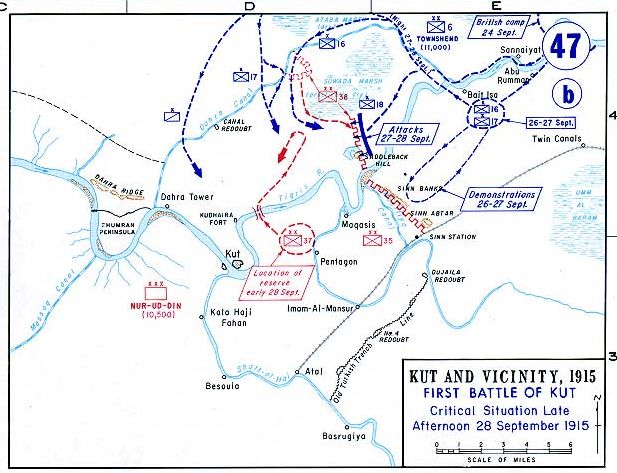
"Kut1915" by This map was created by the Department of Military Art and Engineering, at the U.S. Military Academy (West Point). - http://www.dean.usma.edu/history/web03/atlases/great%20war/great%20war%20%20pages/great%20war%20map%2047.htm. Licensed under Public Domain via Commons - https://commons.wikimedia.org/wiki/File:Kut1915.jpg#/media/File:Kut1915.jpg

“Kut1915” by This map was created by the Department of Military Art and Engineering, at the U.S. Military Academy (West Point). – http://www.dean.usma.edu/history/web03/atlases/great%20war/great%20war%20%20pages/great%20war%20map%2047.htm. Licensed under Public Domain via Commons – https://commons.wikimedia.org/wiki/File:Kut1915.jpg#/media/File:Kut1915.jpg


Aerial and naval reconnaissance discovered that Nureddin Pasha’s Ottoman troops were dug in astride the river in a strong defensive position 8 miles from Sannaiyat and 7 miles from Kut. There were two Ottoman divisions with 38 guns plus two cavalry regiments and 400 camelry. Most of the mounted troops were away on a raid and missed the battle of 28 September.[7] The Ottoman divisions had only six battalions each, meaning that they were outnumbered by the 14 British battalions. Some of the Ottoman guns were obsolete, giving the British an small artillery advantage.[8]

Townshend decided to divide his force into two columns. Column A would demonstrate against the Ottoman troops on the south bank of the Tigris. Column B, its flank protected by the naval flotilla, would attack on the right bank in order to pin the enemy’s centre. Column A would then cross the river and attack the enemy’s left flank.[9]

A boat bridge was laid across the river on 27 September. Column B advanced to within 2,000 yards of the enemy, whilst Column A demonstrated during the day before crossing the river under the cover of darkness. It was ready to attack by 5:00 am, with Column B advancing at the same time. The Ottomans advanced on the south bank at 11:00 am in order to enfilade Column B, but were thrown back by fire from the naval 4.7 inch guns and army 4 and 5 inch guns. The gunboats had moved forward at 11:00 am to engage Suffra Mound, which was taken by Column B by 2:00 pm. The boats came under shell and rifle fire, but the Ottoman artillery was largely silenced by the afternoon. Contact between the two columns was maintained by the aeroplanes and seaplanes, as the strong wind created clouds of dust that made visual signalling between the columns impossible.[10]

At 4:50 pm Column A began to advance on the rear of the enemy facing Column B. Enemy reinforcements appeared 40 minutes later, but Brigadier-General W. S. Delamain re-deployed his troops to face them. A bayonet charge routed the Ottomans, who escaped under the cover of darkness, suffering heavy casualties and leaving four guns behind.[11]

At 6:00 pm the naval flotilla heard of Delamain’s success from a seaplane. Townshend asked Cookson to advance to an obstruction that blocked the river in the hope of destroying it and allowing a pursuit by water and land. The flotilla set off after dark at 6:30 pm, coming under heavy rifle and machine gun fire, as they approached the obstruction, which consisted of a dhow in the centre, attached by wire hawsers to two iron lighters. An attempt to ram the dhow failed, so Cookson jumped on it in an attempt to cut the hawsers with an axe. He quickly suffered several bullet wounds and died 10 minutes later. The flotilla then withdrew.[12]

The flotilla, now commanded by Lieutenant Mark Singleton of the Shaitan, resumed its advance the next morning, 29 September. The Ottomans had retreated from the obstruction and the British vessels reached Kut at 10:00 am. The low level of the river made navigation difficult, but they continued past Kut. On 30 September they encountered two armed Ottoman vessels, the Poineer and Basra. Sumana and Shaitan had both run aground, the former breaking both rudders, so the Comet engaged the two enemy steamers herself before being joined by the Shaitan. The Basra was damaged and withdrew. The British pursued, but then came under fire from shore based guns astern of them. The Shaitan ran aground again and there was a risk that she and the Comet would be cut off, but the Shaitan managed to re-float herself and the British retired to Kut. The difficulty of conducting a pursuit when the only means of transporting heavy equipment was along a low river meant that the Ottomans were able to withdraw to a prepared position at Ctesiphon.[13]

The British suffered 1,233 casualties of whom 94 were killed. They captured 1,700 men and 14 guns: total Ottoman casualties were 4,000.[14] Twelve men on the Comet, four of them soldiers, were wounded.[15] Cookson is the only sailor listed on naval-history.net as being killed in Mesopotamia from 27-30 September. He was awarded a posthumous Victoria Cross. The same website gives the citation:

29446 – 21 JANUARY 1916

Admiralty, 21st January, 1916.

 The KING (is) pleased to approve of the grant of the Victoria Cross to Lieutenant-Commander Edgar Christopher Cookson, D.S.O., R.N., in recognition of the following act of most conspicuous gallantry during the advance on Kut-el-Amara:

On the 28th September, 1915, the river gunboat “Comet” had been ordered with other gunboats to examine and, if possible, destroy an obstruction placed across the river by the Turks. When the gunboats were approaching the obstruction a very heavy rifle and machine gun fire was opened on them from both banks. An attempt to sink the centre dhow of the obstruction by gunfire having failed, Lieutenant-Commander Cookson ordered the “Comet” to be placed alongside, and himself jumped on to the dhow with an axe and tried to cut the wire hawsers connecting it with the two other craft forming the obstruction. He was immediately shot in several places and died within a very few minutes.


[1] C. V. F. Townshend, My Campaign in Mesopotamia (London: T. Butterworth Ltd, 1920), pp. 35-36.

[2] Naval Staff Monograph (Historical) 1921 vol. iv, Naval Operations in Mesopotamia and the Persian Gulf. pp. 75-76.

[3] D. Gunn, Sailor in the Desert: The Adventures of Phillip Gunn, DSM, RN in the Mesopotamia Campaign, 1915 (Barnsley: Pen & Sword Maritime, 2013). Kindle edition, locations 812-22, Chapter 22. This well researched book, by Phil’s son David, gives an excellent description of the Mesopotamian Campaign from the viewpoint of one of the RN’s lower deck.

[4] Ibid. Kindle locations 1067-79, Chapter 28.

[5] Naval Staff vol. iv. p. 76.

[6] W. A. Raleigh, H. A. Jones, The War in the Air: Being the Story of the Part Played in the Great War by the Royal Air Force, 7 vols. (Oxford: Clarendon Press, 1922). vol. v pp. 253-58. Naval Staff vol. iv. p. 76 says that there were four RNAS seaplanes

[7] Naval Staff vol. iv. p. 76.

[8] J. S. Corbett, H. Newbolt, Naval Operations, 5 vols. (London: HMSO, 1938). vol. iii, p. 192.

[9] Naval Staff vol. iv. p. 77.

[10] Ibid.

[11] Ibid., pp. 77-78.

[12] Ibid., p. 78.

[13] Ibid., pp. 78-79.

[14] Corbett, Newbolt, Naval. vol. iii, p. 195 and footnote 2.

[15] Naval Staff vol. iv. p. 78. Footnote 1.

11 Comments

Filed under War History

The Royal Navy and Townshend’s Regatta

British troops landed near Basra on 6 November, the day after hostilities began with the Ottoman Empire with the objective of securing British interests in the region, notably but not only the Anglo-Persian Oil Company’s refinery at Abadan and the pipeline from it to APOC’s Persian oilfields. These had been achieved by 9 December when they took Qurna.

In early 1915 Ottoman forces attacked from Amara on the Tigris towards the oil pipe-line and from Nasiriyah on the Euphrates towards Basra. The pipeline was cut around Ahwaz. By then General Sir John Nixon was in command of the Mesopotamian Corps of two infantry divisions and a cavalry brigade. He did not, however, have all the equipment, especially transport and medical services, of a corps.

On 12 April the Ottoman attack towards Basra was defeated at Barjisiya. Nixon then launched offensives towards Ahwaz and Amara to protect the pipeline and Nasiriyah to protect Basra. The politicians in London, Lord Crewe, Secretary of State for India until the Liberal/Conservative Coalition was formed in May 1915, and his successor Austen Chamberlain, both urged caution in Mesopotamia once the oil facilities and Basra were safe. They were, however, ignored by the government and army command of British India, which had more ambitious plans.[1]

The lack of a railway and the poor quality of the roads meant that the rivers were vital for communications. The attack on Amara, carried out by Major-General Charles Townshend’s 6th (Poona) Division, was made at a time of unusually high floods, meaning that the land was flooded for miles around the Tigris. The flood water was often shallow, but with ditches, cuts and canals that made it impossible to wade. The Naval Staff Monograph said that ‘there was too much water for the Army, but generally too little for the Navy.’[2]

Infantry were carried were carried on armoured bellums (local boats holding about eight people and propelled by paddles or poles). Other bellums were loaded with supplies, including ammunition. Artillery was loaded on barges, rafts, tugs and paddlers, with machine guns on rafts. Rafts were also used as ambulances, with roofed mahelas (large river sailing boats) used as hospitals. Townshend and some of his staff travelled on the sloop HMS Espiègle, along with the Senior Naval Officer Captain Wilfrid Nunn. The rest of his staff were split between the sloops HMS Clio and Odin. The flotilla also included the Indian Marine ship Lawrence, the armed tugs Comet and Miner, the armed launches Bahrein, Lewis Pelly, Shaitan and Sumana and the stern wheelers Shushan and Muzaffri. The troops called the force ‘Townshend’s Regatta.’[3]

Townshend’s attack began at 5:00 am on 31 May and by noon had succeeded in taking its first objective, a series of Ottoman outposts. Aerial reconnaissance showed that the enemy was in full retreat: the two British aircraft had to fly from Basra as there was no closer ground dry enough for them to land on. Townshend, his staff and a dozen other soldiers boarded the flotilla and headed off in pursuit. A captured Ottoman officer, who was put in one of the launches being used as minesweepers, pointed out the enemy mines on the river.[4]

The next Ottoman position, at Bahran, was bombarded at 5:30 am on 1 June, but had been evacuated. Four lighters had been sunk in an attempt to block the river, but it was possible to pass, although navigation was difficult because the ships had only rough maps of the river, which bent and twisted and whose channel was hard to identify because of the floods.[5]

At 5:50 pm Shaitan, the leading vessel, opened fire on the Ottoman gunboat Marmariss, which was towing some mahelas. The sloops joined in, also firing on the steamers Mosul and Bulbul By 8:05 pm, when the British ships anchored to wait for the moon to rise, the Bulbul had been sunk. The Marmariss escaped by abandoning the craft that she was towing. The British resumed the pursuit at 2:00 am on 2 June. At daybreak they found the Marmariss, abandoned, aground and on fire. The Mosul was found aground nearby, full of troops and stores.[6] As well as the Marmariss and Mosul, two steel lighters, seven mahelas, two field guns, a large quantity of rifles and ammunition, 140 prisoners and over £1,000 worth of treasure were captured.[7]

Townshend decided to press on to Amara with the lighter draught vessels: the sloops could not go any further. He set off at 11:00 am on 2 June with the Shaitan, Sumana, Lewis Polly, three horse-boats, each armed with a 4.7 inch gun, and Sir Percy Cox, the Principal Political Officer, in his steam launch L2. No opposition was met and white flags were being flown. Shaitan entered Amara at 2:00 pm on 3 June. She was surrounded, but was not fired upon. Townshend then arrived and took the surrender of 30-40 Ottoman officers and 700 men. The British were heavily outnumbered, although sources differ on the number involved: the Naval Staff Monograph says ‘Townshend and his 22 men’, whilst Naval Operations, one of the British Official Histories, says 100 ‘besides Lascar stokers.’[8] Possibly the smaller is the number who actually took the surrender and the larger includes all the crews of the vessels involved. The 2nd Battalion of the Norfolk Regiment arrived in the morning to secure Amara.

Townshend’s reputation was later destroyed by his defeat in the Siege of Kut-Al-Amara and his behaviour during his subsequent captivity, when he lived in comfort in Istanbul and made no attempt to find out about the appalling conditions in which his men were being held as prisoners. In this action, however, he led from the front, belying the clichéd image of the First World War general miles behind the lines. He wrote that ‘I owe the whole of the success firstly to the Royal Navy.’[9]

From 31 May to 4 June Townshend’s force captured 139 officers, 1,634 men, 12 field guns and five naval guns and captured or sank the Marmariss, five steamers and several barges and small craft. British casualties from 31 May to 4 June were one officer and three men killed and three officers and 18 men wounded.[10] The Ottomans suffered 120 killed or wounded as well as those captured.[11]

The next stage of the Mesopotamian Campaign was to take Nasiriyah in order to protect Basra. It was too difficult to move on it across the desert at that time of year, so the advance had to be made by river. This meant bringing the ships and river craft back from Amara to Qurna and then along a waterway that went through the very shallow and 10 mile broad Hammar Lake to the Euphrates. Some ships had been sent away: Clio to Bombay for a refit, Lawrence to Bushire and others to Ceylon (now Sri Lanka) to allow their crews to recover from the heat at a hill station.[12]

Nunn’s force was augmented by another stern wheeler, the, but was weaker than at Amara. Espiègle, Odin and Miner could not cross the Hammar Lake. The remaining force consisted of Sumana, the stern wheelers Shushan (armed with a 12 pounder, a 3 pounder and a maxim), Muzaffri (a maxim) and Messoudieh (a 3 pounder and a maxim), two horse-boats, each armed with a 4.7 inch gun, three transports full of troops, each with two 18 pounder guns on her foredeck and four tugs towing mahelas or lighters full of ammunition and supplies. The stern wheelers were given some armour plate, but the amount was restricted because the shallow water meant their draughts could not increase much. There were also mountain guns mounted on bellums. Nunn was onboard Shushan. The troops were from the 30th Brigade of Major-General George Gorringe’s 12th Indian Division, reinforced with additional artillery and engineers.[13]

The force began to cross the Hammar Lake at 4:00 pm on 27 June. Navigating the narrow, shallow and almost unmarked channels was difficult, even without being under fire. Open water was not reached until 4:00 am on 4 July. An Ottoman position at Gurma-Safha, defended by 2,300 troops, later reinforced to 3,000, was attacked and taken the next day. The British had 114 men killed or wounded, but captured 132 men and two guns.[14]

The next resistance was encountered at the Majinina Creek, about six miles from Nasiriyah, where the Ottomans had established a strong defensive position.[15] It was initially defended by about 2,000 Turks, six guns, two launches and ‘large numbers of hostile Arabs.’[16]

Both sides were receiving reinforcements and had about 5,000 men each by 24 July. The British, however, had more artillery and the advantage of an aircraft for reconnaissance.[17] Their attack began with an artillery bombardment at 4:30 am that day, with the infantry assault starting 30 minutes later. Sumana, under heavy fire, positioned a barge to allow the troops to cross the creek with fire support from the stern wheelers. The Ottomans offered stiff resistance but were forced back. [18]

Nunn took Shushan towards Nasiriyah, where white flags were flying, but she was forced to retreat after coming under fire. The Ottomans, however, evacuated the town overnight. On 25 July the leading Arab citizens invited the British to enter the town. Two days later Nunn took Shushan a further 71 miles up the Euphrates to Samawa, a telegraph station whose small garrison had fled after hearing of the fall of Nasiriyah. The Euphrates operation cost the British over 500 dead and wounded, including five sailors wounded. They took 15 guns at Nasiriyah.[19]

The Basra vilayet (province) was now secure and the British should have halted. Townshend and his 6th Division were, however, ordered to advance on Kut-al-Amara, with the intention of taking Baghdad. He argued in his memoirs that this operation should not have taken place. Basra vilayet and the oilfields should have been defended by a force based at Basra, with outposts at Qurna, Nasiriyah and Ahwaz.[20] He was right, but the campaign continued for a number of reasons: the need for a victory somewhere after defeats elsewhere; over confidence by local commanders; and momentum created by a series of easy victories early in the campaign.


[1] This is a summary of the relevant part of my PhD thesis. M. W. Gibson, ‘British Strategy and Oil 1914-1923.’ (University of Glasgow, 2012), pp. 48-55.

[2] Naval Staff Monograph (Historical) 1921 vol. iv, Naval Operations in Mesopotamia and the Persian Gulf. p. 52.

[3] Ibid.

[4] J. S. Corbett, H. Newbolt, Naval Operations, 5 vols. (London: HMSO, 1938). vol. iii, pp. 18-19.

[5] Naval Staff vol. iv. pp. 54-55.

[6] Ibid., pp. 55-56.

[7] Corbett, Newbolt, Naval. vol. iii, p. 20, footnote 1.

[8] Naval Staff vol. iv. p. 56; Corbett, Newbolt, Naval. vol. iii, p. 22

[9] Naval Staff vol. iv. p. 57.

[10] Ibid., pp. 56-57.

[11] Corbett, Newbolt, Naval. vol. iii, p. 23.

[12] Ibid. vol. iii, p. 183.

[13] Naval Staff vol. iv. pp. 59-60.

[14] Ibid., pp. 61-62.

[15] A. J. Barker, The First Iraq War, 1914-1918: Britain’s Mesopotamian Campaign (New York, NY: Enigma, 2009), p. 69.

[16] Naval Staff vol. iv. p. 63.

[17] Barker, The First Iraq War, 1914-1918: Britain’s Mesopotamian Campaign, p. 70.

[18] Naval Staff vol. iv. pp. 64-65.

[19] Ibid., p. 65.

[20] C. V. F. Townshend, My Campaign in Mesopotamia (London: T. Butterworth Ltd, 1920), pp. 35-36.

6 Comments

Filed under War History

Allegations of War Crimes at Sea in 1915

Germany announced on 4 February 1915 that it would conduct unrestricted submarine warfare in the waters round the United Kingdom from 18 February. It justified this on the grounds that the British blockade of Germany contravened international law. This led to heavy losses in Allied shipping, most infamously the sinking of the liner Lusitania on 7 May with the loss of 1,201 lives including 128 Americans.

A number of incidents involving submarines that occurred between 18 and 21 August led to both Germany and the UK accusing the other of being guilty of atrocities.

The first of these took place in the early hours of 18 August. The submarines HMS E8 and E13 were on their way to the Baltic to join their sister boats E1 and E9 when E13 suffered problems with her magnetic compass. She went off course and ran aground in Danish waters. At 5:00 am a Danish torpedo boat arrived, informing Lieutenant-Commander Geoffrey Layton, E13’s captain, that he had the normal 24 hours to get his boat underway, but that no help would be given.

At 9:00 am, by when another Danish torpedo boat had arrived, two German destroyers appeared. One of them, SMS G132, fired a torpedo at E13 from a range of 300 yards and opened fire with all her guns, although the submarine was in neutral waters. She was soon in flames and her crew abandoned ship. The Germans fired on them in the water until one of the Danish torpedo boats put herself between the German ships and the swimming survivors. Fifteen men were killed and the others picked up by the Danes.[1] They were interned, but Layton escaped after three months. He rose to the rank of Admiral, holding commands in the Mediterranean and Far East during the Second World War.

The next two incidents both took place on 19 August. The website uboat.net lists seven British and one Spanish merchant ships as having been sunk that day by U24, U27 and U38, which were operating between Ushant and St George’s Channel. A Norwegian ship was also sunk by U25 in the North Sea. Two days earlier U-boats had sunk 11 merchantmen, but they were on average smaller, with a total tonnage of 15,733 tons versus 38,434 tons for the nine sunk on 19 August. The largest ship sunk on 19 August, the 15,801 ton British liner SS Arabic was bigger than all the ships sunk on 17 August combined.

Kapitänleutnant Rudolf Schneider’s U24 was in the process of sinking the 4,930 ton merchant ship Dunsley by gunfire when she observed the Arabic, which was on her way to the USA, approaching. Earlier that day, U24 had survived attempts to ram her by the armed yacht Valiant II and the unarmed trawler Majestic and had been fired on by the defensively armed liner City of Exeter. Schneider was therefore wary of the Arabic and mistook her zigzag course for an attempt to ram his boat. U-boats had been ordered not to sink passenger liners without warning unless the liner was attacking them. Schneider thought that the Arabic was attacking him, so fired a single torpedo which hit her. She sank about ten minutes later.[2]

There is some doubt about the number of people on board the Arabic and the number of dead, with the three British Official Histories giving different figures: Naval Operations says 40 dead out of 428 onboard; The Merchant Navy gives 39 killed out of 429; and Seaborne Trade states that 44 died.[3] The Naval Staff Monograph, an internal Admiralty document written in 1926, says that she was carrying 429 people, 181 passengers and 248 crew, of whom 40, 18 passengers and 22 crew, were killed.[4] A document later published by the British government in response to German accusations that the British Q-ship HMS Baralong had murdered members of U27’s crew claimed 47 dead, a number that was increased to 49 in a later note.[5] Paul Halpern says that 44 died, including two or three US citizens.[6]

Baralong was one of a number of merchantmen given concealed armament and RN volunteer crews in order to act as decoy ships that could trap and destroy U-boats. She was a 4,000 ton ship, capable of carrying 3,000 tons of coal in four holds, that had been requisitioned as a supply ship by the RN. She was given three 12 pounder guns, two of which were concealed by dummy life belt lockers and the other by a sheep pen. Two of her holds were used for coal and the other two were filled with empty barrels that would help to keep her afloat if torpedoed. She was captained by Lieutenant-Commander Godfrey Herbert RN, a submariner, with Sub-Lieutenant Gordon Steele RNR as first lieutenant. Her maximum speed was 12 knots ‘on a good day.’[7]

Baralong received the Arabic’s SOS, but arrived too late to help.[8] At 3:00 pm she spotted that a steamer 9 miles away had changed her course significantly. She then received a radio message from the steamer, which was the Nicosian, saying that she was being chased by a submarine. Herbert headed for Nicosian, hoisting the signal for ‘Save life’ when 3 miles away.[9]

The Nicosian was a 6,250 ton ship of the Leyland Line, carrying a cargo of cotton, timber, steel rods and tinned meat plus mules for the British Army from New Orleans to Liverpool. She was unarmed, but carried a dummy gun on her stern. She was British but most of the 48 muleteers who tended to the mules were Americans. Baralong then flying the US flag and also had boards along her sides indicating that she was a US ship.[10] Sailing under false colours was legitimate under the rules of war, provided that the ship lowered and replaced them by her true ones before opening fire.

The submarine, which was U27, was firing on the Nicosian, whose crew had taken to her boats, from 1,000 yards. Baralong passed behind the merchantman, meaning that she was out of sight of the U-boat, dropped her neutral colours, raised the White Ensign and opened fire at 600 yards range once U27 was in sight. Several of the German deck gun crew were hit before they could fire on Baralong. She scored 34 hits with her 12 pounder guns and U27 sank, with the surviving members of her crew jumping into the sea and swimming for the Nicosian. Herbert claimed in her after action report that he was worried that they might try to scuttle or set fire to the ship in order destroying her and her cargo. He consequently ordered his crew to fire on them. Six succeeded in getting on board, so Herbert sent a party of marines across, warning them to be careful in case the Germans found the rifles that were in the Nicosian’s charthouse. According to Herbert, the six Germans who made it on board the Nicosian all ‘succumbed to the injuries they had received from lyddite shell.[11]

The German government issued a memorandum to the British government via the US government that accused ‘Captain William McBride’, a pseudonym adopted by Herbert as part of the pretence that Baralong was a merchant ship, of murder. They produced affidavits sworn by six of the American muleteers made to US public notaries. The witnesses were either on or in the process of boarding Baralong when she fired on the Germans in the water. They agreed that U27’s captain, Kapitänleutnant Bernd Wegener, was shot in the water after raising his hands in surrender. [12]

One of them, James J. Curran, claimed that Baralong had opened fire before she lowered her US colours. He also stated that Herbert said to his crew ‘Boys, we’ll shoot those poor wounded devils in the water’ and then told the men that he sent aboard the Nicosian ‘Get them all, take no prisoners.’[13] Another American muleteer, Bud Emerson Palen, said that he heard Herbert tell one of the boarding party that ‘My orders are to take no prisoners.’[14]

The testimony of a seventh American can be disregarded. Larrimore Holland had joined the RN, claiming to be a Canadian. He said that he had been a member of Baralong’s crew, but in fact never went to sea during his four months in the RN. He admitted to being American on 11 August and was discharged from the RN on 24 August.[15]

The British responded to the German demand that ‘McBride’ be charged with murder by suggesting that an impartial court of investigation, perhaps comprising United States Navy officers, should be set up to investigate the alleged incidents in four sinkings that occurred close together: E13 on 18 August, the Arabic and U27 on 19 August and the SS Ruel on 21 August.

The 4,029 ton collier Ruel was attacked by a surfaced submarine whilst returning from Gibraltar to Barry Roads in ballast. After a chase lasting an hour and half Ruel’s crew abandoned ship once the U-boat was a mile away. It then fired on her lifeboats, killing one man and wounding eight. The Ruel sank just as the armed trawler Dewsland and the drifter Campania appeared, chasing off the U-boat.[16]

The Germans said in reply to this that they had already investigated the three incidents in which accusations had been made against their navy. They claimed that that E13 was sunk in the final stage of an engagement and noted that British ships had attacked German ships in neutral waters, that Schneider thought that the Arabic was attacking U24 and that the attack on Ruel was in line with the policies that they had introduced in retaliation to the British blockade. They reiterated their demand that the British take action against ‘McBride.’[17]

The British awarded Herbert the Distinguished Service Order but did not say why, a normal security measure when decorations were given to Q-ship crews.

E13 was certainly attacked whilst helpless in neutral waters. The light cruiser SMS Dresden was sunk by the British in Chilean waters, but she had stayed there longer than allowed by international law, which E13 had not.

It is unlikely that the Arabic was trying to ram U24, but Schneider may well have genuinely believed that she was trying to do so.

The Germans may have intended to scuttle the Nicosian. However, Herbert’s claim that all the Germans who managed to swim from U27 to the Nicosian and haul themselves onboard her by ropes were so badly wounded that they soon died is impossible to believe, suggesting that he had something to hide. There are two witnesses that he told his marines to take no prisoners. Curran was an Irish-American who may have been prejudiced against the British.[18] Palen, however, was born in Canada.[19]

There was no justification for the Germans continuing to fire on the crew of the Ruel after they had abandoned ship.

The allegations made by both UK and Germany against the other would therefore appear to be justified, but there was little hope of either side admitting to this in the midst of a war in which the level of violence and ruthlessness was increasing. The first successful use of poison gas was by the Germans at Ypres on 22 April: the French had earlier made limited use of tear gas and a German attempt to use gas on the Eastern Front in January had failed because it did not work in temperatures below zero.[20] The first raid on London by an airship took place on 31 May, killing five people and injuring 35.[21]

The blockades imposed by Germany and the UK both aimed to starve the enemy. Diplomatically, the big difference was that the Germans killed Americans as well as British.

The USA sent Germany a series of strong diplomatic notes after the sinkings of the Lusitania and the Arabic. On 27 August Kaiser Wilhelm II accepted the view of his Chancellor, Theodore von Bethman-Hollweg, that passenger ships, even enemy ones, should not be sunk without warning. Three days later the order was amended to included ‘small passenger steamers’, without defining what this meant.[22]

The naval high command objected, Grosse Admiral Alfred von Tirpitz, the State Secretary of the Imperial Naval Office, and Admiral Hugo von Pohl, Commander-in-Chief of the High Seas Fleet, both offered their resignations, which were rejected. Pohl argued that the 30 August order meant that U-boats would have to examine ships before attacking them in case they carried passengers, making it impossible to conduct submarine warfare against commerce.[23] Tirpitz was told that he would no longer be needed at ‘consultations on naval questions connected with foreign politics.’[24]

Vize Admiral Gustav von Bachmann was removed as Chief of the Naval staff. On 18 September his replacement, Admiral Henning von Holtzendorf, announced that U-boats would be withdrawn from the west coast of the UK and the English Channel. The minelaying UC-boats based in Flanders and some U-boats continued to operate in the North Sea, but the latter were required to follow prize rules . Others were sent to the Mediterranean, where they could attack Allied commerce and communications with much less risk of sinking American ships or killing Americans. The transfer of boats to the Mediterranean and the need to repair others meant that only four would have been available for use west of the UK.[25]

On the night of 4 September the passenger liner Hesperian, bound from Liverpool to Canada, suffered an explosion 125 miles south west of Queenstown. The Germans insisted that she had struck a mine, but fragments of a torpedo were found on Hesperian before she sank. Kapitänleutnant Walter Schweiger’s U20, which had sunk the Lusitania, was in the area.[26] It is unlikely that the Germans would have mined an area in which their submarines were operating..

The last U-boat patrol to the south west of the UK was carried out by U41, which sailed on 14 September. She sank three British ships on 23 September. The next day she stopped and sank the liner Urbino. Another ship then appeared, which U41 approached and ordered to stop. She was HMS Baralong, now captained by Lieutenant-Commander A. Wilmot-Smith. She opened fire and quickly sank U41, before picking up the crew of the Urbino and the two survivors from the U-boat.[27] One of them, Oberleutnant Iwan Crompton, was later repatriated to Germany because of the severity of his wounds. He claimed that Baralong had been flying the US flag when she opened fire, which the British denied.[28]

The switch of U-boats to the Mediterranean did not prevent them killing Americans. On 7 November U38, a German boat that was flying Austro-Hungarian colours because Germany and Italy were not yet at war, sank the Italian liner Ancona off Bizerte, killing over 200 people, including about 20 Americans.[29]

From the outbreak of war to the start of unrestricted submarine warfare on 28 February 1915 U-boats sank 13 merchant ships with a total tonnage of 23,490 tons. From March to September they sank 431 ships of 677,184 tons.[30] New construction and seizure of enemy shipping meant that the British merchant fleet actually increased in size in the first year of the war. Construction, however, began to fall as shipyards switched to naval construction and repair work and shipyard workers joined the armed forces. At the same time, overseas campaigns increased the demand for shipping.[31]

Five U-boats were lost in 1914, two in January 1915 and 15 from March to September 1915.[32] New construction, meant that Germany had 46 boats at the end of September, but 15 of them were UB coastal boats and 14 were UC coastal minelayers. Only 17 were ocean going, compared with all 26 available at the start of the year. These figures exclude U25, which had been damaged too badly to return to active service, the obsolete U1-4 and U66-70, built in Germany, originally for Austria-Hungary, and then undergoing trials.[33]

The U-boats had shown that they were a potentially deadly weapon. The numbers available in 1915 could not, however, do enough damage to Allied shipping to balance the harm that they did to German relations with the USA.

[1] The last two paragraphs are based on J. S. Corbett, H. Newbolt, Naval Operations, 5 vols. (London: HMSO, 1938). vol. iii, pp. 135-36.

[2] Ibid., p. 131.

[3] Ibid; C. E. Fayle, Seaborne Trade., 3 vols. (London: HMSO, 1920). vol. ii, p. 103; A. S. Hurd, The Merchant Navy, 3 vols. (London: HMSO, 1921). vol. ii, p. 25.

[4] Naval Staff Monograph (Historical) 1926 vol. xiv, Home Waters part v, July 1915 to October 1915. pp. 81-82.

[5] PP, Further Correspondence with the German Government Respecting the Incidents Alleged to Have Attended the Sinking of a German Submarine and Its Crew by His Majesty’s Auxillary Cruiser “Baralong” on August 19, 1915, HMSO 1916 [Cd. 8176]. p. 4; Memorandum of the German Government in Regard to Incidents Alleged to Have Attended the Destruction of a German Submarine and Its Crew by His Majesty’s Auxiliary Cruiser “Baralong” on August 19th, 1915 and Reply of His Majesty’s Government Thereto’, January 1916, HMSO 1916 [Cd. 8144]. p. 16.

[6] P. G. Halpern, A Naval History of World War I (London: UCL Press, 1994), p. 301.

[7] T. Bridgland, Sea Killers in Disguise: The Story of the Q Ships and Decoy Ships in the First World War (London: Leo Cooper, 1999), pp. 21-22.

[8] Ibid., p. 23.

[9] Naval Staff vol. Xiv. ‘Appendix N, Report from M.F.A. Baralong’, p. 229,

[10] Bridgland, Sea Killers, pp. 24-27.

[11] Naval Staff vol. Xiv. pp. 229-30.

[12] PP, Cd. 8144. pp. 1-4.

[13] Ibid., p. 11.

[14] Ibid., p. 8.

[15] Bridgland, Sea Killers, p. 37.

[16] Hurd, Merchant. vol. ii, pp. 33-34.

[17] PP, Cd. 8176.

[18] Bridgland, Sea Killers, pp. 26, 36.

[19] PP, Cd. 8144. p. 6.

[20] H. H. Herwig, The First World War: Germany and Austria-Hungary, 1914-1918 (London: Arnold, 1997), pp. 135, 168-69.

[21] W. A. Raleigh, H. A. Jones, The War in the Air: Being the Story of the Part Played in the Great War by the Royal Air Force, 7 vols. (Oxford: Clarendon Press, 1922). vol. iii, pp. 97-98.

[22] Naval Staff vol. Xiv. p. 173.

[23] Corbett, Newbolt, Naval. vol. iii, p. 141

[24] Naval Staff vol. Xiv. p. 173.

[25] Halpern, Naval, p. 302.

[26] Naval Staff vol. Xiv. p. 175.

[27] Ibid., pp. 176-77.

[28] Bridgland, Sea Killers, pp. 51-54.

[29] Halpern, Naval, p. 385.

[30] V. E. Tarrant, The U-Boat Offensive, 1914-1945 (London: Arms and Armour, 1989), pp. 152-53.

[31] Halpern, Naval, p. 303.

[32] Tarrant, U-Boat, p. 24.

[33] R. H. Gibson, M. Prendergast, The German Submarine War, 1914-1918. (London: Constable, 1931), pp. 63-64.

7 Comments

Filed under War History

The First Sinking of a U-Boat by a Q-Ship

The Royal Navy, faced with increasing losses of merchant ships to U-boats, came up with the idea of using decoy ships to trap German submarines. They were eventually known as Q-ships after Queenstown, now Cobh, in Ireland, where many of them were based.

Early war U-boats carried only around six torpedoes, so their captains preferred to surface and sink smaller merchant ships by gunfire. A Q-ship would give the impression of being an innocuous tramp steamer. Her armament would be hidden inside false deck houses or lifeboats or on swivel mountings that could appear when needed. Most of her crew, who were volunteers, would also be concealed, with hidden alleyways and special trap doors allowing them to get to their action stations without being seen. The majority of the crew of a warship are concerned with fighting rather than sailing her, so Q-Ships had far larger crews than they would have had as merchantmen. The collier Loderer had a crew of about six officers and 25 men in merchant service and 11 officers and 56 men after being converted to the Q ship HMS Farnborough.[1]

The first Q-ship to see action was HMS Prince Charles, a 373 ton collier that was given an armament of two 6 pounder guns, two 3 pounders and a number of rifles. Her civilian crew of Captain F. N. Maxwell and Chief Engineer Anderson and nine other men volunteered to remain on board. Lieutenant William Mark-Wardlaw RN was given command, with the crew being completed by Lieutenant J. G. Spencer RNR, two RN petty officers and nine RN ratings.[2]

Prince Charles was a civilian ship under charter to the RN and based at Scapa Flow. The terms of her charter allowed her to defend herself. Mark-Wardlaw’s orders of 20 July 1915 from Admiral Sir Stanley Colville included the following clauses (the earlier ones describing the area in which he was to operate have been omitted):

  1. ‘The object of the cruise is to use the Prince Charles as a decoy, so that an enemy submarine should attack her with gun fire. It is not considered probable, owing to her small size, that a torpedo would be wasted on her.

  2. In view of this, I wish to impress you to strictly observe the role of decoy. If an enemy’s submarine is sighted make every effort to escape, if she closes and fires, immediately stop your engines, and with the ship’s company (except the guns’ crews, who should most carefully be kept out of sight behind the bulwarks alongside their gun, and one engineer at the engines) commence to abandon ship. It is very important, if you can do so, to try and place your ship so th a t the enemy approaches you from the beam.

  3. Allow the submarine to come as close as possible, and then open fire by order on whistle, hoisting your colours (red ensign).

  4. It is quite possible that a submarine may be observing you through her periscope unseen by you, and therefore on no account should the guns crews on watch be standing about near their guns.

  5. If by luck you should succeed in sinking a submarine, on no account are you to allow the information to leak out of your ship, the strictest precautions are to be taken on arrival in a harbour, or meeting a ship at sea, that none of the officers or men give away the information.’[3]

Prince Charles left Scapa Flow at 8:00 pm on 21 July. In the early hours of 24 July she encountered a merchant ship stopped near a surfaced submarine 10 miles WNW of Rona. Mark-Wardlaw’s report stated that:

‘Shortly after this the submarine was observed to start her oil engine and proceed towards us at full speed. I then hoisted my ensign. At about 7.5 p.m., submarine being about 3 miles distant, 5 points on the port bow, she fired a shot which pitched about 1,000 yards over.

I then stopped engines, put ship’s head to swell from NNW, blew three blasts, and boat’s crews were ordered to get boats out.

All this time the submarine was coming very fast towards us (20 knots) and at 7.10 she fired a second shot which went between funnel and foremast and landed 50 yards over.

The submarine then turned so as to bring her broadside to us at about 600 yards, and as the submarine continued to fire and seeing that the range could not close any more, I opened fire with both port guns.

Directly I opened fire the gun’s crew of the submarine deserted their gun and entered conning tower and she apparently attempted to dive.’[4]

The submarine, which was U36, was struck by a shell as she dived. She came back up, turning. Prince Charles closed to 300 yards and continued to fire, scoring several hits. U36’s crew abandoned ship, with 15 out of 33 men, including her captain, Kapitänleutnant Ernst Graeff, being saved by the British.[5]

The steamer that had been near U36 when Prince Charles came upon them was Danish. Mark-Wardlaw suspected that she had been supplying the U-boat, so ordered her to follow him to port for inspection. The Danes turned out to be pro-British and delighted at the outcome of the action. They agreed to keep quiet about it and were released. [6]

­U36 had sunk a Norwegian sailing ship and steamer, a French steamer, a Russian steamer and nine British trawlers during her cruise. She had also fired on but missed the armed merchant cruiser HMS Columbella and captured the US sailing ship Pass of Belhama, which was sent to Cuxhaven with her cargo of cotton. She later became the German commerce raider Seeadler, like Prince Charles an apparently innocuous vessel with a concealed armament.[7]


[1] T. Bridgland, Sea Killers in Disguise: The Story of the Q Ships and Decoy Ships in the First World War (London: Leo Cooper, 1999), pp. 14-15.

[2] Ibid., pp. 8-9.

[3] Naval Staff Monograph (Historical) 1926 vol. xiv, Home Waters part v, July 1915 to October 1915. Appendix J, p. 220.

[4] Ibid., p. 37.

[5] Ibid., p. 38.

[6] Ibid.

[7] Ibid., pp. 38-40.

16 Comments

Filed under War History

The First Aerial Torpedo Attack on a Ship

The first ship to be torpedoed by an aircraft was an Ottoman steamer supplying troops during the Gallipoli Campaign. On 12 August 1915 a Short 184 seaplane flown by Flight Commander Charles Edmonds took off from the seaplane carrier HMS Ben-my-Chree in the Gulf of Xeros carrying a 14 inch torpedo.

He spotted a merchant ship and dropped his torpedo from an altitude of 15 feet and a range of 300 yards. It struck the ship abreast the mainmast, sending up a large amount of debris and water. Edmonds saw that the steamer was settling by the stern. It was subsequently discovered that the ship had been beach four days earlier after being torpedoed and shelled by the submarine HMS E14, captained by Lieutenant-Commander Edward Boyle VC.

Edmonds torpedoed another enemy ship 5 days later when he launched a torpedo from an altitude of 15-20 feet and a range of 800 yards that struck one of three Ottoman steamer bringing supplies and reinforcements to Gallipoli. The ship caught fire and had to be towed to Istanbul.

On the same day Flight Lieutenant G. B. Dacre was forced to land on the sea near an enemy hospital ship by engine trouble. He persuaded the ship that he was a friend with a wave. His engine was working well enough to taxi, so he headed off on the surface. He spotted and approached a large steam tug, fired his torpedo and scored a hit. He came under rifle fire, but was able to take off after a two mile run, returning to Ben-my-Chree. The tug sank.

During the Gallipoli Campaign, Royal Naval Air Service aircraft made 70 attacks on enemy ships with torpedoes and bombs. These helped the attempts by submarines to shut down Ottoman seaborne supplies to Gallipoli. The main problem was that the Short 184 seaplane could only take off with a torpedo if conditions were ideal: a calm sea with a slight breeze and an engine that was in perfect working order. Even then, they could carry enough fuel for only a 45 minute flight when armed with a torpedo.[1] The performance figures quoted in the Wikipedia page linked in the first paragraph are for a later model with a 260 horse power engine. Ben-my-Chree carried the first Short 184s built.[2]

R. D. Layman points out in his history of Naval Aviation in the First World War that it is impossible to indentify the Ottoman ships involved or to be sure of how badly damaged they were because no accurate list of all Ottoman merchant ships sunk during the war is available.[3] It appears from the British reports, however, that all three ships were attacked and at least damaged.

HMS Ben-my-Chree belonged to the Isle of Man Steam Packet Company before the war: her name means Woman of My Heart in Manx. She was requisitioned by the Admiralty and converted to a seaplane carrier in 1915. She carried 4 seaplanes and was capable of 24.5 knots, making her the fastest of the merchantmen converted to seaplane carriers by the RN. She was sunk by Ottoman onshore artillery on 11 January 1917.[4]

Edmonds served in the Royal Air Force after the war, rising to the rank of Air Vice Marshal during the Second World War. He had previously been awarded the Distinguished Service Order for his part in the Cuxhaven Raid on 25 December 1914.


[1] The above is based on W. A. Raleigh, H. A. Jones, The War in the Air: Being the Story of the Part Played in the Great War by the Royal Air Force, 7 vols. (Oxford: Clarendon Press, 1922). vol. ii, pp. 64-65.

[2] R. D. Layman, Naval Aviation in the First World War : Its Impact and Influence (London: Chatham, 1996), p. 149.

[3] Ibid., pp. 62-63.

[4] R. Gray, Conway’s All the World’s Fighting Ships, 1906-1921 (London: Conway Maritime Press, 1985), p. 68.

3 Comments

Filed under War History