Tag Archives: Napoleonic War

The End of Napoleon’s Russian Campaign

After a fierce action, the rearguard of Napoleon’s Grande Armée crossed the River Berezina on 29 November. It seemed to the 55,000 men who had made it over the Berezina that the worst was over. Armand Caulaincourt, formerly Napoleon’s Ambassador to Russia, and a member of his entourage, wrote that ‘After the crossing of the Berezina all faces brightened.’[1]

In fact, although the Berezina was the last major action of Napoleon’s Russian Campaign, his army continued to lose men in rearguard actions and to the weather. The temperature was still falling and was recorded as being -30° C (-22° F) on 30 November and -37.5° C (-35.5° F) on 6 December by Dr Louis Lagneau.[2]

Napoleon’s original plan had been to defeat Admiral Pavel Chichagov’s army in order to clear the route to Minsk, but the losses incurred in the crossing meant that he had no choice but to retreat to Vilnius.

He reached Smorgoni on 5 December. He then informed his marshals that he intended to return to Paris. He would take only a small entourage and escort, posing as Caulaincourt’s secretary. He reached Paris late on 18 December.

David Chandler notes that the marshals and most subsequent commentators agree that Napoleon’s decision to return to Paris was correct. His subordinates could handle the rest of the retreat, and he was needed in Paris to recruit new troops and to rally public opinion.[3]

The Emperor left Marshal Joachim Murat in command. Adam Zamoyski says that he would have preferred to appoint Prince Eugène but feared that Murat would mutiny if put under Eugène’s command.[4]

Chandler argues that Murat was more suited to pursuing a defeated enemy than to carrying out a retreat. He attributes Napoleon’s decision to appoint Murat instead of Eugène to the influence of Marshal Louis Berthier, his chief of staff.[5]

Murat’s orders were to make for the supply base at Vilnius. About 20,000 of the men who had crossed Berezina failed to make it; the survivors reached it between 8-10 December. It contained four million rations of biscuits, nearly as much meat and plenty of clothes and weapons. However, the starving troops rioted. Many drank themselves into a stupor and died of exposure. [6]

Many of the Grande Armée’s losses were caused by typhus. In 2001 a mass grave was found by construction workers in Vilnius. It was initially assumed that it contained either Jews murdered by the Nazis or victims of Stalin’s terror.

However, the grave contained French coins and belt buckles from the Napoleonic era, showing that the corpses were of some of Napoleon’s soldiers. A scientific analysis showed that they died of typhus. See this article from Slate.com for more details.

Napoleon had ordered Murat to allow the army to rest and recuperate in Vilnius for at least eight days. Murat, however, was concerned by the threat from Cossacks and ordered the retreat to resume on the night of 9 December; 20,000 men wounded earlier in the campaign were left behind in the hospitals.

The army crossed the River Niemen and left Russia on 14 December. The pursuing Russians, by now reduced to 40,000 men, stopped at the frontier. [7]

The forces on the flanks of the main force also withdrew from Russia. General Ludwig Yorck, commanding 17,000 Prussians and 60 guns, was surrounded on 25 December. After five days of negotiations  he signed the Convention of Tauroggen, making his troops neutrals. He acted without the consent of his king, but the news was received enthusiastically in Prussia.

Prince Karl Schwarzenberg, commanding the Austrians also signed an armistice with the Russians. Austria and Prussia would fight against France in 1813.

According to Chandler, Napoleon took 655,000 troops into Russia, including reinforcements. Only 25,000 out of the 450,000 in the central army group, commanded by Napoleon himself, crossed back over the Niemen. Losses in the flanking forces were high, but not quite as bad; 68,000 of them returned, making a total of 93,000 who retreated out of Russia.

Of the approximately 570,000 who did not, 370,000 died in action or of illness or exposure. The other 200,000, including 48 generals, were captured; about half of them died in captivity.

Napoleon also lost 200,000 horses and 1,050 of the 1,300 guns that he took into Russia. The Russians captured 929, the others being destroyed. New guns were built and new soldiers recruited, albeit inexperienced ones. The horses were the hardest to replace

Russian casualties were 150,000 killed and at least twice as many wounded or frost bitten. Chandler says that the impact of the campaign on Russian civilians cannot be calculated.[8]

Click here for a link to a graphic created by Charles Minard in 1869. It shows the routes taken by the Grande Armée to and from Moscow, with the thickness of the lines indicating its strength at each point. This is then compared with the temperatures throughout the campaign, shown in the chart at the bottom. The temperature is given in Reamurs. Multiply by 1.25 to obtain the temperature in Celsius.

The next and final post on this campaign will discuss why it failed.


[1] Quoted in A. Zamoyski, 1812: Napoleon’s Fatal March on Moscow (London: HarperCollins, 2004), p. 481.

[2] Ibid., pp. 482, 504.

[3] D. Chandler, The Campaigns of Napoleon (London: Weidenfeld & Nicolson, 1966), p. 849.

[4] Zamoyski, 1812, pp. 495-96.

[5] Chandler, Campaigns, p. 850.

[6] Ibid.

[7] Ibid., pp. 850-51.

[8] Ibid., pp. 852-53.
4 Comments

Filed under War History

Napoleon’s Crossing of the Berezina

Napoleon fought off the pursuing Russians under Prince Mikhail Kutuzov at Krasny on 17 November 1812. However, he was forced to continue to retreat to the River Berezina, leaving Orsha on 20 November.

Click here for a link to a map of Napoleon’s retreat from Moscow on Wikimedia.

Kutuzov had missed a number of opportunities to cut off and destroy Napoleon’s Grande Armée as it retreated from Moscow. This angered Tsar Alexander, who said that Kutuzov displayed ‘inexplicable inactivity.’[1]

Three Russian armies were converging on Napoleon. As well as Kutuzov, Admiral Pavel Chichagov had captured Minsk, a major French supply base, and was approaching the Berezina from the south with 60,000 men. In the north, Prince Peter Wittgenstein, with 50,000 troops, had defeated Marshal Claude Victor at Smoliani.

Adam Zamoyski argues that Kutuzov realised that Napoleon and his generals and marshals were better commanders than himself and his subordinates. He consequently did not want to engage in a frontal battle with the Emperor, preferring to wait until Napoleon’s line of retreat had been cut by Chichagov and Wittgenstein.[2]

On 22 November Napoleon learnt that Chichagov had taken Borisov and its wooden bridge across the Berezina. The next day Marshal Charles Oudinot defeated Chichagov and retook the town, but the retreating Russians burnt the bridge.

Normally the ice would have been thick enough in late November to allow the Berezina to be crossed without bridges. However, the Grande Armée, having suffered great privations from the cold, now suffered from an unexpected thaw, which caused the ice to break up.

Fortunately for Napoleon, the Russians were not pressing his army vigorously. They were also suffering from the winter, and his reputation continued to intimidate all their commanders, not just Kutuzov. He also thought that a crushing victory was not necessarily in Russia’s interests, as it would benefit Britain more. General Sir Robert Wilson, a British observer, reported that Kutuzov had said that:

I am by no means sure that the total destruction of the Emperor Napoleon and his army would be such a benefit to the world; his succession would not fall to Russia or any other continental power, but to that which already commands the sea whose domination would then be intolerable.[3]

Napoleon considered attacking Wittgenstein, and then taking an alternative route, which would enable him to reach Vilna without crossing the Berezina. He rejected this because of the exhaustion of his troops, the poor roads and the muddy terrain, deciding to construct a pontoon bridge at Borisov.

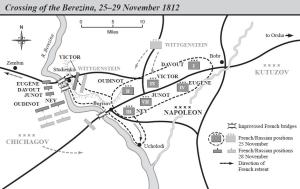
Source: http://en.wikipedia.org/wiki/File:Battle_of_Berezina_map.jpgGregory Fremont-Barnes (main editor) - The Encyclopedia of the French Revolutionary and Napoleonic Wars, page 137. Adapted from Chandler 1966, 840.

Source: http://en.wikipedia.org/wiki/File:Battle_of_Berezina_map.jpg
Gregory Fremont-Barnes (main editor) – The Encyclopedia of the French Revolutionary and Napoleonic Wars, page 137. Adapted from Chandler 1966, 840.

Napoleon had ordered General Jean Baptiste Eblé, the commander of his bridging train, to destroy his equipment in order to prevent it being captured. However, Eblé had destroyed only the actual pontoon bridge, retaining his tools, smithies and charcoal. Thus, his engineers, who were mostly Dutch, could build a pontoon bridge by tearing down local houses for their wood.The problem was that the river was wide at the site of the burnt bridge, and large blocks of ice, propelled by a strong current, were floating down it. This made construction of a replacement at the same site very difficult.

General Jean Baptiste Corbineau, one of Oudinot’s cavalry brigade commanders, then reported that he had found a ford at Studienka, eight miles north of Borisov. Napoleon initially rejected Oudinot’s suggestion of crossing there, but changed his mind after meeting Corbineau on 25 November.

Eblé was ordered to start building three bridges across the Berezina at Studienka at nightfall on 25 November. Various demonstrations were planned in order to distract Chichagov, whose army was to the west of the Berezina an south of Borisov.

A detailed plan was prepared to move the troops still under discipline across the river, starting as soon as the bridges were complete. However, it depended on the enemy being distracted by the diversionary operations and no specific plans were drawn up to allow stragglers to cross.

The first bridge, intended for infantry, was completed by 1pm on 26 November, and the crossing began immediately. The second one, capable of taking wagons, was ready by 4pm. The plan to build a third was abandoned because there were not enough materials to do so.

Lack of time and materials meant that the bridges were improvised and flimsy, and continual repairs were required. The heavier one had to be closed from 8pm  until 11pm on 27 November, from 2am until 4am the next morning and from 4pm to 6pm later that day. The breakages caused hundreds of death.

However, most of the organised and armed troops were across by the end of 27 November, leaving just Victor’s IX Corps as rearguard. The Gendarmes had so far prevented unarmed men and civilians from crossing, but they were now invited to cross. Many, having settled down beside camp fires and, seeing no immediate danger, decided to wait until morning.

The strength of the Grande Armée at this stage is uncertain, but David Chandler estimates that 25,000 men under arms, 110 guns and 40,000 stragglers left Orsha. Joining up with Oudinot and Victor’s corps increased its strength to perhaps 49,000 combatants, 250-300 guns and 40,000 stragglers. About 75,000 Russians were close enough to interfere with the crossing.[4]

Chichagov was slow to realise what was happening, and did not engage Oudinot, who was covering the southern flank on the west bank of the Berezina, until the morning of 27 November. The French had to surrender ground, but maintained their line.

On the east bank of the Berezina, Victor also gave up some ground under pressure from Wittgenstein, but his corps remained intact and Napoleon left able to withdraw one of its brigades, comprised of Germans from Baden, across the river.

The action on both banks began again early on 28 November. Chichagov’s advance guard, commanded by General Eufemiusz Czaplic, a Pole, attacked Oudinot. The position looked so bad for the French that Napoleon prepared to commit the Old Guard, but Oudinot rallied his men. He was wounded, for the 22nd time in his career, and Marshal Michel Ney took command.

Ney was outnumbered by over 30,000 to 12-14,000 men, and his troops were in a worse physical condition. Three quarters of his men, which included Poles, Italians, Wüttermbergers, Dutchmen, Croats, Swiss and Portuguese as well as Frenchmen, fought gallantly.[5]

Ney ordered General Jean-Pierre Doumerc’s cuirassier division to charge the enemy. Czaplic was wounded and 2,000 of his men were captured. This charge, described as ‘brilliant’[6] by Chandler, forced the Russians back. Fighting continued for the rest of the day, but the line had been stabilised.

On the east bank Victor’s force of 8,000 men, mostly from Baden, Hesse, Saxony and Poland, was attacked at 9am by Wittgenstein, who had numerical advantage of four to one. However, the morale of Victor’s men remained, according to Zamoyski, ‘unaccountably high’[7] and they held out.

Victor faced a crisis on his left flank because he was short of troops. One of his divisions, commanded by General Louis Partouneaux, had been ordered to withdraw from Borisov to Studienka in the early hours of 28 November. It took the wrong road and was captured.

Napoleon therefore ordered the Baden brigade that had been withdrawn the day before to cross back over the Berezina. Doing so was very difficult because of the large number of stragglers coming the other way, but the infantry managed to force their way across.

The Russians were able to bring up guns on Victor’s left, which bombarded the bridges, causing panic and great losses amongst the stragglers. Napoleon deployed guns on the west bank, and they inflicted heavy casualties on the Russians who were trying to envelop Victor’s left.

Victor and his men were ordered to retire across the river at 9pm. The bridges had first to be cleared of the dead men and horses and the wreckages of wagons. By 1am, only a small screen was left on the east bank. Victor and Eblé urged the remaining stragglers to cross, but most again decided to wait.

Victor’s last men withdrew at 6am, and the stragglers at last realised the urgency of the situation. Eblé had been ordered by Napoleon to burn the bridges at 7am, but waited until 8:30am because so many were still on the other side of the river. By then the Russians were close to the bridges, leaving him no choice to set them on fire, even though thousands had still to cross.

Chandler argues that ‘Napoleon was undoubtedly in a position to claim a strategic victory’ at the Berezina.’[8] He had extracted the survivors of the Grande Armée, albeit with heavy losses. Chandler attributes this to the inactivity of the Russian commanders and the efforts of Eblé, who he describes as ‘the true hero of the Berezina’[9], Oudinot and Victor.

Chandler also suggests that Kutuzov’s lack of urgency during this phase of the campaign is difficult to interpret as ‘anything else than a deliberate desire to allow Napoleon to escape over the Berezina’[10]

The crossing of the Berezina marked the last major combat of Napoleon’s 1812 Campaign. He had originally intended to fight Chichagov in order to clear the route to Minsk, but the losses incurred in the crossing meant that he had no choice but to retreat to Vilna.

The crossing of the Berezina did not, however, mean the end of the Grande Armée’s ordeal. It continued to suffer casualties in rearguard actions, and to the weather; the temperature was still falling.


[1] Quoted in A. Zamoyski, 1812: Napoleon’s Fatal March on Moscow (London: HarperCollins, 2004), p. 432.

[2] Ibid., pp. 435-7.

[3] Quoted in D. Chandler, The Campaigns of Napoleon (London: Weidenfeld & Nicolson, 1966), p. 834.

[4] Ibid., pp. 841-42.

[5] Zamoyski, 1812, pp. 471-73.

[6] Chandler, Campaigns, p. 842.

[7] Zamoyski, 1812, p. 473.

[8] Chandler, Campaigns, p. 845.

[9] Ibid., p. 841.

[10] Ibid., p. 846.

8 Comments

Filed under War History

The Battle of Krasny, November 1812.

The previous post in this series described Napoleon’s retreat from Moscow to Smolensk, which he reached on 9 November 1812. It took another four days until all his units had arrived. Only 41,500 of the 100,000 men who had started out from Moscow made it to Smolensk.[1]

Click here for a link to a map of Napoleon’s retreat from Moscow on Wikimedia.

There were fewer supplies in Smolensk than Napoleon had hoped, and looting meant that those that there were did not last as long as they would have done if carefully rationed. On the night of 12 November the temperature fell as low as -23.75°C (-10.75°F). Many of the troops were camped out of doors.[2]

Adam Zamoyski points out that Armand Caulaincourt, formerly Napoleon’s Ambassador to Russia, and a member of his entourage, thought that the Emperor could have turned the losses to his advantage by creating a mobile force of around 40,000 men

The wounded could have been left in Smolensk with medical attendants and supplies. Horses, by now in short supply, could have been freed up by ditching loot and the wagons carrying it and part of the artillery. The remaining field force would have been mobile enough to fight its way out of Russia and small enough to be supplied. Instead, the retreat was poorly organised, with the Emperor postponing decisions until the last moment. [3]

Napoleon ordered his army to resume the retreat on 12 November. One corps left each day, ending with the rearguard, commanded by Marshal Michel Ney, on 17 November. The army was therefore strung out along the road. The Emperor himself departed on 14 November.

On 15 November Napoleon and his Imperial Guard reached Krasny. He decided to wait for the rest of his army to catch up. It was harassed by Cossacks and skirmished with the Russian advance guard under General Mikhail Miloradovitch.

The next day Prince Eugene’s 4,000 Italians found the road from Smolensk to Krasny blocked by Miloradovitch’s far larger Russian force. The Italians managed to hold out until nightfall, but seemed certain to be destroyed the next day.

Eugene, however, took them on a night march round the Russians to Krasny. Zamoyski says that a Russian speaking Polish Colonel persuaded Russian sentries that they were acting under orders from Prince Mikhail Kutuzov, the Russian C-in-C.[4]

Napoleon now faced a problem. If he withdrew, then his remaining troops, commanded by Marshals Louis Davout and Ney, might not be able to fight their way through. If he waited for them, then he might find his own retreat cut off by Kutuzov, who was a couple of miles to the south of Krasny. He therefore decided to attack Miloradovitch.

Napoleon led his Imperial Guard forward. They were outnumbered, but Zamoyski says that ‘his bearing…seemed to have impressed not only his own men but the enemy as well.’[5]

Miloradovitch withdrew, allowing Davout’s corps to pass. Kutuzov was urged by his subordinates to attack, since the Russians were strong enough to surround and destroy the enemy, but he did nothing.

Kutuzov did, however, threaten Napoleon’s line of retreat. The Emperor withdrew with the Old Guard, leaving the Young Guard to cover Davout’s retreat. The French suffered heavily from enfilading fire and the Young Guard was almost wiped out. Kutuzov, however, would not attack Napoleon. Zamoyski says that ‘Many on the Russian side felt a deep-seated reluctance to take him on and preferred to stand by in awe.’[6]

David Chandler argues that Krasny ‘reveals the degree of moral ascendancy retained by Napoleon’[7] over his opponents. He also says that it shows that he was correct not to commit the Imperial Guard at Borodino, since events showed that he needed it at Krasny.

Napoleon reached Orsha, a reasonably well stocked supply base on 19 November. He intended to wait there for the remainder of his army. His greatest concern was whether Ney and his 6,000 organised troops, plus double that number of camp followers and stragglers, could make it through Krasny.

Ney encountered Miloradovitch on 18 November, and declined an invitation to surrender. The French tried to break through, but were beaten back with heavy casualties. Miloradovitch and General Sir Robert Wilson, a British observer with the Russian army, both commented on the courage of the French.[8]

Unable to fight his way through, Ney decided to go round the Russians. A crossing point on the Dnieper, which ran north of and roughly parallel to the road, was identified.

After leaving enough camp fires burning to persuade the Russians that his corps was staying put, he led the 2,000 survivors north to the crossing point. The river was frozen, and the ice was just thick enough to take men, provided that they crossed in small groups, but not wagons, guns or horses. Some horsemen and light wagons managed to cross, but cracks appeared in the ice when more tried to follow. In the end, 300 men and all the guns had to be left on the south bank.

The French found food at a village on the north bank that had previously escaped the ravages of war. They were harassed by Cossacks all the way to Orsha, but Ney and 1,000 men made it back to the army.

Napoleon could not linger at Orsha. On 18 November he learnt that Minsk, a major supply base, had been captured by the Russians. Prince Karl Schwarzenberg’s Austrian Corps had been supposed to protect it.

Napoleon accused the Austrians of betrayal. However, Schwarzenberg had moved south-west to support General Jean Reynier’s VIII Corps, which had been attacked by General Fabian Sacken. This left the route to Minsk open to the Russian army commanded by Admiral Pavel Chichagov.

Napoleon’s northern flank was also open. He had ordered Marshal Claude Victor to re-take Polotsk, but he was defeated at Smoliani by Prince Peter Wittgenstein on 13-14 November.

Kutuzov claimed victory at Krasny, but Chandler states that Napoleon had the better of the battle.[9] Zamoyski points out that a real Russian victory would have produced more trophies than Davout’s Marshal’s baton.[10]

However, Napoleon had no alternative but to continue to retreat towards the River Berezina.


[1] D. Chandler, The Campaigns of Napoleon (London: Weidenfeld & Nicolson, 1966), p. 828.

[2] A. Zamoyski, 1812: Napoleon’s Fatal March on Moscow (London: HarperCollins, 2004), pp. 415-16.

[3] Ibid., pp. 418-19.

[4] Ibid., p. 421.

[5] Ibid., p. 422.

[6] Ibid., p. 424.

[7] Chandler, Campaigns, p. 829.

[8] Zamoyski, 1812, pp. 426-27.

[9] Chandler, Campaigns, p. 829.

[10] Zamoyski, 1812, p. 431.

5 Comments

Filed under War History

Napoleon’s Retreat from Moscow to Smolensk

The previous post in this series described how Napoleon decided to retreat from Moscow on 18 October 1812. His intention was to make for the supply depot at Smolensk by a southerly route. This might require a battle with Mikhail Kutuzov’s Russian army, but would mean that the French were not moving through the territory that had been ravaged in their advance on Moscow.

The Grande Armée set off on 19 October, moving south west towards Kaluga. The main body took the older of the two roads to Kaluga, with Prince Eugene’s IV Corps taking the newer road, which was further to the west. Napoleon ordered Marsahl Edouard Mortier, commander of the French rearguard, to destroy the Kremlin before withdrawing on 23 October. The French demolition charges did not work properly, damaging but not destroying the Kremlin.

According to David Chandler, Napoleon had told his men that he intended to attack Kutuzov’s left flank, realising that this news would reach the Russians. He hoped that Kutuzov would consequently move to the east and allow the French to escape to Smolensk.[1]

Adam Zamoyski speculates that Napoleon may have intended to attack the Russians, with Eugene launching a flanking manoeuvre. If Napoleon did consider this, he changed his mind, since on 21 October the main French army moved to join Eugene on the new road.[2]

Kutuzov was quickly informed that the French had left Moscow, but was slow to move. General Dimitry Dokhturov learnt from prisoners that the Grande Armée corps was heading for the road junction at Maloyaroslavets. The French would threaten the flanks and supply lines of the Russian army if they took the junction, so Dokhturov moved his corps there. Control of Maloyaroslavets would give mean that Napoleon could proceed to Smolensk via either Medyn or Kaluga

General Alexis Delzons’s 13th Division reached Maloyaroslavets ahead of Dokhturov, but Delzons left only two battalions in the town. Dokhturov’s corps attacked at dawn on 24 October, taking the town and forcing Delzons to retreat back across the river.

Delzons launched a counter-attack and forced the Russians back. The Croatians of the 1st Illyrian Regiment did particularly well. Kutuzov’s leading corps, under General Nikolai Raevsky, arrived and re-captured the town. General Domenico Pino’s 15th (Italian) Division then took it back. The Russians fell back, but took up a position that covered the bridges over the river.

By 1pm most of the Grande Armée was drawn up on the north back, but Napoleon decided not to send it across the river because the well-positioned Russian artillery would have inflicted heavy casualties on it as it moved.

Fierce fighting continued in the town for the rest of the day and the Italians held it at nightfall. General Sir Robert Wilson, a British observer with the Russian army, wrote that:

The Italian army had displayed qualities which entitled it evermore to take rank amongst the bravest troops in Europe. [3]

The action had involved 27,000 soldiers and 72 guns of the Grande Armée against 32,000 Russians with 354 guns. Napoleon had lost 6,000 men, including Delzons. Russian casualties were higher, but they could be replaced. Napoleon now had only about 65,000 men with him, facing 90,000 Russians with 500 guns.

Early on the 25 October Napoleon carried out a reconnaissance of the battlefield. He was nearly captured by Cossacks, but his escort fought them off. Baron Agathon Fain, his secretary, said that the Emperor was badly affected by the sight of the corpses on the battlefield, many of whom had been burnt to death.[4]

Kutuzov had withdrawn two kilometres to a new position. Attacking it might result in a decisive French victory, but casualties would be heavy. The Russian withdrawal had opened up the route to Smolensk via Medyn, but taking this route would mean that the Grande Armée would be closely pursued by the Russians all the way to Smolensk.

Napoleon therefore decided to retire and head for Smolensk via the route that the Grande Armée had originally advanced along.

Zamoyski points out that Kutuzov, concerned about the inexperience of his troops, was reluctant to fight a pitched battle with the Grande Armée . He suggests that if Napoleon had moved boldly, he could have reached Medyn, where supplies were available, joined up with General Louis Baraguay d’Hilliers’s division and reached Smolensk by 3 or 4 November.[5]

Chandler argues that Napoleon’s plan to defeat Kutuzov before heading to Smolensk via Kaluga was the best option open to him. Changing his plan now meant that six days had been wasted. He could still have headed for Smolensk via Medyn, but reverting to the original line of advance ‘was to court disaster.’[6] Charles Esdaile calls Maloyaroslavets a ‘pointless battle’[7] for the French as it wasted a lot of time.

The Grande Armée marched along a single road, meaning that those further back had to march through ground churned up by those ahead of them. The horses were in poor condition, so it was hard for them to pull guns and wagons. Some generals wanted to speed up the column by abandoning part of the artillery, but Napoleon refused, as he argued that he was making a tactical withdrawal rather than retreating.

On 28 October the head of the column reached the battlefield of Borodino. The corpses had not been cleared away, and large numbers of French wounded had not been evacuated. Napoleon ordered that they should be taken along, against the advice of his Surgeon-General, Baron Dominique Jean Larrey and other doctors. Few survived the retreat.

Napoleon reached Vyazma on 1 November. He reached despatches that informed him that things were going badly on his flanks. In the south the Austrian Prince Karl Schwarzenberg was withdrawing towards the River Bug, exposing Napoleon’s flank. In the North a Franco-Bavarian army under Marshal Laurent St Cyr had been forced to retreat from Polotsk

St Cyr had been promoted to Marshal after the First Battle of Polotsk on 18 August 1812, in which he took over from the wounded Marshal Charles Oudinot and defeated Prince Peter Wittgenstein’s Russian army.

On 18 October Wittgenstein, who had been reinforced and now outnumbered St Cyr, launched a new attack on St Cyr at Polotsk. The Franco-Bavarians held off the attack on the first day; casualties on both sides were heavy. St Cyr realised late the next day that he was in danger of being encircled. A Bavarian counter-attack on 20 October enabled the Franco-Bavarian force to withdraw, but the road to the French supply base at Vitebsk was opened.

The retreat continued, with the column being pressured by both Cossacks and Kutuzov’s advance guard, commanded by Count Mikhail Miloradovich. On 3 November Miloradovich attacked the Grande Armée’s rearguard, Marshal Louis Davout’s I Corps, to the east of Vyazma.

Davout received support from Eugene’s IV Corps and Marshal Josef Poniatowski’s IV Corps. The French suffered heavy casualties, but were able to fall back on Marshal Michel Ney’s III Corps. It had been left at Vyazma with orders to replace the I Corps as the rearguard once it was clear of the town.

French casualties were about 6,000 dead and wounded and 2,000 prisoners. Poniatowski, crushed beneath his horse, was amongst the wounded. Russian losses were at most 1,845. As well as human casualties, the Grande Armée suffered a loss of cohesion. Zamoyski argues that the Russians could have destroyed four French corps if Kutuzov had attacked with his full army.[8]

Until 3 November the retreat had taken place in reasonable weather. The temperature fell sharply on the night of 4-5 November, and the snow began on 6 November. Armies did not then normally campaign in the winter, so the French uniforms were completely inadequate for the Russian winter. Zamoyski describes how men out on fur coats and even women’s dresses that they had plundered from Moscow to take home to their womenfolk.[9]

Troops in units that retained their discipline and cohesion coped best. Stragglers, without comrades to help and support them, fared worse. The animals fared worse; deaths amongst horses meant that wagons and thus supplies had to be abandoned. Saul David’s recent BBC TV series on logistics and war, Bullets, Bombs and Bandages, explained that the French horses had the wrong type of shoes, which made it hard for them to walk on the snow and ice.

Napoleon continued to receive bad news as he retreated. On 6 November he was told that General Claude Malet, a patient at a sanatorium, had escaped and tried to launch a republican coup in Paris on 23 October, claiming that the Emperor was dead. It was quickly suppressed, but Malet had easily fooled some local commanders and Napoleon’s infant son and heir had received little support. The Emperor therefore decided that he needed to return to Paris as soon as possible.

The next day Napoleon learnt that Marshal Louis Victor had been forced to retreat after a battle with Wittgenstein at Czasniki on 31 October. The seriousness of the situation was shown by the phrasing of the order that Napoleon sent to Victor to attack Wittgenstein and re-capture Polotsk. Victor was told to:

Take the offensive  – the safety of the whole army depends on you; every day’s delay can mean a calamity. The army’s cavalry is on foot because the cold has killed all the horses.[10]

Napoleon reached Smolensk on 9 November. It was four days before the whole of the retreating column arrived. The food stocks were lower than expected and this was compounded by looting. Chandler says that in three days the army ate supplies that could have been eked out to last a fortnight; it now comprised only 41,500 men.[11]

The Grande Armée did not stay long in Smolensk. Napoleon wanted to link up with Victor and Oudinot’s 25,000 men and considered wintering at his Vitebsk supply base. He did not know that the Russians had captured it on 7 November.


[1] D. Chandler, The Campaigns of Napoleon (London: Weidenfeld & Nicolson, 1966), p. 820.

[2] A. Zamoyski, 1812: Napoleon’s Fatal March on Moscow (London: HarperCollins, 2004), p. 369.

[3] Quoted in Ibid., p. 373.

[4] Ibid., p. 374.

[5] Ibid., pp. 375-77.

[6] Chandler, Campaigns, p. 823.

[7] C. J. Esdaile, Napoleon’s Wars: An International History, 1803-1815 (London: Allen Lane, 2007), p. 478.

[8] Zamoyski, 1812, pp. 387-88.

[9] Ibid., pp. 391-92.

[10] Quoted in Chandler, Campaigns, p. 827.

[11] Ibid., pp. 827-28.

4 Comments

Filed under War History

The Siege of Burgos and Wellington’s Retreat, 1812.

This post leads on from previous ones on the Battles of Salamanca and Garcia Hernandez.

Wellington was faced with a dilemma after his army liberated Madrid. Politically he could not fall back to Salamanca, but he faced the risk of being counter-attacked by a larger French forces from more than one direction.

The French had withdrawn their garrisons to Burgos and Valencia. According to Charles Esdaile they could field at least 100,000 men against the 60,000 of Wellington’s Anglo-Portuguese army, which might be increased to 70,000 by the addition of Spanish regulars. The guerrillas were good at harassing the enemy, but they could not resist a French counter-offensive.[1]

In late August General Bertrand Clausel advanced on Valladolid, north of Madrid, intending to relieve the isolated French garrisons of Astorga, Toro and Zamora. Wellington, seeing a chance to defeat part of the French army before it concentrated against him, moved north with 21,000 men.

Wellington had taken what Esdaile describes as ‘a serious risk’[2] by moving with such a small force, but it was politically impossible for him to take more troops from Madrid. He hoped to receive support from General Fransisco Castaños’s Spanish 6th Army, which had just taken Astorgas.

In the event, the Spanish, who were short of supplies and artillery, moved slowly, and Clausel was able to retreat, taking the garrisons of Toro and Zamora with him.

Esdaile argues that Wellington should then have gone back to Madrid. He faced two French armies, and have could looked for an opportunity to win a major victory by concentrating against one of them.[3] Instead, he decided to advance on Burgos.

Click here for a link to map of Burgos in 1812.

The city was being pillaged by guerrillas, but a well supplied French garrison of veterans occupied a strong position in Burgos Castle. Esdaile compares General Jean-Louis Dubreton, its commander, to General Armand Phillipon, who had successfully defended Badajoz in 1811 and inflicted heavy casualties on the attackers before being forced to surrender the city in April 1812.[4]

Burgos had nine heavy guns, 11 field guns and six howitzers. The garrison of 2,000 men had no permanent shelter. Frederick Myatt argues that the fortress could resist guerrillas or an army without siege guns but not an army well equipped with a siege train and engineers. [5]

However, Wellington had only three 18 pounder guns, five 24 pounder howitzers, five engineer officers, eight Royal Military Artificers, 10 assistant engineers and 81 tradesmen. His army was short of tools, although it found some French ones in the town.

Burgos was invested by the British 1st and 6th Divisions and two Portuguese brigades on 19 September. The 5th and 7th Divisions were positioned to the north-east to guard against a French attempt to lift the siege.

Wellington’s shortage of artillery meant that he had to concentrate on digging and mining, with his guns being used mainly to support assaults. An outer works, the Hornwork, was captured on the first evening of the siege, but at the cost of heavy casualties; 421 Allied compared with 198 French dead, wounded and captured according to Jac Weller.[6] Seven French field guns were taken as well as 60 prisoners.[7]

An attack on the castle’s outer wall on 22 September failed, and Wellington then concentrated on mining. The miners had to operate under fire from the castle, with little support from their own guns, and it often rained.

By 29 September the miners believed that they had reached the scarp wall and a mine was detonated that evening. The subsequent attack failed after troops became lost and failed to find the breach. In the morning it was revealed that it was not a good one, and that the French were working at shoring up their defences. The mine had been detonated too far forward, as the foundations that the miners had met were ancient ones rather than the those of the wall.

The failure damaged Allied morale; Myatt points out that the French had:

‘the reasonable hope that relief would arrive. The British…[were] feeling (perhaps rightly) that they were attempting a hopeless task with quite inadequate support’[8]

The British worked on a second mine. They also set up a battery 60 yards from the outer wall, which was ready by 1 October. The French moved their guns to deal with this new threat and destroyed the battery the same day. The damaged guns were withdrawn and a new position prepared that night. The French artillery destroyed it before the guns could be moved into it.

It was intended to detonate the second mine on 3 October, but problems with the rocky ground meant that it was not ready until the next day. British guns made a breach 60 feet wide in the wall, which was extended to 100 feet when the mine detonated. The British attack succeeded in taking the breach with relatively light casualties.

Preparations now began for an assault on the second wall, but these were hampered by French sorties and poor weather. The attack was planned for 17 October, but Wellington delayed it for a day as he thought that the breach made in the second wall was inadequate. A third mine was detonated  underneath the church of San Roman.

The French beat off the attack on 18 October. Wellington had, according to Jac Weller, 24,000 Anglo-Portuguese troops and 10,000 Spaniards around Burgos. He was now faced with 53,000 French soldiers commanded by General Joseph Souham, who had replaced Clausel. Another French army was advancing on Madrid from Valencia.

Wellington therefore called off the siege and withdrew on the night of 21 October. The French suffered 623 dead, wounded and captured during the siege, but inflicted 2,059 casualties on the besiegers.[9]

Wellington’s rearguard fought an action against French cavalry at Venta del Pozo on 23 October. He initially hoped to make a stand along the River Carrión forty miles to the north-east of Valladolid and to join up with General Sir Rowland Hill’s corps from Madrid.

A series of engagements took place between 25 and 29 October, known collectively as the Battle of Tordesillas. The French captured the bridge over the Carrión at Palencia on 25 October and the bridge over the Duero at Tordesillas on 29 October. Wellington was therefore forced to retreat and ordered Hill to do the same

Hill had been preparing to fight a battle against the advancing French, commanded by Marshal Nicholas Soult. Instead, his rearguard fought an action against the French at Aranjuez on 30 October and he abandoned Madrid the next day. Wellington and Hill combined near Salamanca on 8 November and took up a strong defensive position. The French arrived six days later.

Soult moved to the west to threaten Wellington’s communications with Ciudad Rodrigo. Marshal Auguste Marmont had tried a similar manoeuvre in June and had been defeated after being caught on the march. Soult avoided this by staying further away from Wellington.

This left Wellington with the options of attacking a force that outnumbered him 95,000 to 70,000 or retreating. He chose to retire to Ciudad Rodrigo; it started to rain heavily just after the withdrawal began.

Esdaile says that ‘the French pursuit was none too vigorous.’[10] However, the Allies still lost 6,000 killed, wounded and missing. They included Sir Edward Paget, Wellington’s newly arrived second-in-command, who was captured on 17 November. Discipline and morale broke down as the troops retreated in bad weather, echoing the retreat to Coruña in 1809.

Wellington had lost much of the ground that he had won earlier in the year. However, the Allies still held the fortresses of Ciudad Rodrigo and Badajoz, known as the keys to Spain. An army invading Spain from Portugal had to hold these, so Wellington had a better starting point for his 1813 offensive than he had possessed in 1812.


[1] C. J. Esdaile, The Peninsular War: A New History (London: Allen Lane, 2002), p. 409.

[2] Ibid., p. 410.

[3] Ibid., p. 411.

[4] Ibid.

[5] F. Myatt, British Sieges of the Peninsular War (Tunbridge Wells: Spellmount, 1987), p. 134.

[6] J. Weller, Wellington in the Peninsula 1808-1814, New ed. (London: Greenhill, 1992), p. 236.

[7] Myatt, British Sieges, pp. 136-37.

[8] Ibid., p. 142.

[9] Weller, Peninsula, pp. 237-38.

[10] Esdaile, Peninsular War, p. 418.

2 Comments

Filed under War History

Napoleon Retreats from Moscow, 18 October 1812

This post leads on from this one on the Battle of Borodino on 7 September 1812.

After Napoleon’s victory at Borodino led to the French capture of Moscow, Prince Mikhail Kutuzov’s Russian army retreated to Tarutino, south and slightly to the west of Moscow. Adam Zamoyski describes this as ‘a good position.’[1] It was a sufficient distance from Moscow to be safe from a major French attack, threatened the French lines of communication and protected the routes to the south.

The French cavalry, commanded by Marshal Joachim Murat, and Marshal Josef Poniatowski’s V Corps were near Tarutino. Some Russian generals, notably Count Levin Bennigsen, wanted to attack them, but Kutuzov realised that his army needed time to rest, recuperate and receive reinforcements.

The rest of the French army was around Moscow. Much of the city was destroyed by a fire that started on 15 September and lasted for three days. City Governor Count Fyodor Rostopchin had made preparations to burn any stores useful to the French and city and had ordered Police Superintendent Voronenko to set fire to not only the stores, but to anything that would burn. Rostopchin had also withdrawn all the fire fighting pumps and their crews from the city.

Zamoyski suggests that the fires started by Voronenko and his men were further spread by local criminals and French soldiers engaged in looting, and by the wind. He contends that the fire left many French troops without shelter. Other historians who believe that the fires were started deliberately by the Russians include David Bell and Charles Esdaile.[2]

David Chandler agrees that Rostopchin ordered the fires, but says that most supplies and enough shelter for the 95,000 French troops remained intact. He argues that a complete destruction of the city would have actually been better for the French, as it would have forced them to retreat earlier. Instead, Napoleon stayed in the hope that he could persuade Tsar Alexander to come to terms.[3]

On the other hand, Leo Tolstoy claims in his novel War and Peace, the most famous book on the 1812 Campaign, that the fire was an inevitable result of an empty and wooden city being occupied by soldiers who were bound to smoke pipes, light camp fires and cook themselves two meals a day.[4]

On 5 October Napoleon sent delegations to attempt to negotiate a temporary armistice with Kutuzov and a permanent peace with Alexander. Kutuzov, who wanted to gain time to strengthen his forces, received the French delegates politely and gave them the impression that Russian soldiers wanted peace.

However, Kutuzov refused to allow the delegation to proceed to St Petersburg to meet the Tsar. He sent their letters on to the Tsar, with a recommendation that Alexander refuse to negotiate, which the Tsar accepted. According to Chandler, Napoleon refused to believe that the Tsar would not negotiate until a second French delegation also failed.[5]

The balance of power was moving against Napoleon as time passed. Chandler says by 4 October Kutuzov had 110,000 men facing 95,000 French at Moscow and another 5,000 at Borodino. The Russians had an even greater advantage on the flanks.[6]

Napoleon had been sure that Alexander would negotiate once Moscow fell and had not planned what to do if the Tsar refused to make peace. According to Zamoyski, Napoleon had studied weather patterns and believed that it would not get really cold until December, but did not realise how quickly the temperature would drop when it changed.[7]

Chandler argues that he had six options:

  1. He could remain at Moscow. His staff thought that there were sufficient resources to supply his army for another six months. However, he would be a long way from Paris, in a position that was hard to defend and facing an opponent who was growing stronger. His flank forces would have greater supply problems than the troops in Moscow.
  2. He could withdraw towards the fertile region around Kiev. However, he would have to fight Kutuzov and would move away from the politically most important parts of Russia.
  3. He could retreat to Smolensk by a south-westerly route, thus avoiding the ravaged countryside that he had advanced through. This would also mean a battle with Kutuzov.
  4. He could advance on St Petersburg in the hope of winning victory, but it was late in the year, his army was tired and weakened and he lacked good maps of the region.
  5. He could move north-west to Velikye-Luki, reducing his lines of communication and threatening St Petersburg. This would worsen his supply position.
  6. He could retreat to Smolensk, and if necessary, Poland the way that he had come. This would be admitting defeat and would mean withdrawing through countryside already ravaged by war.

There were major objections to each option, so Napoleon prevaricated, hoping that Alexander would negotiate. On 18 October Napoleon decided on the third option, a retreat to Smolensk via the southerly route, which would entail a battle with Kutuzov. He ordered that the withdrawal should begin two days later.[8]

Also on 18 October, however, Kutuzov decided to attack Murat’s cavalry at Vinkovo. An unofficial truce had been in operation, so the French were taken by surprise. Murat was able to fight his way out, and Kutuzov did not follow-up his limited success.

However, the Battle of Vinkovo, also known as the Battle of Tarutino, persuaded Napoleon to bring the retreat forward a day. Around 95,000 men and 500 cannon left Moscow after 35 days, accompanied by 15-40,000 wagons loaded with loot, supplies, wounded and sick soldiers and camp followers.[9]

In an attempt to distract Kutuzov, Napoleon sent another offer of an armistice and told his men that he intended to attack the Russian left flank, expecting this false intelligence to reach Kutuzov.


[1] A. Zamoyski, 1812: Napoleon’s Fatal March on Moscow (London: HarperCollins, 2004), p. 333.

[2] D. A. Bell, The First Total War: Napoleon’s Europe and the Birth of Modern Warfare (London: Bloomsbury, 2007), p. 259; C. J. Esdaile, Napoleon’s Wars: An International History, 1803-1815 (London: Allen Lane, 2007), p. 478; Zamoyski, 1812, pp. 300-4.

[3] D. Chandler, The Campaigns of Napoleon (London: Weidenfeld & Nicolson, 1966), pp. 814-15.

[4] L. Tolstoy, War and Peace, trans., A. Maude, Maude, L. (Chicago IL: Encyclopaedia Britannica Inc., 1952). Book 11, p. 513.

[5] Chandler, Campaigns, p. 814.

[6] Ibid., pp. 815-16.

[7] Zamoyski, 1812, p. 351.

[8] Chandler, Campaigns, pp. 817-19.

[9] Ibid., pp. 819-20; Zamoyski, 1812, pp. 367-68.

8 Comments

Filed under War History

Battle of Smolensk, 17 August 1812.

This post follows on from this one on Napoleon’s campaign in Russia up to Battle of Vitebsk on 28 July 1812.

The Russian commander, General Michael Barclay de Tolly, was reluctant to attack. The further that the French advanced into Russia, the better the odds became for the Russians. The French were being harassed by Cossacks and had to leave troops to guard their lines of supply, whilst the Russian were able to bring up more troops.

However, most Russians could not understand why they were surrendering so much territory without a fight, especially after Barclay was joined by General Peter Bagration’s Second Army on 4 August. According to David Chandler, Barclay commanded 125,000 men and Napoleon had about 185,000 in the immediate area.[1]

Barclay was under pressure both from both Tsar Alexander and from his subordinates to attack. On 6 August his generals persuaded him to concentrate against Marshal Joachim Murat’s cavalry and Marshal Michel Ney’s corps. The next day, Barclay received false reports that there was a French force at Poriechie to his north. He re-aligned his army to the north to face the supposed French threat.

General Matviei Platov, commanding the Don Cossacks. did not receive the order to move north. He encountered and defeated General Horace Sebastiani’s cavalry division at the Battle of Inkovo, taking 200 prisoners, but had to retreat when the French counter-attacked.

Barclay ordered a cautious advance on 13 August, but Bagration, angered by Barclay’s continual changes of orders, declined to co-operate. He had put himself under Barclay’s command when they united on 4 August, but he was not officially subordinate to Bagration.

Napoleon had halted his advance on Smolensk and prepared to receive a Russian attack when he learnt of Inkovo. By 10 August it was apparent that this was not going to happen and he resumed preparations for an attempt to envelop the Russians at Smolensk. Chandler says that:

Almost all commentators agree that this operational plan constitutes one of Napoleon’s masterpieces…This was a manoeuvre of strategic envelopment worthy of the one that preceded his great triumph of Jena-Auerstadt in 1806, and if it had succeeded the fruits of victory would have been no less impressive.[2]

The French manoeuvres started on 11 August. Barclay put a rearguard of 8,000 infantry and 1,500 cavalry under General Neveroski on the south bank of the Dnieper to guard the approaches to Smolensk. It held up the French cavalry, which might otherwise have reached Smolensk on 14 August. Instead, Napoleon paused for a day to re-group.

Napoleon had now lost the element of surprise and the Russians were able to withdraw to Smolensk. Barclay ordered General Raevski to occupy it with 20,000 men and 72 guns. It had a medieval wall and some more modern defences, but these were in a poor state of repair.

The French reached Smolensk on 16 August. Some fighting took place, but they did not attempt to storm the city until the next day. The Russians held on, suffering 12-14,000 casualties, but inflicting 10,000. Chandler says that it is unclear why Napoleon attacked rather than masking the city and moving to threaten the Smolensk to Moscow road.[3]

Barclay feared such a manoeuvre and evacuated Smolensk on the night of 17-18 August after destroying all his stores. Grand Duke Constantine, the Tsar’s brother, and General Bennigsen objected to this and accused Barclay of cowardice.

The French were slow to move, and their pursuit did not get properly underway until 19 August. General Junot was ordered to take his corps over the Dnieper at Prudichevo in order to cut off the Russian retreat, but took all day to find a crossing, and then did not attack. Ney and Murat were held up by the Russian rearguard under Eugen and Tutchkov at Valutino, and the main Russian

Napoleon did have some good news on 18 August; a victory at Polotsk secured his northern flank. Marshal Charles Oudinot, the French commander, was wounded, but General Laurent St Cyr took over and defeated the Russians. St Cyr was promoted to Marshal.

However, Napoleon was having to advance even further into Russia in an attempt to bring the Russians to battle.


[1] D. Chandler, The Campaigns of Napoleon (London: Weidenfeld & Nicolson, 1966), p. 782.

[2] Ibid., pp. 783-84.

[3] Ibid., p. 786.

3 Comments

Filed under War History

Allied Liberation of Madrid, 12 August 1812.

As described in this post, on 22 July 1812 Wellington‘s Anglo-Portuguese army defeated the French at the battle of Salamanca. On 6 August Wellington moved towards Madrid with about 60,000 men.The French and their Spanish allies had 210,000 troops in Spain, but many of these were spread around the country in garrisons. Others were in Andalusia in the south under the command of Marshal Nicolas Soult

King Joseph Bonaparte and Marshal Jean Jourdan had only 22,000 men with which to oppose Wellington. On 10 August Joseph and his royal household left Madrid for Valencia, accompanied by 15,000 civilians in a convoy of 2,000 wagons. Only a small garrison was left behind.

The poor communications between Andalusia and Madrid meant Soult did not learn of the French defeat at Salamanca until 12 August. He was forced to withdraw. He ended his siege of Cadiz on 25 August and evacuated Seville two days later, apart from a small rearguard that was quickly defeated by an Anglo-Spanish force. Soult joined with other French forces from Extremadura at Cordoba and withdrew to Granada. On 16 September he retreated to Valencia.

Wellington’s army entered Madrid on 12 August 1812 to the cheers of the population. The French had lost half the territory that they had gained in Spain since 1808 in eight months.

The Spanish could theoretically put 100,000 troops in the field, and more could be raised from the liberated territories. The British hoped for a general Spanish mobilisation against the French, but this did not happen. Charles Esdaile says that the British attributed this to ‘Spanish laziness and incompetence’[1] but argues that this view ignored the true situation in Spain and the ineffectiveness of the government.

The 1811 harvest was disastrous, and the countryside had been pillaged by a series of armies. The crowds that cheered Wellington’s armies wanted bread rather than a chance to fight the French.

Police controls imposed by the French were little relaxed. Feudalism was theoretically abolished, but landowners simply replaced feudal levies with rents. Some guerillas preferred banditry to pursuing the French or joining the regular army. There was consequently anarchy in much of the country.

The country was also in a dire financial state. The French invasion and troubles in the Spanish American colonies reduced revenue from 407.7 million reales in 1810 to 210.6 million in 1811 and 138 million in 1812. Esdaile argues that Spain was bankrupt unless it could stabilise the situation in its American colonies. Only British subsidies allowed it to continue the war.[2]

Despite the liberation of the capital of Spain and half the country, the Peninsular War was a long way from being over.


[1] C. J. Esdaile, The Peninsular War: A New History (London: Allen Lane, 2002), p. 403.

[2] Ibid., pp. 406-7.

1 Comment

Filed under Political History, War History

Napoleon’s 1812 Russian Campaign to the Capture of Vitebsk on 28 July

This post follows on from previous ones describing Napoleon’s invasion of Russia in June 1812 and the reasons why he invaded.

Napoleon was aware that his invasion of Russia presented major supply problems, describing it as ‘the greatest and most difficult enterprise that I have ever attempted.’[1] He did not expect to have to advance far into Russia, believing that he could win a decisive victory near the frontier.

Napoleon reached Vilna on June 28. He had hoped to engage Tsar Alexander I and the First Army under General Prince Michael Barclay de Tolly, but they had retreated north-east towards Drissa. This increased the distance between the First Army and the Russian Second Army, commanded by General Prince Peter Bagration.

Napoleon attempted to trap and destroy Bagration’s army between the I Corps of Marshal Louis Davout and his right flank, commanded by his brother Jerome, King of Westphalia; the 45,000 Russians would be surrounded by 110,000 troops.[2]

On 4 July, Bagration learnt that Davout had crossed his line of retreat and moved south towards Minsk. Jerome,  hampered by supply problems, poor roads and heavy rain, moved slowly, and Bagration escaped. Jerome failed to keep his brother informed of his movements. Napoleon told him that:

If you had the most elementary grasp of soldiering, you would have been on the 3rd where you were on the 6th, and several events which would have resulted from my calculations would have given me a fine campaign.[3]

Napoleon blamed Jerome for the French failure to destroy Bagration’s army. Charles Esdaile says that this is now generally regarded as being unfair; Jerome was not a good general, but he was given an impossible task by his brother. The French faced great supply problems in a country where they could not rely in the local population. The army was too big and the distances too vast to allow Napoleon to control the battle and to carry out a battles of encirclement.[4] Adam Zamoyski blames Napoleon, who had appointed his brother, who had no military experience, to high command for political reasons.[5]

Napoleon put Jerome under the command of  Davout. Jerome was angered by his brother’s criticisms and got on poorly with Davout. He left the army and returned to Westphalia.

Napoleon ordered Davout to pursue Bagration and prevent the two Russian armies joining forces. Napoleon intended to destroy Barclay de Tolly’s army, which had reached Drissa on 11 July. Its fortifications were strong, so Napoleon decided to turn its flank, forcing the Russians to retreat and fight in the open.

On 12 July Alexander accepted that Drissa was a trap for his army, and that it should withdraw to Vitebsk. Adam Zamoyski points out that this decision, whilst militarily correct, created problems for Alexander. He had made a rousing speech the day before, promising his troops a victorious battle. The army had done nothing to fight the invader, and Alexander had given up a large proportion of his empire. The Tsar was persuaded by his advisers that his place was in his capital, rallying his people and recruiting more troops. He therefore left the army.[6]

On 19 July Napoleon received a report that the Russians had left Drissa. He expected the Russian armies to meet at Polotsk, and thus moved towards Kamen. Two days later he realised that their rendezvous was to be at Vitebsk. On 23 July Bagration and Davout fought a battle, called Mogilev by the French and Saltanovka by the Russians. Bagration was unable to break through and unite with Barclay.

Engagements took place between the French cavalry under Marshal Joachim Murat and Barclay’s troops at Ostrovno on 25 and 26 July. This convinced Napoleon that Barclay was willing to give battle, and he decided to wait until 28 July to bring up more troops, rather than attacking on 27 July with the troops available.

David Chandler considers this decision to be a major error by Napoleon. Barclay abandoned his original plan to fight at Vitebsk when he learnt that Bagration could not move to support him. The day’s delay allowed the Russians to withdraw towards Smolensk. There were enough good roads for him to be sure of getting there safely.[7]

Barclay, according to Adam Zamoyski, was correct to withdraw. A Russian victory would have been highly unlikely, and would not have been decisive; Barclay commanded the main Russian army but faced only part of Napoleon’s army. The failure to win a victory damaged French morale.[8]

The French took Vitebsk on 28 July. It had been the most easterly city of Poland until 1772,  when Austria, Prussia and Russia carried out the first of their three partitions of Poland. The French had taken all of Lithuania and had a defensible position. Napoleon initially claimed that:

Here I stop! Here I must look around me, rally, refresh my army and organise Poland. The campaign of 1812  is finished.[9]

Napoleon, however, soon changed his mind.  The country to the east was more fertile and the Russian armies were only about 100 miles away. On 12 August he marched on Smolensk, intending to inflict a decisive defeat on the Russians; see the next post in this series.


[1] Quoted in C. J. Esdaile, Napoleon’s Wars: An International History, 1803-1815 (London: Allen Lane, 2007), p. 462.

[2] D. Chandler, The Campaigns of Napoleon (London: Weidenfeld & Nicolson, 1966), pp. 775-76.

[3] Quoted in A. Zamoyski, 1812: Napoleon’s Fatal March on Moscow (London: HarperCollins, 2004), p. 176.

[4] Esdaile, Napoleon’s Wars, p. 468.

[5] Zamoyski, 1812, pp. 167-68.

[6] Ibid., pp. 171-72.

[7] Chandler, Campaigns, p. 779.

[8] Zamoyski, 1812, pp. 179-81.

[9] Quoted in Esdaile, Napoleon’s Wars, p. 470.

4 Comments

Filed under War History

The Battle of Garcia Hernandez, 1812

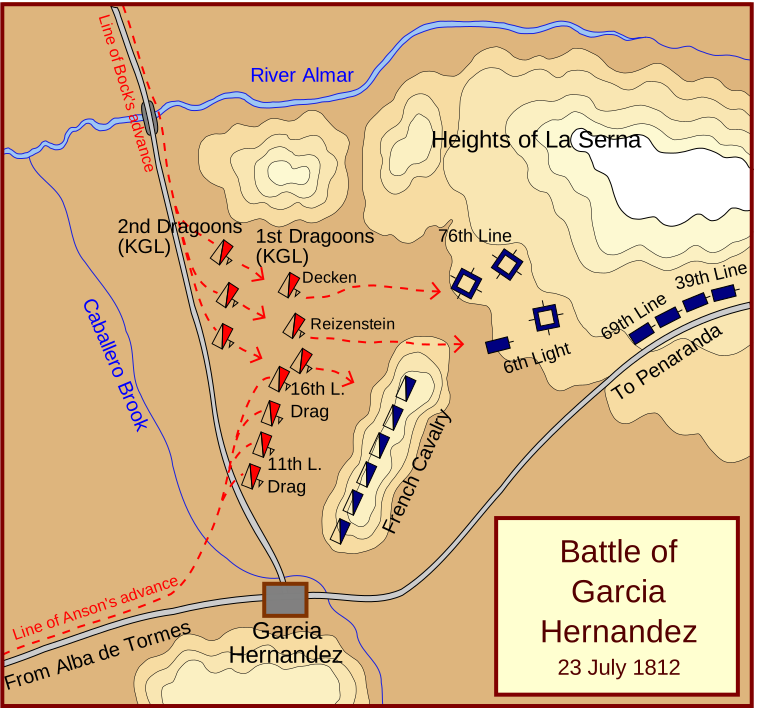
This action took place on 23 July 1812, the day after Wellington‘s Anglo-Portuguese army defeated Marmont‘s French at Salamanca.  A brigade of 770 heavy cavalry of the 1st and 2nd Dragoons of the King’s German Legion, commanded by General Georg Bock, supported by the 1,000 British light cavalry of General George Anson’s brigade encountered a French division of 4,000 infantry commanded by General Maximilian Foy.

The British monarch, King George III,  was also Elector of Hannover. A large part of the Hanoverian Army escaped to Britain when the French invaded their country in 1803 and formed the KGL, which was part of the British Army.

Foy’s division had not been engaged at Salamanca, and it was acting as the rearguard for the retreating French army. His cavalry fled as the KGL advanced, so he formed his infantry into squares.

A square was a square or rectangular formation, at this time normally formed by a single battalion. Infantry caught in line or column by cavalry would be massacred, but were generally safe in a square. The British, whose lines were two men deep, formed squares that were four deep. The French, whose lines were three deep, formed squares that were either three or six deep. Squares were usually hollow, but solid ones could be formed to rally troops in an emergency.

Horses would not attack the rows of bayonets offered by a square, so disciplined infantry in a square were safe from unsupported cavalry. Cavalry could defeat squares by bringing up their supporting horse artillery, which would destroy the squares by firepower. All artillery was pulled by horses. The gunners of horse artillery, which had light guns, rode on the horses or limbers, so could move faster than the heavier foot artillery, whose gunners marched.

Infantry caught in the wrong formation because of errors by commanders or because the attacking enemy was concealed by terrain or poor visibility could be massacred. This happened to British infantry that was caught in line by French and Polish cavalry coming out of the mist at Albuera in 1811. The day before at Salamanca General Maucanne observed British cavalry advancing and formed his division into squares, only to be surprised by British infantry that attacked over the crest of a ridge.

Garcia Hernandez was a small action, but it is famous because it was the only battle of the Napoleonic Wars involving the British Army in which a formed square, of either side, was broken exclusively by cavalry.

File:Garcia Hernandez.svg

Battle of Garcia Hernandez. Source: //upload.wikimedia.org/wikipedia/commons/e/e3/Garcia_Hernandez.svg

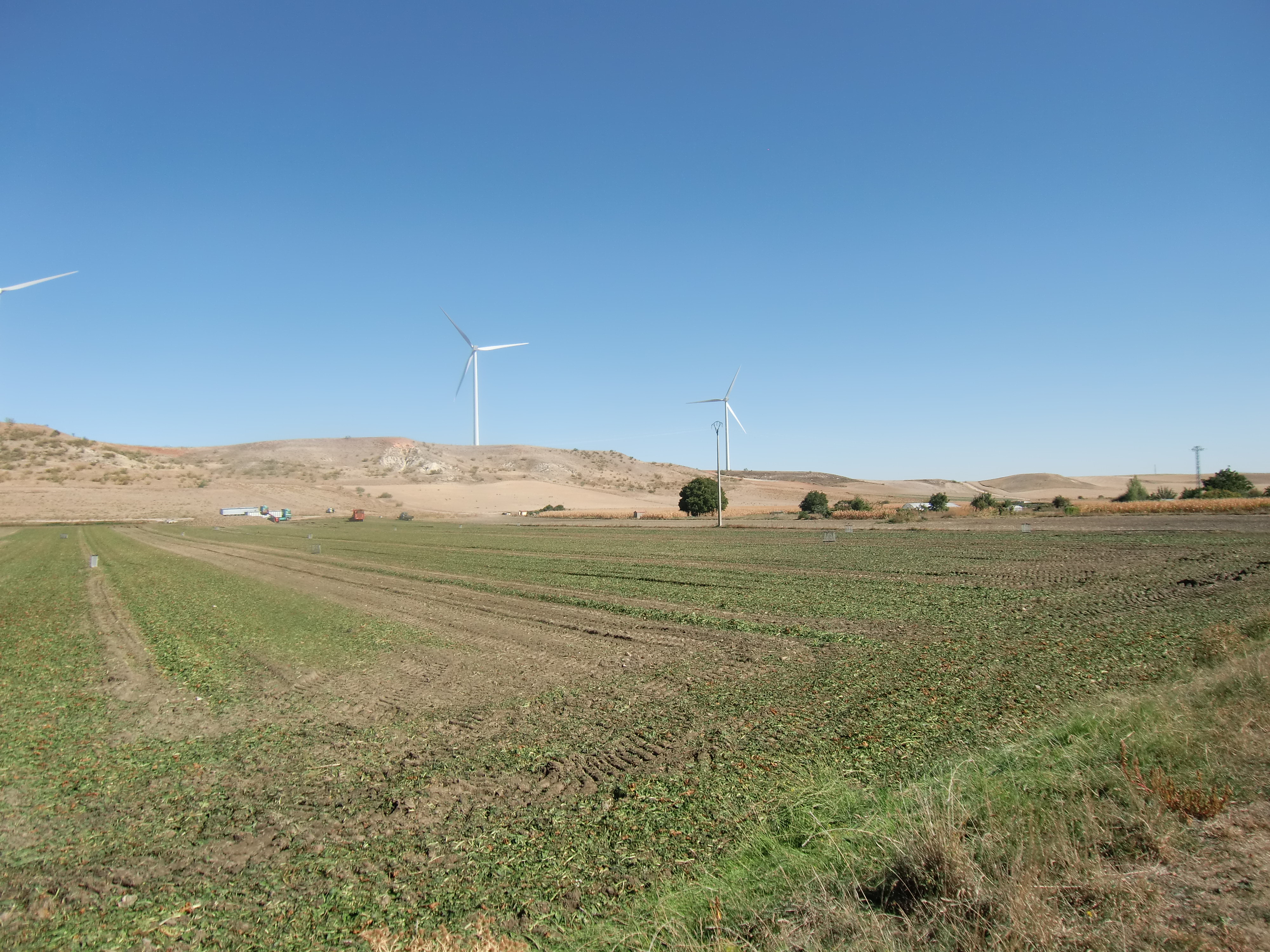
Battlefield of Garcia Hernandez today.

The KGL charged a square of the French 6th Light Infantry Regiment. It allowed the cavalry to get too close before firing, and a mortally wounded horse fell into the side of the square, creating enough of a gap for other cavalry toget inside the square. The square broke, with most of its members surrendering.

A second French square was shaken by this, and its men fled or surrendered when the German dragoons attacked it. Foy withdrew the rest of his division. According to Sir Charles Oman 200 Frenchmen were killed and 1,400 captured. The KGL lost 54 killed and 62 wounded. The reason for the high ratio of dead to wounded was the deadly effect of very short-range musket fire.[1]

The map in this post is from Wikipedia; link given in the caption. The photo was taken by myself when I visited the battlefields of Wellington’s campaigns of 1809-12 in a tour led by Ian Fletcher. I have no connection with Ian Fletcher Battlefield Tours except as a satisfied and repeat customer.


[1] C. Oman, Wellington’s Army, 1809-1814 (London: Edward Arnold, 1912), pp. 101-2.

2 Comments

Filed under War History