Tag Archives: German navy

The Battle of Helgoland Bight 28 August 1914

An improved version of this post is available  by clicking on this link to The Dreadnought Project.

It uses the Naval Staff Monographs, written between the two world wars by Royal Navy staff officers for internal RN use, which I was unaware of at the time that wrote the initial version.

The first month of the First World War saw little naval action in the North Sea. Kaiser Wilhelm II was unwilling the risk the German fleet in action. Admiral Alfred von Tirpitz, the architect of the German fleet thought that ‘it was simply nonsense to pack the fleet in cotton wool’, but his job was largely administrative and gave him little input into strategy.[1]

Wilhelm and his Chancellor Theobald von Bethman Hollweg wanted to preserve the fleet as a post war bargaining counter. The German generals saw the navy’s role as protecting the army’s flank and stopping amphibious assaults by the British on Germany’s North Sea coast or the Russians in the Baltic.

The German navy had expected the British to carry out a close blockade of the Helgoland Bight, which would allow the Germans to whittle down the Royal Navy (RN). However, the RN instead conducted a distant blockade of the North Sea.

The RN had assumed that the Germans would come out and challenge it at the start of the war. Admiral Sir William James, a Commander in 1914 who served in Naval Intelligence and the Room 40 code-breaking centre later in the war, told the naval historian Arthur Marder that ‘[r]epeated [German] excursions might have seriously weakened us.’ Marder notes that the Germans failed to use the major advantage that the use of Zeppelins for reconnaissance would have given them.[2]

By 19 August the bulk of the British Expeditionary Force (BEF) had been transported to the Continent. The RN closed the English Channel to raiders and the Grand Fleet was positioned to prevent the German High Seas Fleet from interfering with the transports.

Admiral Reinhard Scheer, then commanding the German Second Battle Squadron, described the idea that the Germans might have attacked the British supply lines as a ‘totally impossible demand’ that would have led to heavy German losses.[3]

Some of the more aggressive British officers wanted to take action. These included Commodores Roger Keyes and Reginald Tyrwhitt, commanding respectively the submarines and destroyers at Harwich, and Vice Admiral Sir David Beatty, commanding the Grand Fleet’s battlecruisers.

Keyes’s submarines gathered useful intelligence about the organisation of German patrols. He put forward his plan, supported by Tyrwhitt, on 23 August. Three surfaced submarines would be placed 40 miles off Helgoland in order to draw out the German destroyers. They would then be attacked by Tyrwhitt’s 1st and 3rd destroyers flotillas, each led by a light cruiser.

Three more submarines would lie submerged closer in to the coast in order to attack any German cruisers that came out to support their destroyers and two more would be placed at the mouth of the River Ems. The battlecruisers HMS Invincible and New Zealand, which had recently moved to the Humber under the command of Rear Admiral Archibald Gordon  Moore, would give support. Five old Cressy class armoured cruisers would be held in reserve under the command of Rear Admiral Arthur Christian.

On 24 August it was decided to carry out Keyes’s plan four days later. Admiral Sir John Jellicoe, the commander of the Grand Fleet, was not informed until 26 August. He suggested bringing the Grand Fleet south in support; he was told that this was unnecessary, but that his battlecruisers could ‘support if convenient.’[4] On the morning of 27 August he sent Beatty’s three battlecruisers and Commodore William Goodenough’s six light cruisers south.

The signal informing the local commanders that Beatty and Goodenough’s ships were supporting them reached Christian but not Keyes or Tyrwhitt. This nearly led to Goodenough’s light cruisers being fired upon by other British ships.

The Battle of Helgoland Bight is described by Paul Halpern as being ‘a most confusing encounter.’[5] Fog and haze restricted visibility and restricted the involvement of the German shore batteries.

The tides meant that German capital ships could not cross the Jade Bar and put to sea in the morning. Marder wonders if this ‘may have been lucky for the attackers (or was it foresight in planning?).’[6] Most other writers, including Sir Julian Corbett, the official historian, mention this fact without giving any indication whether it was due to luck or judgement.[7] However, Robert Massie notes that Beatty had a set of the German coastal tide tables.[8]

Tyrwhitt had the Third Flotilla of 16 modern L class destroyers and his flagship the brand new light cruiser HMS Arethusa (2 6 inch, 6 4 inch guns, 4 21 inch torpedo tubes) along with the First Flotilla of the light cruiser HMS Fearless (10 4 inch guns, 2 18 inch torpedo tubes) and 15 older  destroyers. The First Flotilla’s other four destroyers were with the Humber battlecruisers. Keyes flew his flag in the destroyer HMS Lurcher, which was accompanied by the destroyer HMS Firedrake.

Tyrwhitt’s force first sighted a German destroyer at 7 am and was soon engaged with ten enemy destroyers. Two German light cruisers, SMS Stettin and Frauenlob (both 10 4.1 inch guns, 2 17.7 inch torpedo tubes) appeared about 8 am. They easily outgunned the British destroyers and were similarly armed to Fearless. Arethusa was theoretically more powerful, but was new and not fully worked up. However, Goodenough’s Town class light cruisers had 6 inch guns, making them far more powerful than the German cruisers.

The British destroyers fell back on Arethusa and Fearless. Stettin withdrew after covering the withdrawal of the German destroyers. Arethusa was reduced to 10 knots and one 6 inch gun because of damage inflicted by Frauenlob and gun jams, but was able to damage Frauenlob so badly that she retired. The only German ship sunk in this part of the battle was the destroyer V187.

The action was very confused because of the poor visibility and poor co-ordination by both sides. Keyes had not been informed that Goodenough’s squadron was in the area, so assumed that HMS Nottingham and Lowestoft were German when he first saw them. The submarine E6 fired a torpedo at HMS Southampton, which then tried to ram E6. Neither vessel was damaged.

By 10:40 am Arethusa had restored her speed to 20 knots and brought all four of her 4 inch guns back into action. Eight more German light cruisers had by then left harbour, but Rear Admiral Leberecht Maass, their commander, committed them piecemeal. By 11 am Tyrwhitt’s flotillas were engaged with four German light cruisers; SMS Stettin, Strassburg and Ariadne and Köln: some sources call the last named ship Cöln, but I have used the current spelling of the city’s name. A fifth, Mainz, was on the way. All were armed with 4.1 guns, but the British wrongly identified Köln as a much more powerful armoured cruiser.

Beatty ordered Goodenough to send two of his cruisers to support Tyrwhitt, but Tyrwhitt took all his squadron. Beatty was concerned that the British light forces might be overwhelmed, but also of the risk to his battlecruisers from mines, U-boats, enemy capital ships and even mis-identification by British submarines.

Beatty said to his Flag Captain Ernle Chatfield that ‘if I lose of these valuable ships the country will not forgive me.’ Chatfield replied that ‘surely we must go’, which convinced Beatty to order all five battlecruisers to head for the action at full speed at 11:35 am.[9] They arrived at 12:37 pm and withdrew at 1:10 pm. By then Köln, Mainz and Ariadne were sunk or sinking.

The first two German battlecruisers SMS Moltke and Von der Tann did not cross the Jade Bar until 2:10 pm. They were ordered by Rear Admiral Franz Hipper, commanding the German battlecruisers, not to engage the enemy until he joined them with his flagship SMS Seydlitz, which was an hour behind. He did not want to repeat Maas’s error of feeding in his ships piecemeal.

Helgoland Bight was a clear British victory: three German light cruisers and a destroyer were sunk and three light cruisers damaged, with 1,242 Germans were killed, capture or wounded. Maas was amongst the dead. Only one member of Köln’s crew survived. Others abandoned ship but the Germans did not search the area for three days, by when all the rest were dead. The British had one light cruiser and three destroyers damaged but lost no ships. 35 British sailors were killed and 40 wounded.[10]

Despite this, the British made a number of mistakes. There was little co-ordination between the different squadrons and flotillas and communications were poor. As well as the failure to tell Keyes and Tyrwhitt that they were being supported by Beatty and Goodenough, Keyes and Tyrwhitt did not give the speeds and courses of their ships when requesting support.

The Germans concluded that their system of patrol lines was a mistake and replaced them with minefields. In future there would always be at least four capital ships outside the Jade Bar, with all at two hours’ notice for steaming. The Kaiser became even more determined not to risk his ships. He ordered that the commander in chief of the High Seas Fleet should ask his permission before taking part in a fleet action.

The main impact of the battle was moral, both positive on the British and negative on the Germans. The New Statesman said that it was of ‘immense moral, if slight material, importance in its effect upon the two fleets.’[11]

[1] Quoted in A. J. Marder, From the Dreadnought to Scapa Flow; the Royal Navy in the Fisher Era, 1904-1919, 5 vols. (London: Oxford University Press, 1961-70). ii, p. 43.

[2] Ibid. ii, pp. 45-46.

[3] Quoted in P. G. Halpern, A Naval History of World War I (London: UCL Press, 1994), p. 29.

[4] Quoted in Marder, From. ii, p. 51

[5] Halpern, Naval, p. 31.

[6] Marder, From. ii p. 52.

[7] G. Bennett, Naval Battles of the First World War (London: Pan, 1983), p. 133; J. S. Corbett, H. Newbolt, Naval Operations, 5 vols. (London: HMSO, 1938). i, p. 119; Halpern, Naval, p. 31; R. K. Massie, Castles of Steel: Britain, Germany, and the Winning of the Great War at Sea (London: Jonathan Cape, 2004), p. 107.

[8] Massie, Castles, p. 108.

[9] Quoted in Marder, From. ii, p. 52.

[10] Corbett, Newbolt, Naval. i, p. 119 and footnote 1.

[11] 5 September 1914 edition, quoted in Marder, From. ii, p. 54

3 Comments

Filed under War History

Allied Capture of German Naval Code Books

In the early hours of 26 August, the German light cruiser SMS Magdeburg ran aground at Odensholm lighthouse off Estonia whilst participating in a sweep against Russian patrols in the Gulf of Finland. The destroyer SMS V26 had to abandon her attempts to free Magdeburg when the Russian armoured cruiser Pallada and the protected cruiser Bogatyr appeared.

The Germans tried to scuttle Magdeburg, but were only partially successful. One of her four copies of the Signalbuch der Kasierlichen Marine (SKM), the German navy codebook, was burnt and two thrown overboard. However, the Russians recovered the latter two from the sea and the fourth from the captain’s safe. They later scrapped Magdeburg where she lay.

The Russians retained two of the codebooks for themselves and offered the third to the British, provided that a British ship collected it. This did not happen immediately, but the Admiralty received the codebook on 13 October.

Winston Churchill, then First Lord of the Admiralty, later wrote that Britain ‘received from our loyal allies these sea-stained priceless documents.’[1] Christopher Andrew and Robert Massie both note that the copy of the SKM in the UK National Archives [ref ADM 137/4156] is not sea-stained.[2] The Russians kept the two copies retrieved from the sea and gave the British the one from the captain’s safe.

As well as the SKM codebook, the British obtained a set of the German squared charts of the North Sea and Heligoland Bight that used to identify the location of German and enemy forces. Arthur Marder writes that Churchill and The Naval Staff of the Admiralty, a Naval Staff Monograph, both state that they were provided by the Russians. However, he goes on to say that Lieutenant W. F. Clarke RNVR, who worked in codebreaking, says in an unpublished paper called ‘Jutland’ that they were from the safe fished up by the trawler.[3]

It took some time until the British could read German naval signals sent using the SKM. Weather reports were encoded only by it, but other ones were re-ciphered. By early November, Fleet Paymaster Charles Rotter, a Naval Intelligence Department German expert, had realised that the re-ciphering was a simple substitution table. The key was changed periodically, but later ones were broken more quickly.

The SKM was the second German naval codebook obtained by the British. The SS Hobart, a German merchant ship, had been boarded by Australians off Melbourne on 11 August. They seized a copy of the Handelsverkehrsbuch (HV), which was used principally for communications between warships and merchantmen, but was also used by naval shore bases and later by U-boats and Zeppelins.

The Australians did not initially realise the importance of their prize and it then took time to send it to Britain, so the Admiralty did not receive it until late October.

The British obtained the third German naval codebook, the Verkehrsbuch (VB), when a trawler caught a lead-lined chest on 30 November. It had been thrown overboard by a German destroyer sunk on 17 October. The VB was used for cable communications with naval attachés and warships abroad and by admirals at sea.

The ability to read German codes would become very significant later in the war, but it took time for the Admiralty to get its decryption operation, known as Room 40 after its original office, working well. At first, the civilian cryptographers did not always understand naval matters and some naval staff officers looked down on them. The Admiralty was also excessively secretive with the decrypts, meaning that it did not always make the best use of the intelligence. Paul Halpern comments that ‘Room 40 would not reach its peak of efficiency and become a true intelligence centre until much later in the war.[4]


[1] W. S. Churchill, The World Crisis, 1911-1918, 5 vols (London: Odhams Press, 1939), v, Kindle edition, location 7846 out of 9432.

[2] C. M. Andrew, Secret Service: The Making of the British Intelligence Community (London: Heinemann, 1985), p. 89; R. K. Massie, Castles of Steel: Britain, Germany, and the Winning of the Great War at Sea (London: Jonathan Cape, 2004), footnote, p. 316.

[3] A. J. Marder, From the Dreadnought to Scapa Flow; the Royal Navy in the Fisher Era, 1904-1919, 5 vols (London: Oxford University Press, 1961-70), ii, footnote 2, p. 132. Marder says that Captain Stephen Roskill, whosse papers are now at Churchill College, Cambridge, had a copy of Clarke’s paper.

[4] P. G. Halpern, A Naval History of World War I (London: UCL Press, 1994), p. 37.

9 Comments

Filed under War History

SMS Goeben and Breslau Escape to Constantinople August 1914

At the outbreak of war the Royal Navy’s Mediterranean Fleet was commanded by Admiral Sir Archibald Berkley Milne, a well connected officer whose career had benefitted from his service on the royal yacht. His father had commanded the RN’s North America and West Indies Station during the American Civil War and his grandfather had also been an admiral.

Milne had been told by the Admiralty on 30 July that in the event of war:

‘The attitude of Italy is, however, uncertain, and it is especially important that your squadron should not be seriously engaged with Austrian ships before we know what Italy will do. Your first task should be to aid the transportation of their African Army, and if possible, bringing to action individual fast German ships, particularly Goeben, who may interfere with that transportation…Do not at this stage be brought to action against superior forces, except in combination with the French, as part of a general battle. The speed of your squadron is sufficient to enable you to choose your moment.’[1]

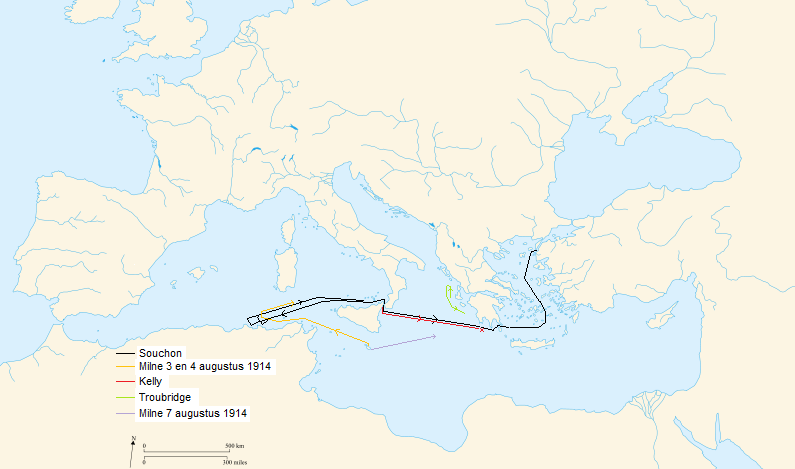
The German Mediterranean squadron, commanded by Rear Admiral Wilhelm Souchon, consisted of the battlecruiser SMS Goeben and the light cruiser SMS Breslau.

Goeben was armed with 11 inch guns compared with the 12 inch guns of the three British battlecruisers, HMS Inflexible, Indefatigable and Indomitable, in the Mediterranean. However, she had 12 of them compared with eight in the British ships and was faster and better armoured than them. Rear Admiral Ernest Troubridge’s First Cruiser Squadron included four armoured cruisers, HMS Defence, Black Prince, Duke of Edinburgh and Warrior. They were armed with 9.2 inch and either 6 inch or 7.5 inch guns.

 Goeben’s broadside was 6,680 lbs, more than any individual ship, but far less than the combined totals of 15,300 lbs for the British battlecruisers and 8,680 lbs for the armoured cruisers. [2]

Breslau was faster than the four British light cruisers, but was armed with 12 4.1 inch guns compared with HMS Gloucester‘s two 6 inch and 10 4 inch and the other three British ships’ eight 6 inch guns. The British also had 16 destroyers, but they were of the relatively slow Beagle class, the last coal fired British destroyers.

The bulk of the French navy was in the Mediterranean under the command of Vice Admiral Augustin Boué de Lapeyrère. He had been Minister of Marine from 1909-11, producing a coherent plan for the expansion of the French navy after a period in which it lacked a strategy because of frequent change in the Minister of Marine.

De Lapeyrère divided the French Mediterranean fleet, the 1ère armée navale into three group. One consisted of six semi-dreadnoughts, three armoured cruisers and twelve destroyers; the second of a dreadnought, five pre-dreadnoughts, three armoured cruisers and twelve destroyers; and the last of four older pre-dreadnoughts. Its main task at the outbreak of war was to protect the transit of the French XIX Corps from Algeria to France.

Britain and France had agreed that their combined forces in the Mediterranean would be commanded by a French admiral. As Milne was senior to de Lapeyrère, this meant that the British contingent would be commanded at sea by Troubridge. The combined Anglo-French fleet comfortably outnumbered the Austro-Hungarian navy and the German Mediterranean squadron,

The two sides would have been evenly balanced had Italy entered the war on the side of its Triple Alliance, but it declared its neutrality on 2 August. Fear that the long Italian coastline was vulnerable to Anglo-French naval attacks was a factor in this decision. It was justified on the grounds that the alliance was defensive and Austria-Hungary was the aggressor in the war.

Robert Halpern describes Italian neutrality in 1914 ‘as being one of their biggest services to the British and French during the war.’[3] See this post for the naval balance in 1914.

Milne was told by the Admiralty on at 12:55 pm on 3 August that ‘the Italian Government have declared neutrality. You are to respect this neutrality rigidly and should not allow any of H.M. ships to come within 6 miles of the Italian coast.’[4]

As well as meaning that his fleet was outnumbered, Italian neutrality restricted the options open to the Austro-Hungarian fleet commander Admiral Anton Haus. He could have moved his fleet into the Mediterranean had Italy been allied to Austria-Hungary, but the location of its only major base at Pola, now Pula in Croatia, meant that it was now restricted to the Adriatic.

The Chief of the Austrian General Staff Field Marshall Franz Conrad von Hötzendorff, supported by Foreign Minister Count Leopold Berchtold, wanted the fleet to move to the Black Sea to operate against the Russians. He feared that it would soon be destroyed by the Anglo-French fleet. Haus rejected this: his fleet would lack bases, coal stocks and a fleet train in the Black Sea; the Allies might destroy it in transit; and the Austro-Hungarian Adriatic coast would be left unprotected.

Goeben was at Pola undergoing repairs to her boilers when Austria-Hungary declared war on Serbia on 28 July. Souchon, according to Robert Massie, did not want to be ‘subordinate to an Austrian admiral not inclined to fight Britain and France.’[5] He therefore sailed the next day with the repairs incomplete. He had difficulties obtaining coal from Italian ports, but replenished his supplies from German merchant ships at Messina.

On the evening of 3 August, the day that Germany declared war on France, Goeben and Breslau fired the first shots of the naval war when they bombarded the French ports of Philippeville and Bône in Algeria.

Souchon’s subsequent options appeared to be to attempt to exit the Mediterranean via the Straits of Gibraltar or to return to Pola, possibly first attacking the French troop transports.

Unknown to the Allies, Germany and the Ottoman Empire had signed an alliance on 2 August. In the early hours of 4 August Souchon received a signal ordering him to make for Constantinople, now Istanbul. Goeben did not have enough coal to make the voyage at its normal cruising speed, so he ordered a return to Messina to refuel.

Milne, aware that the German had been at Taranto, guessed correctly that she would then make for Messina, but they had left by the time that the light cruiser HMS Chatham arrived. At 6:30 pm [times quoted are local unless otherwise stated] he was ordered that ‘two battle-cruisers must proceed to Straits of Gibraltar at high speed ready to prevent Goeben leaving Mediterranean.’[6]

At 10:46 am on 4 August Indomitable and Indefatigable reported that they had sighted Goeben and Breslau. Britain and Germany were not yet at war, but the British ships, later joined by the light cruiser HMS Dublin, tailed the German ones. The British battlecruisers could not keep up with the Germans, losing sight of them at 5 pm. Dublin stayed in touch with them until 10:25 pm.[7]

The British vessels needed their hulls to be de-fouled and their engines overhauled. They had peace rather than war complements, which meant that they were short of stokers. Coal fired ships needed more stokers in order to maintain full speed, so carried more in wartime than in peacetime.

Indomitable reported that the Germans were making 26-27 knots.[8] Arthur Marder says that Goeben ‘managed to increase her speed to 24 knots for a short period. Her mean speed from noon to 8 pm was 22.5 knot.’[9] This exaggeration of the speed of the German ships would have consequences later.

War between Britain and Germany began at 11 pm British time (midnight Central European) on 4 August, but neither Britain nor France was yet at war with Austria-Hungary.

The German ships reached Messina in the early hours of 5 August. Milne argued that his orders to stay more than six miles from the Italian coast meant that he could not follow the Germans into the straits of Messina because they were only two miles wide. He further claimed that the Germans could have escaped from any ship more than six miles from the Italian coast because of their greater speed.

Milne expected Souchon move north out of the Straits of Messina, head west and attack the French troop transports. Alternatively, he could take the south exit and head for the Adriatic.

Milne took his flagship HMS Inflexible to join Indefatigable well to the west of the Straits of Messina. Indomitable was sent to Bizerte to refill her coal bunkers. Troubridge and his armoured cruisers were near Corfu in case Souchon headed for the Adriatic. The light cruiser HMS Gloucester was the closest British warship to Messina, covering the south exit.

At 10 am on 6 August Indomitable informed Milne that ‘[t]he French Admiral reports first transport left Algerian coast and French Fleet will not probably be free until 10th August as second shipment is necessary.’[10]

Milne appeared not to realise that the troopships were now sufficiently protected since at 4:33 pm he offered the French the assistance of ‘two battle-cruisers and 1 light cruisers’ if the Germans had sailed undetected.[11]

Souchon sailed at 5:00 pm. His plan was to feint towards Pola, before turning towards Constantinople after dark. Half an hour after issuing his orders he was informed by the German Admiralty that ‘[a]rrival Constantinople not possible for political reasons’, but decided to go ahead anyway.[12]

Milne was informed of the German departure by Gloucester at 6:16 pm.[13] He then headed west, as his orders prevented him entering the Straits of Messina and the Germans might still turn west towards the transports after exiting the southern end of the Straits.

Too late, a signal from the Admiralty told him that ‘[i]f Goeben goes south from Messina, you should follow through the Straits, irrespective of territorial waters.’[14] It was sent at 7:45 pm, but not received until 10:54 pm.

Gloucester, under the command of Captain Howard Kelly, followed the Germans as Goeben tried to sail as quickly as possible. Kelly managed to keep his superiors informed of the German movements despite their attempts to jam his ship’s wireless transmissions, Souchon did not know that Gloucester was alone, so could not take the chance of turning back to sink her.

Unknown to Souchon, the risk of a major action had already passed. Troubridge, with his four armoured cruisers and eight destroyers, was positioned off Cephalonia, south of Corfu. However, his destroyers were short of coal. The light cruiser Dublin, captained by Howard Kelly’s brother John, and the destroyers HMS Beagle and Bulldog were on the way to join him. John Kelly intended to be in position to attack Goeben at 3:30 am on 7 August, but his ships failed to find the enemy.

Troubridge at first assumed that Souchon was heading for the Adriatic and that he was heading south in order to shake off Southampton. He headed north, with the intention of engaging them in narrow waters where he could choose his range.

At midnight, however, he realised that the Germans were going to the eastern Mediterranean. He could intercept them, but the action would take place in daylight. E. W. R. Lumby says that Troubridge believed that his squadron could defeat the enemy only ‘by night, in half light, or in narrow waters.’[15]

Troubridge had earlier told Milne that ‘I consider a battle-cruiser to be a superior force to a cruiser squadron, unless they can get within their range of her.’ Milne replied ‘That question won’t arise as you will have the Indomitable and Indefatigable with you’, which in the event he did not.[16]

Although he thought that to do so would break his orders not to engage a superior force, Troubridge had reluctantly decided to attack, telling his Flag Captain Fawcet Wray at 2:45 am on 7 August that ‘[t]he Mediterranean [Fleet] will stink if we don’t attack her.’ He later explained to his court martial that thought that the Fleet ought not to have allowed Goeben to escape from the Straits of Messina.

However, at 3:30 am Wray persuaded Troubridge that engaging Goeben was ‘likely to be the suicide of your squadron.’[17] Goeben was faster and had longer ranged guns, so would be able to stand off and destroy the British squadron. At 4:49 am Troubridge signalled to Milne that:

‘Being only able to meet Goeben outside the range of our guns and inside his I have abandoned the chase with my squadron request instructions for light cruisers. Goeben evidently going to Eastern Mediterranean. I had hoped to have met her before daylight.’[18]

Wray later claimed that his advice ‘was not given with the intention of dissuading [Troubridge] from continuing the chase of the Goeben’, stating that ‘I actually remonstrated with him when I realised that he had decided to abandon the chase.’[19] His objection was to the idea that the British squadron might ‘lie across Goeben’s bows and more or less go bald-headed for her.’[20]

Gloucester continued to pursue the enemy. She exchanged fire with Breslau at 1:35 pm. Goeben then joined in, forcing Gloucester to withdraw, but Souchon could not afford to waste coal engaging a light cruiser. Only Breslau was hit, but she suffered no casualties and her speed was unaffected.

Goeben was pushing her machinery and men to the limit. Massie says that leaks of boiling water from her partially repaired boiler tubes meant that ‘[f]our men were scalded to death.’[21] The chase continued until the ships reached Cape Matapan at 4:40 pm. Gloucester was almost out of coal and Kelly had been explicitly ordered by Milne to go no further.

The British still had one chance. Milne took his battlecruisers east, but slowly. On 8 August, the Admiralty erroneously signalled him that Britain was at war with Austria-Hungary. An over-zealous clerk had seen a telegram prepared in advance of the declaration of war and sent it too soon. Milne therefore abandoned the chase until he was informed of the mistake.

The Germans were delayed by Goeben’s need to coal, so Milne might have caught them without the 24 hour delay caused by the telegram error. They reached the Dardanelles on the evening on 10 August, still not knowing if they would be welcome, which they were.

The next evening the British light cruiser HMS Weymouth, sent ahead of the battlecruisers by Milne, was turned away from the Dardanelles after being informed that Goeben and Breslau were now the Ottoman ships Yavuz Sultan Selim and Midilli. They formally changed hands on 16 August, but retained their German crews, who wore fezzes on ceremonial occasions. Souchon was appointed commander of the Ottoman fleet on 23 September.

The presence of these two ships in Turks led the British keeping Indomitable, Indefatigable, Defence, Gloucester and all available destroyers in the eastern Aegean. They were nominally under de Lapeyrère’s command, but effectively the force was separate from the Allied fleet in the rest of the Mediterranean.

Of the British commanders, only Howard Kelly, who was made a Companion of the Bath, came out of this well.

Milne was cleared of any blame, but did not receive another appointment. He had previously been told his next position would be the prestigious Nore Command. This went instead to Admiral Sir George Callaghan, who had been removed from command of the Grand Fleet on the outbreak of war, five months before his term was due to expire. Admiral of the Fleet Lord Fisher, who had previously called Milne ‘a serpent of the lowest order’ when Milne took Admiral Lord Charles Beresford’s side in his feud with Fisher, said that he would ‘have shot Sir Berkeley Milne for the Goeben.’[22]

Milne’s best option would seem to me to have been the one that Marder proposes, namely to close the north exit of the Straits of Messina with two battlecruisers and the south one with the other one and Troubridge’s squadron.[23] Since their guns had a range of over six miles, the ships could have waited outside Italian territorial waters.

Troubridge initially remained in command of the RN forces in the Aegean, but was then called in front of a Court of Inquiry. It sent him for a Court Martial, where he was defended by a leading barrister, Leslie Scott KC MP, and acquitted. This made it hard for the Admiralty to refuse him further employment, but he was giving only shore based jobs. He was knighted and finished his career with the rank of Admiral.

Although Goeben was vastly superior to any of Troubridge’s ships, he had four armoured cruisers, two light cruisers and a number of destroyers. I would agree with Admiral Prince Louis Battenberg, the First Sea Lord, argued that ‘[s]uperior speed (which undoubtedly existed) in a single ship can be nullified by proper tactical dispositions of four units.’[24]

It is difficult to see how Goeben could have kept out of the gun range of all the armoured cruisers and the torpedo range of all the light cruisers and destroyers. Any damage that reduced her speed would have enabled the British battlecruisers to catch her and steaming at full speed during a battle would have used a lot of her coal.

Commenting on Troubridge’s acquittal, Rear Admiral Frederick Tudor, the Third Sea Lord, thought that Troubridge’s ships ‘stood a chance of being severely punished’ if they had attacked. but that it was ‘out of the question’ that Goeben had enough ammunition to destroyed all of them.[25]

One point that perhaps says a lot about the RN’s attitude to ship design is that the arguments over Troubridge’s conduct revolved around the relative speeds, firepower and gun ranges of the ships involved. Little was said about the Goeben’s superior armour.

Wray was, according to Marder, ‘virtually ostracised’ in the RN.[26] However, he received a number of commands during the rest of the war and was awarded the DSO when captaining HMS Talbot in the Dardanelles. He was promoted to Rear Admiral on retirement and later to Vice Admiral on the Retired List.

Finally, the Admiralty must take a lot of blame. It sent a series of confusing orders instead of giving the local commanders all the facts and then leaving them to make the decisions.

Its order to Milne quoted at the beginning of this post told him to avoid battle with ‘superior forces’ but to seek battle Goeben, whilst noting his squadron’s speed. Taken together these comments appear to mean that the ‘superior forces’ were the Austrian battleships, but this was not explicitly stated, resulting in Troubridge concluding that Goeben was a ‘superior force’, with which he should avoid battle.


[1] Admiralty to C.-in-C., 3:10 pm, 30 July 1914 quoted in E. W. R. Lumby, Policy and Operations in the Mediterranean, 1912-14 (London: Navy Records Society, 1970), p. 146. Orginal source National Archives ADM 137/19

[2] Figures from A. J. Marder, From the Dreadnought to Scapa Flow; the Royal Navy in the Fisher Era, 1904-1919, 5 vols. (London: Oxford University Press, 1961-70). ii, p. 21

[3] P. G. Halpern, A Naval History of World War I (London: UCL Press, 1994), p. 52.

[4] Admiralty to C.-in-C. and Admiral Superintendent, Malta, 12:55 pm 3 August 1914 quoted in Lumby, Policy, p. 157. Original Source ADM 137/19.

[5] R. K. Massie, Castles of Steel: Britain, Germany, and the Winning of the Great War at Sea (London: Jonathan Cape, 2004), p. 27.

[6] Admiralty to C.-in-C. 6:30 pm 3 August 1914 quoted in  Lumby, Policy, p. 153. Original source ADM 137/19.

[7] Times in this paragraphs are from signals quoted in Ibid., pp. 163-64. Original sources Naval Staff Monograph No. 21, The Mediterranean 1914-15, Appendix B.

[8] Signal of 4:10 pm 3 August quoted in Ibid., p. 160. Original source ‘Naval Staff Monograph No. 21’, Appendix B.

[9] Marder, From. ii, p. 23. His source is Hermann Lorey, Der Krieg zur See, 1914-1918. Der Krieg in den turkischen Gewassern (Berlin, 1928-38, 2 vols.), vol. i, pp. 6-7.

[10] Signal of 10:00 am 6 August 1914 quoted in Lumby, Policy, p. 170. Original source ‘Naval Staff Monograph 21’, Appendix B.

[11] Signal of 4:33 pm quoted in Ibid., p. 171. Original source ‘Naval Staff Monograph 21’, Appendix B.

[12] Quoted in J. S. Corbett, H. Newbolt, Naval Operations, 5 vols. (London: HMSO, 1938). i. p. 63.

[13] Signal of 6:16pm 6 August 1914 quoted in Lumby, Policy, p. 172. Original source ‘Naval Staff Monograph 21’, Appendix B.

[14] Signal of 7:45 pm quoted in Ibid., p. 173. Original source ADM 137/19.

[15] Ibid., p. 142.

[16] The Court of Inquiry and the Court Martial 7 September to 9 November 1914 Ibid., p. 367. Original source ADM 156/76

[17] Ibid., p. 324.

[18] Signal of 4:49 am 7 August 1914 quoted in Ibid., p. 181. Original source ‘Naval Staff Monograph 21’, Appendix B

[19] ‘Declaration of Captain Fawcet Wray, 3 August 1917’ Ibid., p. 404. Original source Roskill Paper, which are now ar Churchill Ciollege, Cambridge..

[20] Ibid., p. 406.

[21] Massie, Castles, p. 44.

[22] Quoted in Marder, From. ii. pp. 32-33.

[23] Ibid. ii, p. 24

[24] Ibid. ii, p. 33.

[25] ‘Minutes commenting upon the Court Martial Proceedings, By the Third Sea Lord, 9 December 1914’ Lumby, Policy, p. 398. Original source ADM 156/76.

[26] Marder, From. ii, p. 27, note 5.

14 Comments

Filed under War History

HMS Birmingham Sinks U15 on 9 August 1914

The U-boat became the German navy’s main weapon in both the World Wars of the twentieth century, but Germany was initially slow to adopt the submarine. Holger Herwig notes that Admiral Alfred von Tirpitz, the architect of the German navy, favoured battleships and had little time for either cruiser warfare or submarines.[1] The first U-boat was not completed until late 1906. Rudolf Diesel was German, but the first U-boats with diesel engines were not introduced until 1910. French submarines had used diesel engines from 1904. The switch to the diesel engine meant that the U-boat was considered a potentially decisive weapon for the first time, but against the enemy battle fleet, not merchant shipping.

In 1914 Germany possessed only 24 operational boats. Another four were used for training and 16 were under construction. Only 10 of the operational boats had diesel engines; the others used Körting heavy fuel oil engines that produced a great deal of smoke and sparks. This made them very visible on the surface and required ventilation pipes; stowing these slowed diving.

On 6 August 1914 the German navy sent 10 U-boats into the North Sea, but U9 had to return home early because of engine problems. Two days later the dreadnought HMS Monarch, carrying out gunnery practice near Fair Isle, between Shetland and Orkney, was narrowly missed by a torpedo fired by a U-boat.

Paul Halpern comments that Roger Keyes, then Captain (S), the commander of the RN’s submarines, later wrote ‘that the fact that the Monarch was performing such a task within 500 miles of Helgoland was an example of the navy’s general ignorance of submarine powers and limitations.’[2] The RN had proved in 1910 that its submarines could operate more than 500 miles away from their bases, but apparently did not consider the possibility that the Germans could do the same.

About dawn on 9 August the light cruiser HMS Birmingham, part of a screen 30 miles ahead of the Grand Fleet, observed through the mist a submarine stationary on the surface. The sounds of hammering coming from the submarine, which was U15, suggested that her crew were trying to repair an engine fault.

Birmingham closed the range and opened fire. U15 moved forward slowly, but Birmingham rammed her and cut her in two. U15 sank with all hands. Robert Massie says that 23 men went down with her, although Conway’s All the World’s Fighting Ships 1906-1921 gives her normal crew as 29.[3]

The need for ships meant that only temporary repairs could be carried out to Birmingham at first, so she retained two scars along her bows for some months. U15’s sister boat U13 also failed to return home from the cruise, probably after hitting a mine.

This mission had cost the Germans two U-boats in return for minor, self-inflicted damage to a light cruiser and had shown that the early U-boats were mechanically unreliable. R. H. Gibson and Maurice Prendergast state in the history of the German Submarine War 1914-1918 that:

Not even the hardiest optimist could pretend that the submarine had vindicated its war value by this expedition. Yet, had the Germans known, the effect of the cruise had caused uneasiness to their opponents…it was confidently predicted by some – but not by naval officers – that all other U-boats would soon follow U15 to the bottom.[4]

As soon as the requirement to cover the crossing of the British Expeditionary Force to France was over, Admiral Sir John Jellicoe withdrew his Grand Fleet north west of Orkney. Future sweeps into the North Sea were carried out as quickly as possible.

Jellicoe was concerned that Scapa Flow was poorly defended, so ordered the preparation of a secondary base at Loch Ewe on the west coast of Scotland. Halpern notes that ‘Jellicoe actually felt safer at sea than he did in Scapa Flow.’[5]

This German cruise featured the first attack by a submarine launched torpedo on a moving warship. The Turtle, which made several unsuccessful attacks on British ships in the American War of Independence, and the CSS Hunley, which sank the USS Housatonic in the American Civil War, attacked by attaching explosive devices to the hulls of stationary ships. U15 was the first submarine to be sunk by an enemy ship in the war.

[1] H. H. Herwig, ‘Luxury’ Fleet: The Imperial German Navy, 1888-1918 (London: Allen & Unwin, 1980), p. 88.

[2] P. G. Halpern, A Naval History of World War I (London: UCL Press, 1994), p. 29.

[3] R. Gray, Conway’s All the World’s Fighting Ships, 1906-1921 (London: Conway Maritime Press, 1985), p. 175; R. K. Massie, Castles of Steel: Britain, Germany, and the Winning of the Great War at Sea (London: Jonathan Cape, 2004), p. 79.

[4] R. H. Gibson, M. Prendergast, The German Submarine War, 1914-1918. (London: Constable, 1931), pp. 3-4.

[5] Halpern, Naval, p. 29.

5 Comments

Filed under War History

First British Action and Casualties of WWI 6 August 1914

Most of the hits on the first page of a Google search on ‘first British casualty of wwi’ state that it was Private John Parr of the 4th Battalion of the Middlesex Regiment, who was killed on 21 August 1914. The Daily Mail reports that Henry Hadley, a languages teacher working in Berlin in 1914, was shot by a German soldier on 3 August after an argument on a train that was taking him out of Germany. He died at 3:15 am German time on 5 August, three and a quarter hours after Britain declared war.

Only the Great War Forum states, correctly, that the first British servicemen to by killed by enemy action in the First World War were members of the crew of HMS Amphion, which struck a mine and sank at 6:30 am on 6 August with the loss of about 150 men. The poster Crooneart says that the first dead are considered to be Stokers 1st Class Jesse Foster and Albert Martin,  Stoker 2nd Class William Dick and Leading Stoker Henry Copland, who are all given as dying at 6:30 am on 6 August. Presumably they were in the part of the ship closest to the explosion and were killed instantly.

To be fair to Wikipedia, its entry on Parr does link to its entries on Amphion and Hadley, but the other sites produced by the search appear to assume that first British casualty means first British soldier killed, ignoring naval casualties.

At dawn on 5 August, the Harwich Force of two destroyer flotillas, supported by armoured cruisers and submarines, sailed on a sweep towards the Dutch coast. Captain H. C Fox, captain of Amphion, was in command of the 3rd Destroyer Flotilla. At 10:15 am a British trawler informed the destroyer HMS Laurel that it had seen a ship ‘throwing things overboard’[1]

Correctly assuming that the ‘things’ were mines, Fox ordered his flotilla to spread out and search for the suspicious ship. The destroyers HMS Lance and Landrail sped ahead to the point at which the trawler had seen her. Around 11 am they spotted the German minelayer Königin Luise, which in peacetime ferried passengers between Hamburg and Heligoland. She was painted in the colours of  a British steamer of the Great Eastern Railway.

Lance and Landrail, supported by Amphion, gave chase and sank Königin Luise by noon. This was the first ship to be sunk in the war and the first casualties to be inflicted on the enemy by British. The shots fired were not, however, the first ones of the naval war; the German Mediterranean squadron of the battlecruiser SMS Goeben and the light cruiser SMS Breslau had bombarded the French ports of Philippeville and Bône in Algeria on the evening of 3 August.

On the way back to Harwich Amphion spotted another steamer in Great Eastern Railway colours, this one flying a German flag. The flotilla opened fire, but the steamer then raised the British Red Ensign. She was the Great Eastern Railway steamer St Petersburg and was carrying the German ambassador, his wife and staff to the neutral Netherlands on their way back to Germany. The destroyers initially ignored Fox’s orders to cease fire, and he had to place Amphion between them and the St Petersburg in order to stop them firing.

At 6:30 am on 6 August Amphion struck one of Königin Luise’s mines. The crew were ordered to abandon ship, but she hit another mine almost immediately and sank quickly. As well as about 150 of her own men, 18 survivors of Königin Luise went down with Amphion.


[1] Quoted in J. S. Corbett, H. Newbolt, Naval Operations, 5 vols. (London: HMSO, 1938) vol. i, p. 38.

1 Comment

Filed under War History

The Naval Balance of Power in 1914

In 1914 the British Royal Navy (RN) remained the largest in the world. Admiral Alfred von Tirpitz, supported by Kaiser Wilhelm II, had attempted to create a German navy that could match the RN, but the British had comfortably maintained their lead in the subsequent naval arms race.

Britain had traditionally aimed to have a navy that was equal in strength to the next two in the world, the two power standard. In 1912 this was replaced by a measure of a 60 per cent superiority to the second largest navy. This was then the German navy; Germany was the only one of the world’s leading naval powers that Britain was then likely to fight.

The Press, public and politicians measured the strength of navies by the number of dreadnought battleships and battlecruisers. However, navies also had a large number of other types of warships.

Naval Strengths in August 1914

Naval strength 1914

Source: P. G. Halpern, A Naval History of World War I, (London: UCL Press, 1994), pp. 7-20.

British numbers include the Royal Australian Navy’s battlecruiser and three light cruisers and three dreadnoughts being built in Britain for foreign countries that were requisitioned for the RN at the outbreak of war; two that had just been completed for the Ottoman Empire and a Chilean one that was still under construction. There were fears that the Ottoman ones might be sold to Germany, which would have left the RN below its target of a 60 per cent margin over Germany. Another Chilean dreadnought under construction in Britain that was completed as a British aircraft carrier is not included.

German numbers include a dreadnought that was never completed and a battlecruiser and a light cruiser that were transferred to the Ottoman Empire just after the outbreak of war. The German SMS Blücher is classified as an armoured cruiser above because she was armed with 8.2 inch guns. In the words of Robert Massie, she ‘was the supreme embodiment of the armoured cruiser.’[1]

Russia needed three separate fleets. Its Asian one was small and consisted mostly of old ships. The Baltic and Black Sea ones contained all the battleships, armoured cruisers and planned dreadnoughts. The Baltic fleet was the biggest.

One of the Japanese battlecruisers building was completed in August 1914. Nine small and old US submarines, based in the Philippines, that were suitable only for coastal defence are excluded. Some numbers are given as ranges because of doubts over the usefulness of some older vessels. The only other countries with dreadnoughts were Brazil and Argentina, with two each, and Spain, which had one in service and two more building.

Warship Types

Pre-dreadnought battleships carried a number of guns of differing calibres, which were intended to carry out different roles. They normally had a main armament of four 12 inch guns, although some had smaller but faster firing main guns. A secondary battery, most commonly of 6 inch guns, although some had smaller or larger guns, was intended to deal with smaller opponents. Some pre-dreadnoughts carried an intermediate battery of 8-10 inch guns in order to increase their firepower against enemy battleships.

Pre-dreadnoughts were made obsolete in 1906 by HMS Dreadnought, which carried an armament of 10 12 inch guns, supplemented by only 24 12 pounders to deal with torpedo boats. A single calibre armament was both more powerful than a mixed one and superior for fire control purposes. The range of guns was increasing, making the old tactic of overwhelming ships with a hail of fire from many guns at short range obsolete. She was the first battleship to be powered by steam turbines and the first to be constructed to burn a mixture of fuel and oil, although others had been converted to do so. She was capable of 21 knots, fast for a battleship.

Dreadnought’s secondary armament proved to be inadequate. The next British battleship, HMS Bellerophon, carried 16 4 inch guns and later dreadnoughts had secondary armaments of 6 inch guns.

Although Dreadnought made British as well as foreign battleships obsolete, the decision of Admiral Sir John ‘Jacky’ Fisher, the First Sea Lord, to move first ensured that Britain maintained its naval supremacy. Most subsequent battleships were dreadnoughts, but some that took on many of Dreadnought’s innovations but retained a mixed armament were built. These were known as semi-dreadnoughts.

Armoured cruisers were large ships with an armoured belt protecting their sides and an armoured deck. They were faster than battleships, but had weaker armour and a main armament of 8-10 inch guns. Protected cruisers were an old and smaller type that had armoured decks but no side belts.

HMS Dreadnought was followed by HMS Invincible, generally regarded as the first of a new type, the battlecruiser. She had a battleship armament of 12 inch guns, but was faster and more lightly armoured. Fisher, who thought that speed was a better protection than armour, saw the battlecruiser as the eventual successor to the battleship. Nicholas Lambert and Jon Sumida argue that he intended to use torpedo armed destroyers and submarines for home defence, with battlecruisers protecting Britain’s global trade.[2] This idea was not supported by his successors.

Invincible was originally rated as an armoured cruiser, but the term battlecruiser was later adopted because of the main armament of these ships was the same size as that of battleships. Previous armoured cruisers carried smaller guns than pre-dreadnought battleships. Only Germany and Japan followed Britain in building battlecruisers, although other navies planned to do so.

The RN, needing reconnaissance ships, built 4 inch gun armed scout cruisers for a period, but these proved to be too small and slow. They were succeeded by light cruisers, originally called light armoured cruisers because they had some armour. British ones had either a main armament entirely of 6 inch guns or a mixture of 4 and 6 inch guns. Germany moved from 4.1 to 5.9 inch guns as the main armament of its light cruisers in 1914.

Torpedo boats were introduced in the late nineteenth century as cheap vessels that could attack battleships with the newly invented motorised torpedo. The torpedoes used in the American Civil War were static weapons that were renamed mines after the development of the motor torpedo.

Destroyers, originally called torpedo boat destroyers, were developed to defend battle fleets. The two types eventually merged. The rapid development of warships in the early twentieth century meant that the oldest destroyers were slower than the newest battlecruisers.

Submarines were in their infancy and views differed over their utility and employment. Should they be used to attack enemy battle fleets, to raid enemy commerce or just for coastal defence?

Coast defence ships were small, slow and short ranged battleships. Navies also had many smaller vessels, not listed above, that were used for tasks such as minesweeping, trade protection, shore bombardment and colonial policing. The British used armed merchant cruisers for trade protection and blockade duties during the war, and the Germans armed merchantmen as commerce raiders.

The older ships were very vulnerable to underwater attack by torpedoes and mines and the older cruisers were too slow to perform scouting duties. However, the RN, which had a large superiority in older ships, found them to be very useful for blockade and trade protection and in secondary theatres.

The Royal Navy versus the German Navy

British dreadnoughts generally had larger guns than contemporary German ones, initially 12 versus 11.1 inch guns, then 13.5 versus 12 inch guns. Britain laid down its first 15 inch gun armed ships in 1912 and had 10 building at the start of the war. Germany followed in 1913, but had only three under construction at the outbreak of war, one of which was never completed. Most other countries armed their dreadnoughts with 12 inch guns, but the first 14 inch armed Japanese and US ones entered service in 1914.

British ships were mostly faster but worse protected than equivalent German ones. The German propellant was more stable than the British one and British shells had a tendency to break up on contact with armour. The British have often been criticised for the poor anti-flash protection for their magazines. However, the Germans initially made the same mistake, which they corrected after the battlecruiser SMS Seydlitz almost blew up at the Battle of Dogger Bank in 1915.

Before the war Arthur Pollen, a British civilian, had designed a fire control system using an analogue computer to predict ranges. Andrew Gordon describes it ‘as important a development for gunnery as John Harrison’s chronometer had been for navigation 150 years before.’[3] It allowed for frequent changes in range and bearing, so ships equipped with it would not have to remain in line ahead formation.

The British instead adopted a cheaper system designed by Captain Frederick Dreyer. It used parts of Pollen’s system to plot bearings mechanically, but still required manual input of ranges, meaning that ships had to stay in straight lines. The RN was also slow to adopt Admiral Sir Percy Scott’s system of director firing, in which one officer controlled the main armament. Only eight battleships had it at the start of the war and two of the Grand Fleet’s dreadnoughts still lacked at the Battle of Jutland in 1916.

However, the Germans had nothing comparable to Dreyer’s system, never mind Pollen’s. They did have a system of director firing, but their main gunnery strength was their stereoscopic sights. These, according to Arthur Marder, required a man with ‘excellent and identical vision in both eyes’, but were superior to the British ones, especially in poor light.[4]

Another British weakness was that the RN’s main bases of Plymouth, Portsmouth and Chatham were positioned for a war with France rather than Germany. A new major base at Rosyth, on the Firth of Forth, was not ready in 1914. For much of the war, it was used only by the battlecruisers. The anchorages at Cromarty and Scapa Flow had no protection against submarines and Harwich was suitable only for light forces. The Kiel Canal allowed Germany to quickly and safely move its ships between the North and Baltic Seas.

The RN’s biggest advantage, apart from numbers, was that its sailors were long service professionals and thus better trained and more experienced than the three year conscripts who made up a large proportion of German naval personnel. The large British merchant navy provided a further source of trained seamen. Tirpitz had thought that conscription would be an advantage for Germany because it would be able to recruit more sailors than Britain, but he was wrong.


[1] R. K. Massie, Castles of Steel: Britain, Germany, and the Winning of the Great War at Sea (London: Jonathan Cape, 2004), p. 381.

[2] N. A. Lambert, Sir John Fisher’s Naval Revolution (Columbia, SC: University of South Carolina Press, 1999); J. T. Sumida, In Defence of Naval Supremacy: Finance, Technology and British Naval Policy, 1889-1914 (Boston MA, London: Unwin Hyman, 1989).

[3] G. A. H. Gordon, The Rules of the Game: Jutland and British Naval Command (London: John Murray, 1996), p. 351.

[4] A. J. Marder, From the Dreadnought to Scapa Flow; the Royal Navy in the Fisher Era, 1904-1919, 5 vols. (London: Oxford University Press, 1961-70). vol. i. p. 416.

12 Comments

Filed under War History

The Naval Arms Race Before 1914

In 1914, the British Royal Navy (RN) had dominated the world’s oceans for over a century. There were, according to Paul Halpern, periods in the nineteenth century when the ‘innovative’ French navy was able to offer ‘a credible threat’, but this was no longer the case by the end of the nineteenth century.[1]

British naval strategy was based on the two power standard, meaning that the RN should be as strong as the next two navies combined. In 1818 Lord Castlereagh, the Foreign Secretary, stated that a Franco-Russian alliance was the ‘only one that can prove really formidable to the liberties of Europe.’[2]

According to Arthur Marder, the two power standard dated back to 1770. It was not, however, clearly stated to be an official policy until the Naval Defence Act of 1889; the First Lord of the Admiralty, Lord George Hamilton, then told the House of Commons ‘that our [naval] establishment should be on a scale that it should be at least equal to the naval strength of any two other countries.’[3]

The Admiralty insisted that the calculation of the relative strengths of navies was a complex exercise, involving many factors. However, it was easier for politicians and the public to gauge the two power standard by a comparison of the number of battleships possessed by the RN and the next two largest navies, which were then those of France and Russia.

The increase in the size of the German navy meant that in October 1902 Lord Selborne, the First Lord, asked for ‘equality plus a margin’, defined as an RN equal to the French and Russian navies plus six battleships and 14 armoured cruisers by December 1907.[4]

Kaiser Wilhelm II of Germany was a keen reader of the works of the American naval theorist Admiral Alfred Mahan. Wilhelm believed that Germany needed a large navy in order to be able to be taken seriously as a world power. In 1897 he settled a dispute about the future shape of the German navy by replacing Admiral Friedrich von Hollman, an advocate of a fleet of fast commerce raiders, with Admiral Alfred von Tirpitz as Secretary of State for the Imperial Navy Office. Tirpitz’s preference for a battle fleet that could challenge the RN in European waters was in tune with Wilhelm’s own wishes.

The size of the German navy was determined by series of Naval Laws, passed in 1898, 1900, 1906, 1908 and 1912. Tirpitz believed that Germany could build a fleet that would certainly deter and perhaps even defeat the RN. Germany had a bigger economy, its use of conscription would mean that it could recruit more sailors than Britain, which relied on volunteers, and the RN’s global commitments meant that it could not keep all its fleet in home waters. Tirpitz aimed at a 2:3 ratio between the German navy and the RN.

Wilhelm and Tirpitz hoped that, even if the German navy was not big enough to defeat the RN, the Germans should be able to inflict such damage on the RN that it would not be to defend the British Empire. This should mean that Britain would make concessions in colonial disputes; German attempts to expand their overseas empire had run into the problem that they had little to offer the other colonial powers in negotiations about matters outside Europe.

Tirpitz failed to realise that the British would make sure that they maintained the margin that they needed in order to retain their naval supremacy. Admiral Sir John ‘Jacky’ Fisher, appointed First Sea Lord in 1904, carried out a large number of reforms that made the RN more efficient. The Naval Estimates fell from £36.9 million in 1904-5 to £31.5 million in 1906-7, but the RN increased in fighting power.

One of Fisher’s innovations was the construction of HMS Dreadnought, the world’s first battleship with a main armament of a large number of big guns of the same size and the first with turbine engines. Previous battleships, henceforth called pre-dreadnoughts, had a small number of big guns and a greater mixture of gun calibres. She made all other battleships obsolete, which might appear to be a disadvantage for Britain, which was starting from a position of dominance.

However, all big gun battleships were being considered in other countries: the USS South Carolina was designed before Dreadnought, although built later; the Japanese HIMS Satsuma, laid down before Dreadnought, was originally intended to have an all big gun armament, but this had to be changed because of shortages of 12 inch guns; and the Italian designer Vittorio Cuniberti had published plans for an all big gun battleship.

By moving first, Fisher ensured that Britain seized an early lead. The RN had seven dreadnoughts and three battlecruisers, faster ships with the armament of a dreadnought but inferior armour, by May 1910, when the first two German dreadnoughts were completed. The United States Navy then had four dreadnoughts, two of which were inferior to any of the British dreadnoughts. No other navy had any.

The Liberal government elected in the UK in 1905 had hoped to cut defence spending in order to finance greater social spending. However, the growth in the size of the German navy meant that the British Naval Estimates had to be increased to £35.7 million in 1909-10, with further rises in subsequent years.

David Lloyd George, the Chancellor of the Exchequer, increased taxes significantly in his 1909-10 budget. It was popularly known as the ‘People’s Budget’ because it was claimed that the higher taxes on the well off were intended to finance social reform. However, the tax increases allowed both social and defence spending to rise, meaning that the RN continued to maintain its margin over the German navy.

Christopher Clark argues that ‘British policy makers were less obsessed with, and less alarmed by, German naval building than is often supposed.’[5] Britain wanted to remain the dominant naval power and focused on all its potential naval rivals, not just Germany. The Entente Cordiale signed with France in 1904 and the Anglo-Russian Convention of 1907 were intended to iron out potential colonial disputes.

Since the passing of Tirpitz’s first Naval Law in 1898, the naval balance of power had changed. Britain signed an alliance with Japan in 1902, allowing it to reduce the size of its fleet in the Far East. The Russians then suffered disastrous naval losses in their defeat in the Russo-Japanese War in 1904-5.

The French navy slipped to fourth place because of a lack of a coherent naval policy. Ministers of Marine did not stay long in office and Conway’s All the World’s Fighting Ships 1906-1921 notes that each one’s ‘chief aim in office was probably to undo their predecessor’s work.’[6]

In March 1912 Winston Churchill, the First Lord, announced that the strength of the RN would now be based on a 60 per cent superiority over the German navy. Eric Grove notes that ‘this is often seen as a concession of weakness but, given the size of other fleets, in effect was still a two power standard.’[7]

If the difference between the German fleet and the third biggest one, then the USN, was big enough, one + 60 per cent might put produce a larger RN than the two power standard. Moreover, the USA and Germany, unlike France and Russia in the 1890s, were unlikely to combine.

The month before Churchill’s statement, Lord Haldane, the Secretary of State for War, who had attended Göttingen University, had visited Germany in an attempt to negotiate an end to the Anglo-German naval race. His mission failed, because Germany wanted Britain in return to promise to remain neutral in any war between Germany and another European country in which Germany was not the aggressor. Britain had, according to Christopher Clark ‘an understandable disinclination to give away something for nothing: Britain was winning the naval arms race hands down and enjoyed unchallenged superiority.’[8]

The following table shows the average annual naval expenditure of the leading naval powers in the years leading up to the war. Germany and Austria-Hungary had shorter coastlines and fewer bases, so were able to spend a higher proportion of their total expenditure on construction. The USA had many bases, partly because of its long coastlines but mainly because, in the words of Phillips O’Brien, politicians ‘still looked upon the navy as a source of money for their constituents and not as a vital arm of national defence.’[9]

Great Powers Average Naval Expenditure p.a. 1910-14

Great Powers naval expenditure

Source: I. Johnston, I. L. Buxton, The Battleship Builders: Constructing and Arming British Capital Ships (Barnsley: Seaforth, 2013), p. 236.

The naval balance of power in 1914 is the subject of the next post in this series.


[1] P. G. Halpern, A Naval History of World War I (London: UCL Press, 1994), p. 1.

[2] Quoted in E. Grove, The Royal Navy since 1815 : A New Short History (Basingstoke: Palgrave Macmillan, 2005), p. 2.

[3] Quoted in A. J. Marder, From the Dreadnought to Scapa Flow; the Royal Navy in the Fisher Era, 1904-1919, 5 vols. (London: Oxford University Press, 1961-70). vol. i, p. 123.

[4] Quoted in Grove, Royal Navy, p. 87.

[5] C. M. Clark, The Sleepwalkers: How Europe Went to War in 1914 (London: Penguin, 2013), p. 149.

[6] R. Gray, Conway’s All the World’s Fighting Ships, 1906-1921 (London: Conway Maritime Press, 1985), p. 190.

[7] Grove, Royal Navy, p. 102.

[8] Clark, Sleepwalkers, p. 319.

[9] P. P. O’Brien, British and American Naval Power: Politics and Policy, 1900-1936 (Westport, CT: Praeger, 1998), p. 65.

3 Comments

Filed under Political History, War History