Tag Archives: army

The Battle of Montereau 18 February 1814.

Napoleon defeated Prince Gebhardt von Blücher’s Army of Silesia at the Battles of Champaubert, Montmirail, Château-Thierry and Vauchamps between 10 and 14 February 1814. However, Prince Karl Phillip zu Schwarzenberg’s Army of Bohemia had taken the offensive in the Seine sector.

Napoleon’s original plan had been to attack Schwarzenberg’s lines of communication once he had dealt with Blücher. However,. By 15 February it was clear that the French forces facing Schwarzenberg would not be able to hold his advance on Paris for the two to three days that this manoeuvre would take to organise. David Chandler points out that Napoleon ‘could not ignore a direct threat to Paris, and consequently had to adopt a less decisive plan.’[1]

Click here for a campaign map from West Point’s website and here for a map of the Battle of Montereau.

Napoleon left the corps of Marshals Édouard Mortier and Auguste de Marmont to cover Paris in case Blücher resumed the offensive. He took the Imperial Guard and General Emmanuel de Grouchy’s cavalry 47 miles south in 36 hours, with some of his infantry travelling in wagons and carts. He entered Gugnes at 3pm on 16 February.

Including the troops that were already in the Seine sector, Napoleon now had 60,000 men with which to attack the Army of Bohemia. He was heavily outnumbered, but Schwarzenberg’s four corps were widely spread. General Friedrich von Bianchi’s Austrians, General Karl Phillip von Wrede’s Bavarians, Prince Ludwig Pyotr Wittgenstein’s Russians and the Württembergers under their Crown Prince, were advancing along separate roads. Poor connecting roads, mud and the Seine made it hard for them to stay in contact with each other.

Wittgenstein, on the Coalition right (northern) flank had pushed on ahead of the rest of the Army of Bohemia. On 17 February its 4,300 strong advance guard, under General Pyotr Pahlen, was overwhelmed at Mormant by Napoleon’s advance guard, commanded by General Maurice-Etienne Gérard, with supported from Grouchy. Gérard and Grouchy then forced Wrede’s advance guard to retreat from Valjouan. [2]

Marshal Claude Victor’s corps was supposed to have taken part in these two actions, but moved slowly. Victor, Gérard and Grouchy, along with General Claude-Pierre Pajol’s cavalry, were then ordered to advance quickly to Montereau. Napoleon wanted to beat the retreating Army of Bohemia to Troyes.

Victor had been ordered to reach Montereau at 6 am on 18 February, but paused overnight, allowing the Württembergers time to prepare their defensive position. The first French troops to arrive were 1,500 cavalry, 3,000 National Guards and 800 gendarmes under Pajol. They were poorly trained, and were unable to make any progress against the Württemberg corps of 8,500 infantry, 1000 cavalry and 26 guns.

Victor’s advance guard did not arrive until 9 am. His initial attacks were unsuccessful. Napoleon, angry at his tardiness, replaced him with Gérard. Napoleon and the Guard arrived at 3 pm. The French now had 30,000 men and 70 guns on the field, and the Württembergers withdrew in the face of new attacks. They lost 5-6,000 men, 3,400 of them being captured, and 15 guns. French casualties were 2,500 killed and wounded.

The defenders had the Seine behind them, with only one bridge to retreat across. A final French cavalry charge, in which Pajol was so severely wounded that he took no further part in the war, captured both the Seine bridge and one over the Yonne before the Württembergers could blow them. F. Loraine Petre suggests that they should have retreated and destroyed the Seine bridge as soon as they were attacked, but Schwarzenberg had ordered them not to do so.[4]

On the same day the French reached the Seine at Nogent and Bray, only to find the bridges had been blown. As they then had no bridging train, the capture of the bridge at Montereau was vital. They also took a bridge over the Yonne as after the battle of Montereau.

Schwarzenberg now ordered his army to retreat to Troyes, less Wittgenstein’s corps, which was to link up with Blücher at Méry by 21 February. Napoleon, who now had 75,000 men with him, pursued rapidly with the intention of fighting Schwarzenberg near Troyes on 23 February. Schwarzenberg had 90,000 troops and Blücher 50,000. However, Alexander Seslavin, a Cossack commander regarded as ‘very reliable’ by his superiors, had reported that Napoleon now had 180,000 men.[5]

Petre notes that Schwarzenberg was worried about ‘the incalculable results of defeat.’[6] He was also concerned by the threat to his line of retreat of from Marshal Pierre Augereau’s corps in the south, ‘unnecessarily’ according to Chandler. Schwarzenberg therefore decided to withdraw his army to Troyes. He ordered Blücher to retreat his army, including Wittgenstein’s corps, across the Marne.

Chandler contends that ‘Schwarzenberg’s inglorious but probably justifiable caution thwarted Napoleon of a decisive action.’[7] He goes on to argue that the Emperor had outmanoeuvred and outfought two enemy armies that both outnumbered him, but could not win a military victory because he lacked the necessary manpower and France was war-weary.[8]

Napoleon could probably have now agreed a peace settlement that would have left him Emperor of France within its 1792 borders. He had reluctantly allowed his foreign minister, the Marquis de Caulaincourt, to negotiate on that basis after his defeat at La Rothière on 1 February. However, his subsequent victories meant that he was prepared to accept nothing less than France’s natural frontiers, stretching to the Rhine, and perhaps even wanted to keep Italy. He told his brother Joseph that:

If I had accepted the historical borders I would have taken up arms again two years later, and I would have said to the nation that this was not a peace that I had signed but a forced capitulation.[9]


[1] D. Chandler, The Campaigns of Napoleon (London: Weidenfeld & Nicolson, 1966), p. 978.

[2] Troop strengths in this and the previous paragraph are from are from Ibid.

[3] French casualties are from Ibid., p. 980, which says that Württemberg casualties were 6,000. Other numbers in the last two paragraphs are from F. L. Petre, Napoleon at Bay 1814 (London: John Lane, The Bodley Head, 1914), pp. 83-85.

[4] Ibid., p. 85.

[5] Ibid., p. 88.

[6] Ibid., p. 89.

[7] Chandler, Campaigns, p. 981.

[8] Ibid., p. 982.

[9] Quoted in D. C. B. Lieven, Russia against Napoleon: The Battle for Europe, 1807 to 1814 (London: Penguin, 2010), p. 490.
1 Comment

Filed under War History

The Battle of Vauchamps 14 February 1814

Napoleon defeated two corps of Prince Gebhardt von Blücher’s Army of Silesia at the Battle of Montmirail on 11 February 1814. However, he soon learnt that Prince Karl Philipp zu Schwarzenberg’s Army of Bohemia had taken the offensive in the Seine sector, so prepared to move his army south in order to meet this threat.

Click here for a campaign map from West Point’s website.

Blücher, on learning of Schwarzenberg’s actions, guessed correctly that the Napoleon would head south. He therefore ordered his other two corps, commanded by Generals Friedrich Kleist and Petr Kaptsevich, to advance with the intention of threatening Napoleon’s rear. They totalled about 20,000 infantry and 2,000 cavalry.[1]

Marshal Auguste de Marmont’s 4,000 men, who had been screening Napoleon’s army from Blücher, were forced to retreat from Vertus. However, Marmont withdrew skilfully, allowing Napoleon time to prepare a counter-stroke by 20,000 men of the Imperial Guard and General Emmanuel de Grouchy’s II Cavalry Corps

At 10am on 14 February Marmont, who had now been reinforced to 5,000 men, was attacked at Vauchamps, about 4 miles to the east of Montmirail, by Blücher’s advance guard, commanded by General Hans von Zieten. Grouchy’s cavalry then arrived from the north, attacked Zieten’s right flank and routed his division.

Click here for a map of the battlefield.

Blücher, who had learnt of Napoleon’s presence from a prisoner and seen the fur caps of the Old Guard in the distance, retreated back the way that he had advanced. The Coalition withdrawal was led by Kleist’s corps. Kaptsevich’s corps, accompanied by Blücher, was harried by French infantry and cavalry.

At 4:30pm Kleist’s corps was attacked by Grouchy’s cavalry, which had got ahead of them by advancing along a parallel road. The Coalition retreat was slow because their infantry had to remain in squares in order to defend themselves against cavalry attacks in territory described by Dominic Lieven as ‘excellent cavalry country.’[2] The Prussians and Russians fought bravely, and their discipline held, allowing them to escape, but with heavy casualties.

David Chandler and F. Loraine Petre both argue that the Coalition army escaped only because Grouchy’s horse artillery got stuck in the mud.[3] Napoleonic infantry could beat off cavalry if they formed square in time, but were then very vulnerable to artillery.

After Blücher had extracted his army from the trap, Napoleon ordered the Imperial Guard and Grouchy’s cavalry to move towards the Seine in order to confront Schwarzenberg. Marmont was ordered to continue the pursuit. The battle cost the Coalition 7,000 men killed, wounded and captured, 16 guns and many wagons. The French lost only 600 men.

Napoleon had in six days no more than 30,000 men in any action inflicted losses of 16,000 men killed, wounded and captured, 47 guns and numerous wagons on the Army of Silesia, over a quarter of its strength. Chandler says that

the second week of February is worthy of Napoleon at his best, and many commentators have compared the tactical brilliance he displayed with the great days of the First Italian Campaign.[4]

However, Petre points out that

Napoleon’s movement against Blücher was a brilliant success, but by no means so complete as he hoped for…he had certainly not annihilated [the Army of Silesia].[5]

Marshal Jacques Macdonald’s failure to cut off the Coalition retreat from Montmirail at Château-Thierry and the mud that prevented Grouchy from bringing up his horse artillery against Kleist’s squares at Vauchamps meant that the Army of Silesia survived. Its losses were soon replaced.


[1] Troop numbers are from D. Chandler, The Campaigns of Napoleon (London: Weidenfeld & Nicolson, 1966). pp. 970-75 unless otherwise stated.

[2] D. C. B. Lieven, Russia against Napoleon: The Battle for Europe, 1807 to 1814 (London: Penguin, 2010), p. 489.

[3] Chandler, Campaigns, p. 975; F. L. Petre, Napoleon at Bay 1814 (London: John Lane, The Bodley Head, 1914), pp. 70-71.

[4] Chandler, Campaigns, p. 976.

[5] Petre, Napoleon at Bay 1814, p. 75.

1 Comment

Filed under War History

The Battle of Crysler’s Farm 11 November 1813.

In September 1813 the USA invaded Lower Canada with the intention of capturing Montreal, thus cutting the lines of supply to British troops in Upper Canada. See this website for a map of the theatre of operations.

Two US armies took part in the invasion. One, commanded by General Wade Hampton, was to move from Plattsburgh along the River Chateuaguay, whilst the other, under General James Wilkinson, was to advance from Sackett’s Harbor along the River St Lawrence. The two were to unite at Montreal, but co-operation between them was hampered by a long running feud between the two US generals.

On 6 November Wilkinson learnt that Hampton’s army had been defeated by a Canadian force in the Battle of the Chateuaguay on 26 October. Wilkinson sent a messenger ordering Hampton to march west and rendezvous with him at Cornwall in Eastern Ontario. However, Hampton was retreating towards winter quarters at Plattsburgh.

Wilkinson’s 8,000 men were being followed and harried by a 1,200 man corps of observation as it sailed down the St Lawrence. It was commanded by Lieutenant-Colonel Joseph Wanton Morrison, a British officer who had been born in New York when it was still under British control towards the end of the American War of Independence. The main British force was at their naval base of Kingston, which they assumed was Lawrence’s objective.

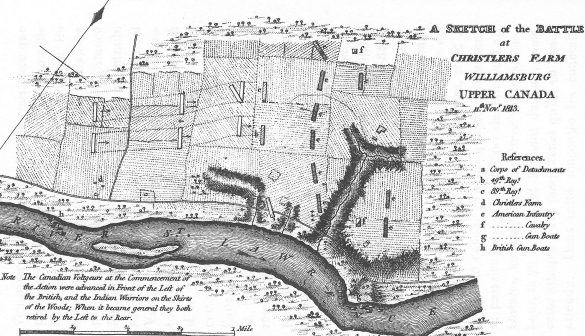
Morrison’s troops consisted of a mixture of British regulars from the 49th and his own 89th Regiments of Foot, three Royal artillery guns and crews, Canadian Fencibles, Canadian Voltigeurs, Tyendinaga and Mississauga Mohawk warriors and the Dundas County Militia. They were supported by a flotilla of gunboats commanded by William Howe Mulcaster. Two-thirds of the 270 Canadian regulars were French speakers.Crysler's Farm 1813

On 10 November a skirmish was fought at Hoople’s Creek. The next day Wilkinson decided that he needed to chase Morrison away before crossing the Long Sault Rapids. He was ill and his second in command, Major-General Morgan Lewis was unavailable, so Brigadier-General John Parker Boyd was put in command.

The Anglo-Canadians headquarters was at Crysler’s Farm, sometimes mis-spelt Chrysler’s Farm. Morrison was able to fight on ground of his choosing . Woods and two ravines enabled his men to take up concealed positions , but the Americans were moving across an open battlefield that exposed them to the accurate fire of the Anglo-Canadians

On 11 November the Americans were slow to attack, used only 4,000 of their troops and committed them piecemeal.  They lost 102 killed,  237 wounded  and 120 captured. Anglo-Canadian casualties were 31 killed, 148 wounded and 13 missing. About a third of the Fencibles, half of whom were French-Canadians, became casualties.

The American attack was called off after three hours. Their men were tired and hungry, and they had fewer experienced officers than their opponents. Despite the defeat Wilkinson ordered his army to cross the Long Sault rapids. However, the next day he received a message informing him that Hampton would not make their planned rendezvous, as he had retreated to winter quarters. Wilkinson therefore ordered his army to retire to winter quarters at French Mills.

As well as ending the US 1813 invasion, the battle is very important in Canadian history because it was a victory won by a mixture of British, English-speaking Canadians, French-Canadians and Mohawks.

The following websites were used in researching this post, in addition to those linked in the text:

About. com Military History

Canadian Military History Gateway.

The Friends of Crysler’s Farm Battlefield Memorial.

The Register of Canadian Historic Places.

3 Comments

Filed under War History

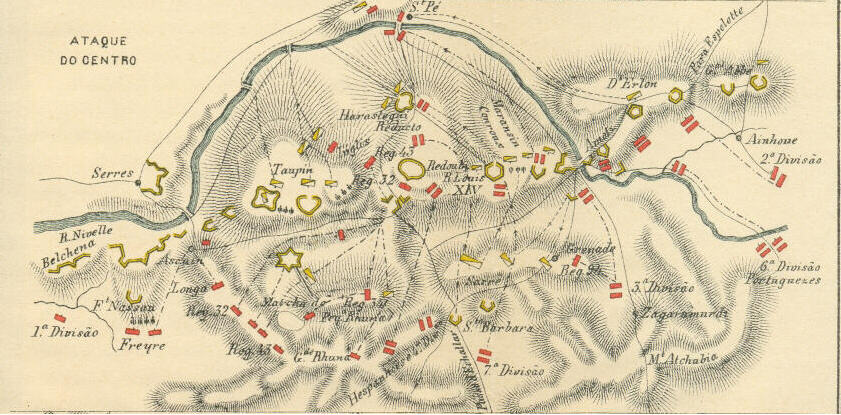
The Battle of the Nivelle 10 November 1813

The Duke of Wellington’s Allied army of British, Spanish and Portuguese troops captured San Sebastian on 31 August 1813, and on 7 October invaded France by crossing the River Bidassoa.

The advance was then delayed, allowing the French, commanded by Marshal Nicolas Soult, to retreat to the River Nivelle. As Charles Esdaile says, ‘the reasons were political.’[1] The French had been cleared out of Iberia, apart from the blockaded and starving garrison of Pamplona, and some in Portugal and Spain were reluctant to participate in an invasion of France. There was also the risk that Napoleon would win his German campaign, allowing him to move huge number of reinforcements to the Franco-Spanish border.

Pamplona surrendered on 31 October, meaning that there was no justification for further delay. The political disputes were overcome, allowing Wellington to use his entire army offensively

The Nivelle itself was not a formidable obstacle, but it was overlooked by hills that had been fortified. Wellington decided to attack to the centre-left of the 20 mile long French position. An assault on the extreme French left was rejected because the mountain passes there were often blocked by snow in winter. The right flank, from the sea to the village of Ascain, was too strongly defended.

Wellington was aware that the French had a strong position, but believed that it could be taken. He told the senior officers of the Light Division that:

‘It appears difficult, but the enemy have not men to man the works and lines they occupy. They dare not concentrate a sufficient body to resist the attacks I shall make upon them. I can pour a greater force on certain points than they can concentrate to resist me.’[2]

Sir John Hope was ordered to demonstrate between the coast and Ascain with 23,000 men in order to tie down an equal number of French troops. The main attack would come between Ascain and the Mondarrain mountain, where the 26,000 men of Sir Rowland Hill’s corps and the 29,000 of Lord Beresford’s corps would be opposed by 40,000 Frenchmen.[3]

The key French position was a hill called the Lesser Rhune, separated from the Great Rhune, taken by the Allies just after they crossed the Bidassoa, by a ravine. The Light Division was selected to attack the Lesser Rhune. Success would expose the flanks of the French troops either side of it.Battle of the Nivelle 10 November 1813

There were three separate enclosed fieldworks along the crest of the Lesser Rhune, and it appeared to be almost impregnable against an assault across the ravine from the Great Rhune. However, Wellington worked out a route that enabled the Light Division to descend into the valley and manoeuvre into a position to attack the Lesser Rhune’s flank. The fieldworks would not then be able to support each other against the attackers, and could be taken one after the other.

The Light Division began its attack before dawn, and had taken the Lesser Rhune by 8 am. The rest of the Allied army then advanced. The French were forced to retreat in order to avoid having their flanks turned.

The French lost 4,500 men killed, wounded and captured, plus 59 guns, and the Allies 2,700 men.[4] The November day was short, and the onset of darkness probably saved the French from a disaster. Soult was able to establish a new line along the next river, the Nive.


[1] C. J. Esdaile, The Peninsular War: A New History (London: Allen Lane, 2002), p. 476.

[2] Quoted in J. Weller, Wellington in the Peninsula 1808-1814 (London: Greenhill, 1992), p. 320.

[3] Ibid.

[4] Ibid., p. 325.

2 Comments

Filed under War History

The Battle of Hanau and the End of Napoleon’s 1813 German Campaign.

Napoleon was forced to retreat to the Rhine after his defeat at Leipzig on 16-19 October 1813. His retreat ‘was on the whole a remarkably successful operation’ in the opinion of David Chandler.[1] The Coalition armies pursued cautiously, and the French were moving along their main line of communications, enabling them to resupply and re-equip as they retired.

About 100,000 French troops reached the large supply base of Erfurt on 23 October.[2] They were issued with new equipment, but had to resume the retreat the next day because the Coalition forces were close behind. The French continued to lose many tired, sick and hungry stragglers on the retreat.

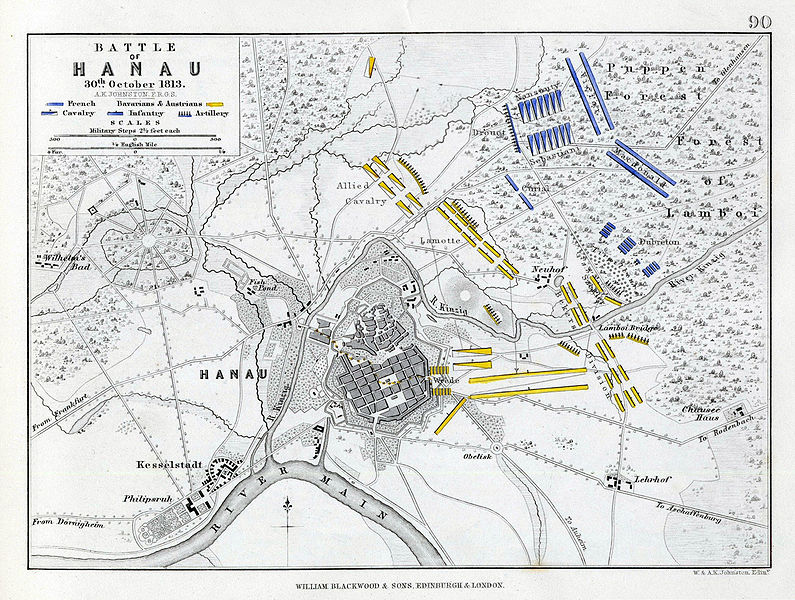
France’s erstwhile ally Bavaria had changed sides and joined the Coalition against France on 14 October. On 30 October, following two days of skirmishing, 43,000 Austrians and Bavarians under the command of the Bavarian General Karl Phillip von Wrede attempted to block Napoleon’s retreat at Hanau, a few miles east of Frankfurt-on-Main, the next supply base on the French line of retreat.

Wrede believed wrongly that the French main body was further north, on the road towards Coblenz, so thought that he faced only 20,000 men. Wrede took up a position described by F. Lorraine Petre as ‘hopelessly bad.’[3]

The River Kinzig flowed behind the Austro-Bavarian centre before turning to divide the right from the rest of the army. They could cross only at the Lamboi bridge because the river was swollen by the autumn rains. A thick forest allowed the French to approach close to the enemy without being spotted.

Napoleon had only about 17,000 men available at first, but attacked the Austro-Bavarian left flank. He was able to obtain a local superiority because of the terrain. Wrede’s left flank, consisting mostly of cavalry, was driven off the field by French cavalry and artillery.

The centre resisted for a little longer, but then had to retreat because its left flank was threatened by the victorious French cavalry. Casualties were increased because the river obstructed the retreat. Wrede brought reinforcements from his right to the centre, but they were forced to retreat back over the Lamboi bridge, and hundreds were drowned.

Napoleon, having driven Wrede off, continued his retreat. The French bombarded Hanau at 2 am on 31 October. Wrede evacuated it, and the French occupied it at 8 am. Wrede launched an unsuccessful counter attack, in which he himself was wounded, and the French passed through Hanau on their way to Frankfurt.

Wrede’s army lost 9,250 men killed and wounded at Hanau. French combat casualties were far lower, but the Coalition captured five French generals, 280 officers and 10,000 men from 28-31 October.[4]

The French reached Frankfurt, less than 20 miles from the Rhine, on 2 November. About 70,000 organised troops and 40,000 stragglers made it across the Rhine. Nearly 300,000 men had been lost so far in the campaign. Another 100,000 in isolated garrisons across Germany were effectively lost.

On 11 November Marshal Laurent St Cyr accepted terms for the surrender of Dresden that would allow the garrison to return to France provided that they did not take part in the war. However, Prince Karl Philip zu Schwarzenberg, the Coalition commander, refused to ratify the agreement, leaving St Cyr little choice other than unconditional surrender. The same thing happened at Danzig and Torgau.

Napoleon had suffered an enormous defeat for the second year running. He failed to learn one of the lessons of the failure of his 1812 Russian Campaign, which was that his army was too big for one man to co-ordinate with the communications of the day. Before the decisive defeat at Leipzig, Napoleon had won all of the battles where he was in personal command, Lützen, Bautzen and Dresden, but his subordinates had lost the other three significant battles of the campaign.

The marshals had to operate more independently than most were capable of. Napoleon should be blamed for failing to train them to do so, and did not make the most of his better commanders. Louis Davout, commanding the Hamburg garrison, and André Masséna, not employed after his defeat at Fuentes de Oñoro in 1811, would surely have done better than Nicolas Oudinot, beaten at Gross Beeren, Jacques MacDonald, beaten at the Katzbach or Michel Ney, beaten at Dennewitz.

Napoleon came up with impressive plans throughout the campaign, but his army was no longer able to execute them successfully. His inexperienced troops were tired and hungry because they were short of supplies. Napoleon also lacked good intelligence of the enemy’s strength and movements because the huge horse casualties of 1812 left him short of the cavalry needed to carry out reconnaissance.

The Emperor made key mistakes during the campaign. He should not have agreed to an armistice after his victory at Bautzen, since the opposing Coalition was building up its forces faster than he could. He might have won at Leipzig if he had not broken his rule of concentrating all available forces at the decisive point by leaving a substantial garrison at Dresden.

In the Autumn campaign the Coalition stuck successfully to its Trachenberg Plan of retreating when facing battle with Napoleon himself, whilst attempting to threaten his lines of supply and defeat isolated French corps, until it was able to concentrate all its forces at Leipzig and win a decisive victory.


[1] D. Chandler, The Campaigns of Napoleon (London: Weidenfeld & Nicolson, 1966), p. 937.

[2] Troop strengths are from Ibid., pp. 937-38.

[3] F. L. Petre, Napoleon’s Last Campaign in Germany, 1813 (London: Arms and Armour Press, 1974, first published 1912), p. 391.

[4] Ibid.

2 Comments

Filed under War History

The Battle of the Chateuaguay 26 October 1813

In September 1813 the USA invaded Lower Canada with the intention of capturing Montreal, thus cutting the lines of supply to British troops in Upper Canada. See this website for a map of the theatre of operations.

Two US armies took part in the invasion. One, commanded by General Wade Hampton, was to move from Plattsburgh along the River Chateuaguay, whilst the other, under General James Wilkinson, was to advance from Sackett’s Harbor along the River St Lawrence. The two were to unite at Montreal, but co-operation between them was hampered by a long running feud between the two US generals.

Hampton’s army included 1,000 men of the New York militia, who refused to cross the border into Canada, leaving him with about 3,000 troops. On 25 October he encountered a Canadian force commanded by Colonel Charles-Michel d’Irumberry de Salaberry, a French-Canadian British Army officer who had formed the Voltigeurs, a unit of French-Canadian regular light infantry recruited for service in Canada only.

De Salaberry’s 1,800 men were a mixture of Voltigeurs, Fencibles, who were recruited for service in North America, militia and First Nations warriors. All were Canadians. British armies had included Canadians in most of the previous battles of this war, but this was the first action to be fought entirely by Canadians.

De Salaberry’s troops were well entrenched, so Hampton sent one of his two brigades, commanded by Colonel Robert Purdy, to cross the Chateuaguay by a ford and take the defenders in the flank. He would launch a frontal assault with the rest of his troops.

Soon after Purdy’s force departed Hampton received a message from War Secretary John Armstrong informing him that winter quarters were being built for his men. Hampton assumed that this meant that the invasion was to be halted, but could not recall Purdy, so went ahead with his attack.

Purdy’s guides were unreliable, and his force got lost. It found the ford around noon, but was beaten back by the Canadian defenders. The US troops came under accurate Canadian sniper fire, whilst their own muskets had unreliable ammunition.

The frontal assault began at dawn on 26 October, but without support from the flanking attack it was unable to make any progress against the strong Canadian defences. De Salaberry sent buglers into the woods to sound the advance, making the Americans think that they were outnumbered and at risk of being outflanked.

The firefight lasted for several hours until 3pm, when Hampton called off the attack. His army retreated to winter quarters in the USA. The US lost 23 dead, 33 wounded and 29 missing. Two Canadians were killed 16 wounded and four reported missing.

This was a small battle, but it stopped half of the US attack on Montreal, and it was the first military victory of an entirely Canadian force.

1 Comment

Filed under War History

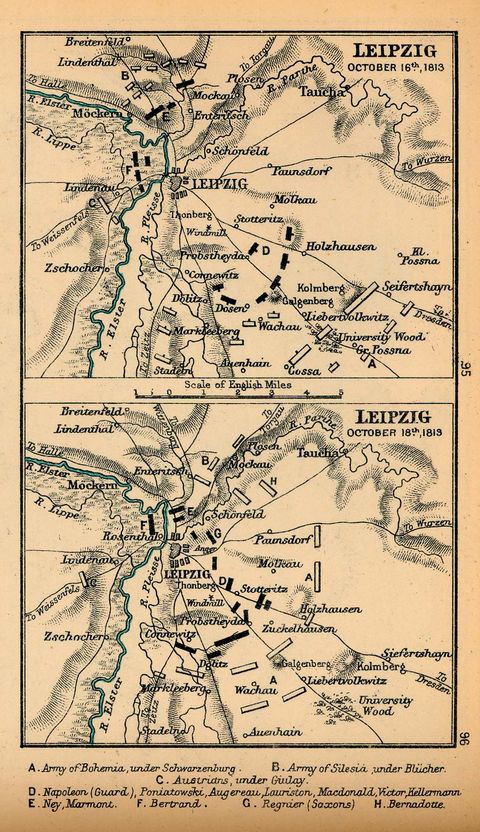
The Battle of Nations: Leipzig (2) The Battle 16-19 October 1813.

On 14 October 1813 Napoleon abandoned his attempt to destroy the three Coalition armies that he faced in Germany in detail, and moved his army to Leipzig. On 16 October he was attacked by the Army of Bohemia under the Austrian Prince Karl Philip zu Schwarzenberg from the south and the Prussian General Gebhard von Blücher’s Army of Silesia from the north. The Army of North Germany under Bernadotte, the Crown Prince of Sweden and formerly one of Napoleon’s Marshals, had moved more slowly, but would be at Leipzig by 18 October.

Napoleon was outnumbered on 16 October but not hugely, except in artillery. According to F. Lorraine Petre the Coalition had 205,000 men, including 3,500 Cossacks and 40,000 other cavalry, and 916 guns at Leipzig on 16 October. The French had 191,000 men, including 30,000 cavalry, and 690 guns. These odds were not enough to counter-balance Napoleon’s superiority to the opposing commanders. However the Coalition would have 321,000 men, including 8,500 Cossacks and 60,000 other cavalry, and 1,382 guns by 18 October. The French army would then have risen only to 205,000 men, including 30,000 cavalry, and 700 guns.[1] David Chandler thinks that both sides had more guns on 18 October than Petre says: 900 French and 1,500 Coalition.[2]

If Napoleon was to win he had to do so quickly. The French were in a strong position, although the Emperor did not intend to sit on the defensive. They had the advantage of operating on interior lines, making it easier for them to move troops around the battlefield. They had increased this advantage by destroying a large number of bridges. Napoleon was looking north for future operations and his possible line of retreat. There was a shortage of bridges if his army had to retreat west, which was the shortest route back to France.

Napoleon, unaware of the locations of Blücher and Bernadotte’s armies, did not expect much action in the north, which was to be held by III, IV, VI and VII Corps under Marshal Michel Ney.

The main French attack would come in the south. The 37,000 men of II, V and VII Corps, would pin the Army of Bohemia. The 23,000 men of Marshal Jacques Macdonald’s XI Corps and General Horace-François-Bastien Sebastiani’s II Cavalry Corps would envelop the enemy right. The decisive blow would be made by the Imperial Guard, including its cavalry, IX Corps and I Cavalry Corps, a total of 62,000 men, supported by either IV or VI Corps moving south.

The Coalition intended that Blücher’s 54,000 men should attack in the north west and General Ignac Gyulai’s 19,000 in the west. Their main attack, however, would be in the south with 77,500 Austro-Russians under Prince Ludwig Pyotr Wittgenstein. The 24,000 men of the Russian and Prussian Guards would be held in reserve.[3]

At 7 am Napoleon ordered Marshal Auguste Marmont to move his VI Corps south. Marmont obeyed, although he could see Blücher ‘s campfires, so knew that the Coalition were likely to attack in the north. However, Blücher ‘s troops then began to advance, and Ney cancelled Marmont’s movement, ordering him to take up position at Möckern instead. Ney told General Henri-Gratien Bertrand’s IV Corps to move south in place of VI Corps, but Gyulai then launched his attack against Lindenau, and Ney sent IV Corps to reinforce against this assault. He sent only two divisions of General Joseph Souham’s III Corps south.

The main Coalition attack in the south started around 8:30 am, but was hampered by poor co-ordination, mist and rain. The poor weather also held up the French enveloping move. A frontal battle therefore took place around Wachau. By 11 am the Coalition attack was running out of steam. Reinforcements were brought up, but they encountered XI Corps moving forward.

In the north Blücher moved cautiously because he knew that Bernadotte would not arrive that day. The fighting in the north and west was going well for the French, but it meant that neither IV nor VI Corps could move south. The two divisions that Ney did send south did not arrive in time to take part in the attack.

The French began counter-attacking in the south at mid-day, and were able to force the Coalition troops back. However, the absence of reinforcements from the north prevented the planned envelopment of the Coalition right from coming to fruition. Nevertheless, Napoleon launched his main attack at 2 pm.

This initially went well. At 2:30 pm a major cavalry action began. The French I Cavalry Corps, commanded by General Jean-Pierre Doumerc because General Marie-Victor-Nicolas Latour-Maubourg had been wounded, broke two Coalition battalions, captured 26 guns and nearly got to Tsar Alexander’s command post. A counter-attack by Alexander’s escort squadron and Russian cuirassiers pushed the tired French cavalry back at 3:30pm. This could have been a decisive breakthrough, but Doumerc and Marshal Joachim Murat failed to send reinforcements. The Army of Bohemia had been forced to retreat, but was still intact.

Napoleon would have sent reinforcements to exploit the success of I Cavalry Corps if he had been on that sector, but he had ridden north to Möckern just 2:30 pm after hearing heavy firing.

The battle round Möckern was fierce. Around 2 pm Blücher sent Count Johann Ludwig Yorck’s corps against Marmont’s VI Corps and Count Alexandre de Langeron’s corps against General Jan Dombrowski’s Polish division on Marmont’s right. The Poles were forced back by weight of numbers. Langeron’s advance was held up, however, when he mistook an advancing French division for a corps and fell back.

Ney recalled the two divisions of III corps that he had sent south. He then changed his mind, and ordered to turn round again. They spent most of the day marching between Möckern and Wachau without playing much role in either battle. Ney would make a similar mistake in the 1815 campaign.

A desperate battle took place between Yorck and Marmont’s corps at Möckern. The leading Prussian division was routed around 5 pm, and Marmont ordered General Karl von Normann’s Württemberg cavalry, which would change sides two days later, to charge. Normann refused, so Marmont advanced his infantry, but they were attacked by Yorck’s cavalry. VI Corps was thrown out of Möckern. Marmont rallied his men, and darkness ended the action before Blücher could commit his reserves.

The French won narrow victories at Lindenau and Wachau on 16 October, but were beaten at Möckern. The Coalition lost 30,000 dead, wounded and prisoners and the French 25,000.[4] The French might have won a decisive victory at Wachau if either the two divisions that Ney marched around the battlefield or the 30,000 man garrison of Dresden had been present, or if I Cavalry Corps’ success had been reinforced.

However, the number of Coalition reinforcements heading for Leipzig meant that the French chance of victory had now gone. Napoleon could have extracted the bulk of his army if he had retreated on 17 October, but he chose to stay and fight. He tried to win time by offering Emperor Francis I of Austria an armistice, but this only convinced the Coalition that Napoleon realised that he was close to defeat.

The 17 October was a quiet day, although there was some fighting between Blücher and Marmont’s troops. Napoleon did not attack, and the Coalition decided to wait a day for their reinforcements.

The Coalition intended to launch six attacks on the French. These were commanded by Blücher  and Bernadotte in the north, Count Levin August Bennigsen, Prince Mikhail Barclay de Tolly and Prince Friedrich Hesse-Homburg in the south and Gyulai in the west

Napoleon ordered the shortening of his line and made preparations to retreat. He ordered, too late, the construction of more bridges at Lindenau. The French held a gap between Blücher and Gyulai, allowing them a line of retreat.

The attacks began slowly. Hesse-Homburg’s attack was repulsed by Prince Józef Poniatowski’s Poles and Gyulai’s by Bertrand’s IV Corps. In the east MacDonald and Sebastiani linked up with General Jean-Louis-Ebenezer Reynier’s newly arrived VII Corps to complete the shortening of the line.

In the afternoon Barclay and Hesse-Homburg’s attacks were repulsed, but Bennigsen, eventually supported by the late arriving Bernadotte, forced MacDonald, Sebastiani and Reynier back. Napoleon committed the Old and Young Guards in a successful counter attack. However, at 4:30 pm two Saxon brigades and an artillery battery of Reynier’s VII Corps deserted to the Coalition, opening a gap in the French line.

Bennigsen and Bernadotte then renewed their attacks. By sunset the French were holding in the south, but had been forced back to the suburbs of Leipzig in the north and east. They were running out of ammunition, and clearly were unable to hold, so Napoleon ordered preparations for a retreat.

III, VII and IX Corps acted as a rearguard under the command of Marshal Nicolas-Charles Oudinot whilst the rest of the army began to retreat across the River Elster at Lindenau. The Coalition did not realise what was happening until 7 am, nearly five hours after the retreat had begun. The French received a further respite when Napoleon persuaded King Friedrich August I of Saxony to ask Alexander to spare Leipzig, resulting in a 30 minute ceasefire at 10 am.

Oudinot had 30,000 men to hold a front line of 6,500 yards.[5] They were forced back into the inner city by 11:30 am, but continued to resist, and it appeared as if the retreat would be a great success.

However, Napoleon had put the ‘unreliable’ General Dulauloy in charge of demolishing the only bridge over the Elster at Lindenau once the French army had crossed it.[6] Dulauloy delegated this to Colonel Montfort, who left a corporal in charge of the demolition charges. The corporal panicked when he saw some Russian skirmishers approach the bridge, and blew it whilst it was full of French soldiers, horses and wagons, with thousands of others still to cross.

Poniatowski, who had just been promoted to Marshal, drowned when he tried to cross the Elster. Those who could not cross fought on until surrendering in the late afternoon.

The Coalition lost about 54,000 me killed and wounded over the four days of battle. French losses were 38,000 killed and wounded, 5,000 Germans deserted and 30,000 captured. Six of Napoleon’s generals were killed, including Poniatowski, 12 wounded, including Marmont, MacDonald and Ney, and 36 captured, including Reynier. The King of Saxony was also captured. The French also lost 325 cannons, many supply wagons and much of their stores, including 40,000 muskets.[7]

Napoleon’s only chance of winning was on the first day because of the many Coalition reinforcements that were on their way. He might have done had he not left 30,000 men at Dresden, or if Ney had not marched two divisions round the battlefield.

The Emperor should have withdrawn on 17 October, but he still would have extracted more men, guns and supplies on 19 October without the negligence of the officers put in charge of demolishing the bridge. However, enough Frenchmen escaped for the war to continue. This might not have been the case if Bernadotte had arrived earlier.

This battle ended Napoleon’s empire east of the Rhine. Saxony was occupied by the Coalition, although Dresden held out until 11 November. Many of the members of the pro-French Confederation of the Rhine followed the lead of Bavaria, the largest member, and joined the Coalition.


[1] F. L. Petre, Napoleon’s Last Campaign in Germany, 1813 (London: Arms and Armour Press, 1974, first published 1912), pp. 328-29.

[2] D. Chandler, The Campaigns of Napoleon (London: Weidenfeld & Nicolson, 1966), p. 932.

[3] Ibid., pp. 924-25.

[4] Ibid., p. 932.

[5] M. V. Leggiere, Napoleon and Berlin: The Franco-Prussian War in North Germany, 1813 (Norman: University of Oklahoma Press, 2002), p. 273.

[6] Chandler, Campaigns, p. 935.

[7] Ibid., p. 936; Leggiere, Napoleon and Berlin, pp. 275-76.

2 Comments

Filed under War History

The Crossing of the Bidassoa 7 October 1813.

The capture of San Sebastian on 31 August 1813 left Pamplona as the only Spanish city in French hands. It was surrounded and was being slowly starved into submission.

On 7 October Wellington’s Allied Army of British, Spanish and Portuguese troops invaded France by crossing the River Bidassoa, which was overlooked by the crests of the Pyrenees on the French side. Marshal Nicolas Soult’s French army had tried unsuccessfully to cross the Bidassoa at Irun and Vera on 31 August in an attempt to relieve San Sebastian.

The 1st Division, another British brigade, a Portuguese brigade and two Spanish division forded the river at Irun. The Light Division and three Spanish divisions crossed at Vera, helped by a demonstration by the 6th Division. Unknown to the French, the Bidassoa could be forded near the mouth of the river at low tide. Spanish shrimpers who worked the area led the British 5th Division across three fords at daybreak.

The British divisions all contained Portuguese as well as British troops, except for the 1st Division, which had two British brigades and one of the King’s German Legion, comprised of German expatriates: many of them were from Hanover, whose Elector was also the British King. See Wikipedia for an order of battle.

The 5th Division was across the river before it was spotted by the French. The attack at Irun began when the morning fog lifted at 7:25 am. The 1st Division was half way across the river before it was fired upon. By 11:30 am the Allied objectives in this area had been taken, and Wellington ordered a halt.

Fighting was fiercer at Vera. The Light Division encountered the Star redoubt, but took it after probing for weak spots. It then reached the crest overlooking the river, which were defended by fresh troops, earthworks and artillery. The rapid attack took the crest in several places, and the other defenders retreated.

The Spanish were held up by a hill on the Allied right called the Rhune. However, the French evacuated it the next day in order to avoid being out flanked.

The Allies had crossed the river and quickly taken their objectives. Jac Weller gives Allied casualties as 400 dead and wounded at Irun and 800 at Vera. French casualties were 450 men and all their artillery and most of their baggage at Irun and 1,250 men at Vera.[1] Charles Esdaile says that Allied casualties totalled 1,600 men, half of them Spanish.[2]

Soult fell back to a new defensive line along the River Nivelle.


[1] J. Weller, Wellington in the Peninsula 1808-1814 (London: Greenhill, 1992), pp. 314-17.

[2] C. J. Esdaile, The Peninsular War: A New History (London: Allen Lane, 2002), p. 476.

5 Comments

Filed under War History

The Battle of the Thames, 5 October 1813

Victory at the Battle of Lake Erie on 10 September 1813 meant that the US controlled the lake. The British could not resupply Fort Amherstsburg at the mouth of the River Detroit or defend it, as most of its guns had been transferred to warships that were lost in the Battle of Lake Erie.

The garrison commander, General Henry Procter, therefore had the fort dismantled before starting to retreat along the River Thames on 27 September. Tecumseh, the leader of the Confederacy of Native American tribes that were allied to Britain, protested because this meant that the western tribes would be cut off from British support.

Most of the 4,000 Native Americans who had joined the British refused to retreat, but Tecumseh reluctantly withdrew  with Procter, who had promised that he would make a stand. [1] Procter kept falling back, despite Tecumseh’s urging to stand and fight, The retreating British were pursued by US troops, commanded by General William Harrison. Lack of supplies and poor leadership by Procter meant that many British troops were lost during the retreat.

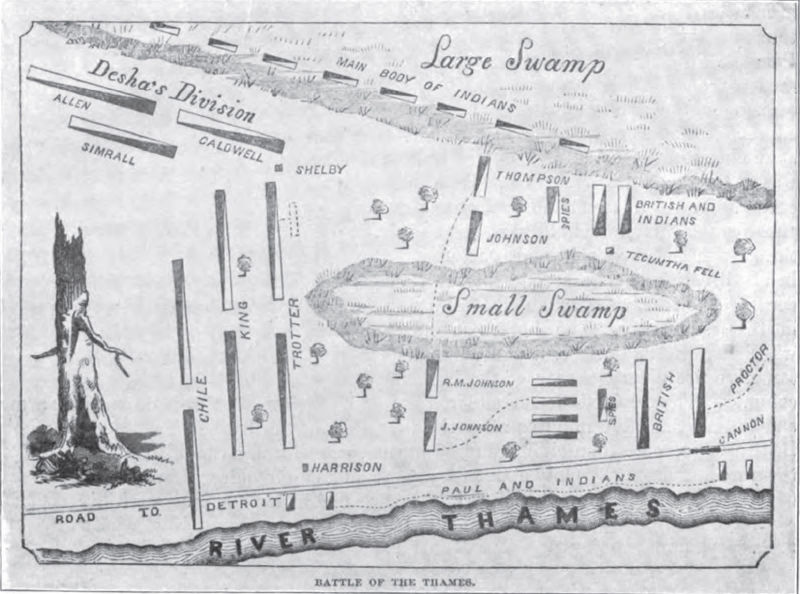
Procter eventually made a stand on 5 October on the Thames near Moraviantown, a community of Native Americans who had converted to Christianity, and modern-day Chatham. The subsequent battle is known as both the Battle of the Thames and the Battle of Moraviantown.

Harrison had about 3,500 troops facing 6-700 British regulars and 1,000 Native Americans. Procter had made no attempt to fortify his position, and a charge by Kentucky mounted riflemen quickly broke through the British line, before taking Tecumseh’s tribesmen in the flank.

Tecumseh was amongst the dead. The Native American Confederacy died with him, and the tribal alliance with Britain ended. Procter was court-martialled for his conduct of the retreat and sentenced to six months loss of rank and pay. This was reduced to a reprimand on review, but this was still enough to end his career. The Battle of the Thames (or Moraviantown) was a resounding US victory that finished the war in the north-west and set Harrison on the path to the Presidency.


[1] Troop numbers are from T. Roosevelt, The Naval War of 1812, 2 vols. (New York, NY: Charles Scribner’s Sons, 1900-2). vol. i. pp. xiii-xiv.

5 Comments

Filed under War History

The Battle of Dennewitz 6 September 1813

At the start of the Autumn 1813 German campaign Napoleon appointed Marshal Nicolas Oudinot to command the Army of Berlin, which was ordered to capture Berlin. Its advance initially went well, but it was defeated by Prussian troops under General Friederich von Bülow at Gross Beeren on 23 August 1813.

Napoleon, following his victory over Prince Karl Philip zu Schwarzenberg’s Army of Bohemia at Dresden on 26-27 August, intended to take part of his army 60 miles north to Luckau. There he would  join up with Oudinot and attack Berlin.

The rest of the main army would remain at Dresden under the command of Marshal Joachim Murat to cover against the Army of Bohemia, which was regrouping. In the east Napoleon believed that Marshal Jacques MacDonald would be able to rally his Army of Bober after its defeat at the Katzbach by Prince Gebhardt Blücher’s Army of Silesia on 26 August.

Oudinot, however, ordered a retreat to Wittenberg on the Elbe rather than Luckau. This exposed the communications of both MacDonald’s army and the main French force.

Napoleon, angry at Oudinot’s performance, replaced him as commander of the Army of Berlin with Marshal Michel Ney on 2 September, but left him in charge of XII Corps. This meant that Ney had an unhappy subordinate in a key position. The army also included General Jean Reynier’s VII Corps, General Henri-Gratien Bertrand’s IV Corps and General Jean-Toussaint Arrighi’s III Cavalry Corps.

Ney’s orders were to attack Berlin, with support from Napoleon at Luckau. However, MacDonald’s army was in a worse state than Napoleon had realised, so he moved to Bautzen on 3 September to confront Blücher. The Army of Silesia withdrew, in accordance with the Coalition’s Trachenberg Plan of avoiding combat with Napoleon himself, but attempting to attack detached French corps.

Napoleon now returned to Dresden, having heard reports that Schwarzenberg was advancing on the city. Michael Leggiere argues that Ney’s orders to his army imply that he did not receive a message sent by Napoleon on 4 or 5 September informing him that his advance on Berlin would not now be supported by troops commanded by Napoleon.[1]

Bernadotte, the Crown Prince of Sweden and commander of  the Coalition Army of North Germany, intended that the advance guard of General Friedrich von Tauentzien’s 4th Prussian Corps would engage the French at Zahna. It would then fall back on the rest of the corps at Dennewitz  and Jüterborg. The rest of the Army of North Germany would then attack Ney’s left and rear.

On 5 September Oudinot’s corps forced Tauentzien’s advance guard to retreat. The next day Bertrand’s corps encountered Tauentzien’s at Dennewitz. Reynier’s corps was late leaving its overnight camp and then took the wrong road. This also delayed Oudinot.

There was a gap between Tauentzien’s right flank and Bülow’s corps. By 11 am Bertrand’s attack on Tauentzien was going well, but the French were unwilling to take risks on their left because of the threat from Bülow. He had started marching towards the guns at 10:30, and his troops reached the battlefield at 12:30. Tauentzien was beaten by then, but his troops had held the French up for long enough for Bülow to arrive.

Reynier did not reach the battlefield until 2 pm, with Oudinot arriving an hour later. The Prussian troops were by then under pressure, with Swedish and Russian reinforcements two or three miles away. F. Lorraine Petre comments that a French attack on their left at this stage could have won them the battle, but ‘Ney seized this moment to ruin his own chances of success.’[2]

Ney could not see what was happening on the left because of thick dust swirling in the air, amd decided that the decisive area was on the right, which he could see. He ordered Oudinot to move his corps from the left to the right in support of the remnants of Bertrand’s corps.

Reynier asked Oudinot to leave at least one division on the left, but Oudinot  insisted on obeying the letter of his orders, although he could see that they were mistaken. Petre, Dominic Lieven and David Chandler all criticise him for this, arguing that he did so because he was still upset at having Ney put above him.[3]

Bertrand was forced back by 5 pm, long before Oudinot was in position. Ney ordered a retreat on Dahme at 6 pm, but many French units did not receive  the orders, and his army scattered. Only a few French troops reached Dahme, and Ney ordered them to continue to retreat to Torgau.

Two Prussian corps totalling 45,000 men had defeated three French corps, killing or wounding 8,000 out of 58,000 enemy troops and captured 13,500 men, 53 guns and 412 supply wagons. Prussian losses were 10,500 killed and wounded including losses at Zahna and in the pursuit.[4]

See this website for a detailed description of the battle, including maps and orders of battle.

Bernadotte’s total army was bigger than Ney’s, but its Swedish and Russian components did not reach the battlefield until the battle was almost won. However, the Russian cavalry contributed significantly to the pursuit, in which most of the prisoners were taken.

Napoleon had won the biggest battle of the campaign so far, at Dresden, but his dilatory handling of the pursuit meant that he did not turn a victory into a rout. His subordinates had lost four other battles: Gross Beeren, the Katzbach, Kulm and Dennewitz. Dominic Lieven points out that the French had so far lost 100,000 men and over 200 guns and the Coalition, which was receiving more recruits, 85,000 men and 50 guns.[5] The campaign was only three weeks old, and the balance had swung against Napoleon.


[1] M. V. Leggiere, Napoleon and Berlin: The Franco-Prussian War in North Germany, 1813 (Norman: University of Oklahoma Press, 2002), p. 193.

[2] F. L. Petre, Napoleon’s Last Campaign in Germany, 1813 (London: Arms and Armour Press, 1974, first published 1912), p. 274.

[3] D. Chandler, The Campaigns of Napoleon (London: Weidenfeld & Nicolson, 1966), pp. 914-15; D. C. B. Lieven, Russia against Napoleon: The Battle for Europe, 1807 to 1814 (London: Penguin, 2010), p. 424; Petre, Napoleon’s Last Campaign, pp. 274-75.

[4] Leggiere, Napoleon and Berlin, p. 209; Petre, Napoleon’s Last Campaign, pp. 271, 276.

[5] Lieven, Russia, p. 425.

2 Comments

Filed under War History