Category Archives: War History

Jutland centenary: building the fleet

Glasgow Uni blog on Scottish industry & workers & Jultland

gugreatwar's avatarGlasgow University's Great War Project

By Dr Jen Novotny, University of Glasgow

On 31 May, the national commemorations of the Battle of Jutland will take place in Orkney. It highlights Scotland’s contribution to the First World War at sea: particularly the great ships constructed along the Clyde and the strategically important harbours of Rosyth and Scapa, from which the fleets of Admirals Beatty and Jellicoe set sail to meet their German counterparts. This post explores the contributions of Scottish industry and the labour tensions that simmered on the home front while war continued to be waged on land and sea.

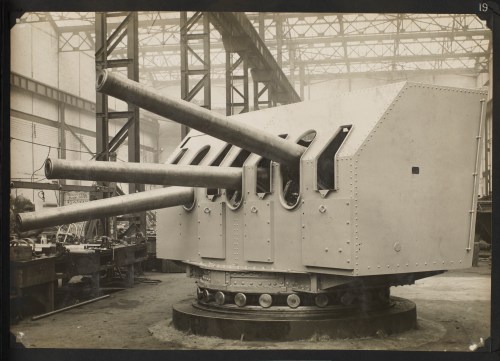
Beardmore _19.jpg Naval guns produced by William Beardmore’s Parkhead Forge, University of Glasgow reference UGD100/1/11/3

View original post 1,003 more words

Leave a comment

Filed under War History

The Lowestoft Raid 25 April 1916

Shortly after taking command of the German High Seas Fleet Admiral Reinhard Scheer laid down the strategy that it should follow. It could not currently win a decisive battle against the Royal Navy’s Grand Fleet (GF), so should avoid having one forced on it. It should instead exert pressure to force the British to send out forces that could be attacked on terms favourable to the Germans. This should be achieved by submarine and mine warfare, attacks on British trade with Scandinavia and sorties by the High Seas Fleet.

The Russians had asked the British to carry out a demonstration in the North Sea to keep the High Seas Fleet there whilst they replaced their minefields in the Gulf of Finland, where the ice was melting. A sweep by destroyers, with close support from the 2nd Light Cruiser Squadron backed by the 2nd Battle and 2nd Battle Cruiser squadrons, in the Skagerrak was therefore planned for 22 April. Submarines were positioned to attack any German ships that came north. Three days before the operation was to take place it was decided to add the 1st Battle Cruiser and 3rd Battle Squadrons.

On the afternoon of 21 April intelligence reached the Admiralty that the High Seas Fleet (HSF) was about to put to sea. The planned sweep was therefore replaced by a sortie by the entire GF. The German operation was then cancelled after the light cruiser SMS Graudenz struck a mine and other German ships reported spotting submarines.[1]

On the night of 22-23 April the British encountered heavy fog, during which the battle cruisers HMAS Australia and HMS New Zealand collided, as did three destroyers whilst a neutral merchantmen rammed the battleship HMS Neptune. There was no sign of the enemy, so the fleet returned to base on the morning of 23 April.[2]

At mid-day on 24 April the High Seas Fleet put to sea. The battle cruisers were led by Rear Admiral Friedrich Bödicker because Franz Hipper, their normal commander, was indisposed. His force was reduced to four ships after SMS Seydlitz struck a mine.[3]

The British were able to intercept and decode German wireless signal and realised that they were at sea when the German fleet flagship took over wireless control from a shore station. The damage to Seydlitz also created a lot of signals. Admiral Sir John Jellicoe, the Commander-in-Chief of the GF was ordered at 3:50 pm to hold the GF at two hours sailing notice once it was refuelled. Ten minutes later he was informed that Irish rebels had seized the General Post Office in Dublin.[4]

On 21 April Sir Roger Casement, an Irish Nationalist and a former British diplomat, had been arrested soon after being landed in Ireland by a U-boat. The same day the German auxiliary Libau, disguised as the Norwegian Aud, had been intercepted with a load of arms for the rebels. She scuttled herself the next day.[5]

Scheer’s memoirs makes no mention of events in Ireland when discussing this operation, but the British Official History argues that they influenced at least its timing. Scheer says that the objective was to force British ships out of port by naval bombardment of Lowestoft and Yarmouth and airship raids on Harwich, Ipswich, Lincoln and Norwich.[6]

At 4:28 pm on 24 April a signal from Scheer ordering that the German operation continue despite the damage to Seydlitz was intercepted. At 5:53 pm Jellicoe was told that the German battle cruisers were heading north west and that the Admiralty thought that the main German fleet was also out. British local defence flotillas, submarines and aircraft on the East coast were put on alert.[7]

Jellicoe ordered the ships at Scapa to raise steam at 7:00 pm, anticipating an order for the whole Grand Fleet to do so that arrived shortly afterwards from the Admiralty. It was clear that the Germans intended to attack somewhere, but it could be somewhere on the East coast or possibly Flanders, where German positions had been bombarded by the RN that morning.[8]

The 5th Battle Squadron, comprising the newest and fastest dreadnoughts, the Queen Elizabeth class, and the 4th Light Cruiser Squadron left Scapa at 9:10 pm. The 1st Battle Squadron departed from Invergordon at 10:000 pm, the Battle Cruiser Fleet (BCF) sailed from Rosyth at 10:50 pm and the rest of the GF left Scapa between 10:00 and 11:00 pm. A mutilated signal intercepted at 8:14 pm indicated that the German battle cruisers were heading towards Yarmouth, although it was possible that this was a feint, with the rest of the HSF heading to Flanders.[9]

At 3:50 am on 25 April, soon after daybreak, the three light cruisers and 18 destroyers of Commodore Reginald Tyrwhitt’s Harwich Force encountered six German light cruisers and a number of destroyers. A few minutes later four battle cruisers became visible. Tyrwhitt turned south in the hope of drawing them over two British submarines. The Germans, however, continued northwards and by 4:13 am were bombarding Lowestoft.[10]

Tyrwhitt turned his force north and at 4:30 pm opened fire on the German light cruisers at 14,000 yards range in poor light. The Germans replied at 4:37 am. No damage was done by either side by 4:49  when the German battle cruisers joined in. The light cruiser HMS Conquest was hit by four or five 12 inch shells from SMS Derfflinger and/or Lützow. She suffered no vital damage, but 25 of her crew were killed and 13 wounded. The only other ship damaged was the destroyer HMS Laertes, which had a boiler put out of action by shell fragments. The Germans turned eastwards at 4:56 am and were soon out of sight. At 5:40 am Tyrwhitt turned north-eastwards in an attempt to regain contact with the Germans.[11]

The GF and BCF were still well to the north when the HSF withdrew. Both sides had submarines in position, but the only ones to be successful were SM UB18 which sank the submarine HMS E22 and UB29 which damaged the light cruiser HMS Penelope. Two German submarines were lost: UB13 struck a mine on 24 April and UC5 ran aground on 27 April; click on the names of the U-boats for more details from Uboat.net.

The raid on Lowestoft destroyed two 6 inch gun batteries and 200 houses. Three civilians were killed and 12 wounded. The attack on Yarmouth was curtailed by poor visibility and the appearance of the Harwich Force.[12] The accompanying raid by six airships was hampered by bad weather and most of the bombs dropped were ineffective. L16 injured one man, destroyed five houses and damaged 100 at Newmarket. A woman died of shock at Dilham, but the only other damage was to sheds and windows. L13 was slightly damaged by anti-aircraft fire.[13]

The operation boosted the prestige of the HSF in Germany.[14] It, however, In Britain there was anger with the RN’s failure to protect the British coast.[15]

This led to a realignment of British naval forces. The 3rd Battle Squadron of HMS Dreadnought and the seven remaining pre-dreadnoughts of the King Edward VII class (the name ship had been sunk by a mine on 6 January 1915) and the three Devonshire class armoured cruisers of the 3rd Cruiser Squadron were to be transferred from the GF to the south east of England. Rosyth on the Firth of Forth was to be developed into a base capable of accommodating the full GF. The work was completed in 1917 , but Rosyth did not become the GF’s main base in April 1918.[16] This did not really weaken the GF since only Dreadnought of the ships moved was modern enough to stand in the line of battle against dreadnoughts.


[1] The above is based on Naval Staff Monograph (Historical) 1927 vol. xvi, Lowestoft Raid 24th-25th April 1916. pp. pp. 6-10.

[2] J. S. Corbett, H. Newbolt, Naval Operations, 5 vols. (London: HMSO, 1938). vol. iii, pp. 298-99.

[3] A. J. Marder, From the Dreadnought to Scapa Flow; the Royal Navy in the Fisher Era, 1904-1919, 5 vols. (London: Oxford University Press, 1961-70). vol. ii, pp. 424-25.

[4] Naval Staff vol. Xvi. p. 11.

[5] Corbett, Newbolt, Naval. vol. iii, p. 300.

[6] Ibid., pp. vol iii, pp. 303-4; R. Scheer, Germany’s High Sea Fleet in the World War (London: Cassell and Company, 1920), pp. 123-30.

[7] Naval Staff vol. Xvi. p. 11.

[8] Ibid., pp. pp. 12-13.

[9] Ibid., p. 14.

[10] Ibid., p. 22.

[11] Ibid., pp. 22-23.

[12] R. K. Massie, Castles of Steel: Britain, Germany, and the Winning of the Great War at Sea (London: Jonathan Cape, 2004), p. 559.

[13] W. A. Raleigh, H. A. Jones, The War in the Air: Being the Story of the Part Played in the Great War by the Royal Air Force, 7 vols. (Oxford: Clarendon Press, 1922). vol. iii, pp. 203-5.

[14] Corbett, Newbolt, Naval. vol. iii, p. 311

[15] Marder, From. vol. ii, pp. 433-34.

[16] Ibid., pp. 434-35.

1 Comment

Filed under War History

Charles Cowley and Humphrey Firman VC

Major-General Charles Townshend’s 6th (Poona) Division, comprised of British and Indian troops, captured Kut-al-Amara on 28 September 1915. Townshend was then ordered to press on to Baghdad. He argued that he needed two divisions to do so but obeyed his orders when his protests were overruled.[1]

The British command structure was confused because of the way in which the British ruled India. Townshend’s immediate superior, General Sir John Nixon, answered to the Indian government, comprised of British officials, in Delhi rather than to the War Office in London. Austen Chamberlain, the London based Secretary of State for India, was concerned about the lengthening lines of communication and lack of river transport in a region with poor roads and no  railways. Townshend wrote in his diary that Nixon ‘does not seem to realise the weakness and danger of his lines of communication…the consequences of a retreat are not to be imagined.’[2]

Nixon, however, claimed that marching the troops with land transport and lightening the river boats would avoid any ‘navigation difficulties.’[3] His view was accepted and the advance continued.

On 22 November Townshend’s troops encountered the Ottomans at the ruined ancient city of Ctesiphon, 22 miles from Baghdad. He believed that the enemy had 11,000 men and 40 guns but they actually had 18,000 men and 52 guns.[4] He had 13,756 men, 30 guns and 46 machine guns, not counting those on the gunboats Firefly and Comet, the armed launches Shaitan and Sumana or the four 4.7 inch guns on horse boats towed by the armed stern wheelers Sushan and Messoudieh.[5]

Townshend was forced to break off the action on 24 November. The next day his force started to retreat towards Kut, which was reached on 3 December. The lack of transport meant that the wounded, who continued to Basra suffered greatly, first travelling on unsprung 2 wheeled ox carts and then on over-crowded boats with inadequate medical facilities.[6] A. J. Barker argues in his authoritative history of the Mesopotamian Campaign that Nixon was not ‘entirely blameless’ but the [British] Indian government must be regarded as primarily responsible’ for the dreadful medical facilities.[7]

British casualties at Ctesiphon, the retreat and a further action at Umm-at-Tubal totalled 4,970: 711 killed, 3,890 wounded and 369 missing. A Turkish account says that the Ottomans lost over 9,500 men including deserters at Ctesiphon, with another giving their casualties excluding deserters as being 6,188. Their casualties at Umm-at-Tubal were 748.[8]

The British also lost the new gunboat Firefly, which was disabled when a shell hit her boiler and the old gunboat Comet, which ran aground when trying to help her. Sumana managed to rescue their crews with Ottoman soldiers already boarding the two stranded gunboats.[9]

Townshend reported initially that his division could hold out in Kut for two months, which was ‘a somewhat conservative estimate.’[10] By seizing local food supplies, putting his men on short rations and killing his animals for meat Townshend was ultimately able to hold out for nearly five months. His initial estimate forced the relief force to move before it was ready. It is strange that an officer who had made his name in a siege, that of Chitral on the North West Frontier of India in 1895, should make such a mistake.

By 24 April the situation in Kut was so desperate that a highly risky resupply mission had to be mounted. The river steamer Julnar was stripped of all unnecessary woodwork and armoured with protective plating. Manned by an all volunteer crew of Lieutenant Humphrey Firman RN, Lieutenant-Commander Charles Cowley RNVR, Engineer Sub-Lieutenant W. L. Reed RNR and 12 ratings she was to carry 270 tons of supplies to Kut.[11]

Cowley had a great knowledge of the River Tigris, having been employed by the Euphrates and Tigris Navigation Company. He had been born in Baghdad, was regarded by the Ottomans as being an Ottoman subject, so was likely to be executed if captured.[12] He had been born in Baghdad. He acted as pilot, with Firman captaining the Julnar.

She set off at 8 pm on 24 April, a dark, overcast and moonless night. Heavy artillery and machine gun fire tried to drown out the sound of her engines, but the Ottomans knew that she was coming. She soon came under rifle fire and could make no more than six knots because of a strong current. Ten miles from Kut she came under artillery fire. Two miles later a shell hit her, killing Firman and wounding Cowley, who took command. A few minutes later she struck a cable and drifted onto the right bank of the river. She was stuck, giving Cowley no choice but to surrender.[13]

Cowley was quickly separated from the rest of the crew. The Ottomans claimed first that he was found dead when the Julnar surrendered, then that he was shot whilst trying to escape. It is most likely that he was executed. He was a British subject, but he was aware that the Ottomans would execute him if he was captured.[14]

Cowley and Firman were both awarded the Victoria Cross posthumously. The citation, from naval-history.net, states that:

Admiralty, 31st January, 1917.

The KING (is) pleased to approve of the posthumous grant of the Victoria Cross to the undermentioned officers in recognition of their conspicuous gallantry in an attempt to re-provision the force besieged in Kut-el-Amara.:

Lieutenant Humphry Osbaldeston Brooke Firman, R.N.

Lieutenant-Commander Charles Henry Cowley, R.N.V.R.

The General Officer Commanding, Indian Expeditionary Force “D,” reported on this attempt in the following words:

“At 8 p.m. on April 24th, 1916, with a crew from the Royal Navy under Lieutenant Firman, R.N., assisted by Lieutenant-Commander Cowley, R.N.V.R., the ‘Julnar,’ carrying 270 tons of supplies, left Falahiyah in an attempt to reach Kut.

Her departure was covered by all Artillery and machine gun fire that could be brought to bear, in the hope of distracting the enemy’s attention. She was, however, discovered and shelled on her passage up the river. At 1 a.m. on the 25th General Townshend reported that she had not arrived, and that at midnight a burst of heavy firing had been heard at Magasis, some 8 1/2 miles from Kut by river, which had suddenly ceased. There could be but little doubt that the enterprise had failed, and the next day the Air Service reported the ‘ Julnar ‘ in the hands of the Turks at Magasis.

“The leaders of this brave attempt, Lieutenant H. O. B. Firman, R.N., and his assistant – Lieutenant-Commander C. H. Cowley, R.N.V.R. – the latter of whom throughout the campaign in Mesopotamia performed magnificent service in command of the ‘Mejidieh’ – have been reported by the Turks to have been killed; the remainder of the gallant crew, including five wounded, are prisoners of war.

“Knowing well the chances against them, all the gallant officers and men who manned the ‘ Julnar’ for the occasion were volunteers. I trust that.the services in this connection of Lieutenant H. O. B. Firman, R.N., and Lieutenant-Commander C. H. Cowley, R.N.V.R., his assistant, both of whom were unfortunately killed, may be recognised by the posthumous grant of some suitable honour.”

The British Official History of Naval Operations states that all ‘the crew were decorated.[15] The awards of the Distinguished Service Order and the Conspicuous Gallantry Medal to other members of the crew  were announced on 11 November 1919.

Honours for Miscellaneous Services.

To be a Companion of the Distinguished Service Order.

Eng. Sub-Lieut. William. Louis Reed, R.N.R. For gallant and distinguished services as a volunteer in H.M.S. “Julnar” on the 24th April, 1916, when that vessel attempted to reach Kut-El-Amarah with stores for the besieged garrison.

To receive the Conspicuous Gallantry Medal.

E.R.A., 2nd Cl., Alexander Murphy, R.N.V.R., O.N. (Mersey) Z3/182. For most conspicuous gallantry as a volunteer in H.M.S. “Julnar” on the 24th April, 1916, when that vessel attempted to reach Kut-El-Amarah with stores for the besieged garrison.

P.O., 1st Cl., William Rowbottom, O.N. J2953 (Ch.). For most conspicuous gallantry as a volunteer in H.M.S. “Julnar” on the 24th April, 1916, when that vessel attempted to reach Kut-El-Amarah with stores for the besieged garrison.

The award of the Distinguished Service Medal to a group of ten ratings, listed on Naval-History.net, was announced the same day. It is likely that they were the other members of the crew, but the citations for the award of the DSM are not available.

Honours for Miscellaneous Services.

To receive the Distinguished Service Medal.

A.B. Herbert Blanchard, O.N. J13427 (Po.).

A.B. William Bond, O.N. J8490 (Dev.).

Ldg. Sto. Herbert Cooke, O.N. K6470 (Ch.).

Sea. John Featherbe, R.N.R., O.N. 6973A.

Sto., Ist.Cl., George William Forshaw, O.N. K18513 (Dev.).

Sto., 1st Cl., Samuel Fox, O.N. S.S.110714 (Po.).

A.B. Harry Ledger, O.N. J9539 (Dev.).

Sto., 1st Cl., Charles Thirkill, O.N. S.S. 115464 (Dev.).

A.B. Alfred Loveridge Veale, O.N. 215734 (R.F.R. Dev./B5936).

A.B. Montagu Williams, O.N. J44546 (Ch.).

The failure of Julnar’s mission meant that the only supplies available to the garrison of Kut were the tiny amounts that could be dropped by the small number of low performance aircraft available. Attempts were made to negotiate an end to the siege, but the Ottomans were not interested in British offers of gold or guns or prisoner exchanges in return for allowing the garrison of Kut to return to India or the fact that they would have to care for a large number of sick prisoners if the garrison surrendered. Townshend therefore surrendered Kut on 29 April.[16]

The Ottomans treated Townshend very well, his officers reasonably and his men very badly in captivity. During the siege 1,025 men were killed, 721 died of disease, 2,446 were wounded and 72 went missing. 247 civilians were killed and 663 wounded. Nearly 12,000 men went into captivity, of whom over 4,000 died. Their treatment eventually improved after representations from the US and Dutch Ambassadors.[17] Townshend’s reputation never recovered from his failure to inquire into the fate of his men whilst he lived in luxury in Istanbul. His performance in the campaign until Ctesiphon had actually been good: see this post.


[1] A. J. Barker, The First Iraq War, 1914-1918: Britain’s Mesopotamian Campaign (New York, NY: Enigma, 2009), pp. 91-92.

[2] Quoted in Ibid., p. 89.

[3] Quoted in Ibid.

[4] Ibid., pp. 97-98.

[5] J. S. Corbett, H. Newbolt, Naval Operations, 5 vols. (London: HMSO, 1938). vol. iii, p. 227; F. J. Moberly, The Campaign in Mesopotamia, 1914-1918, 4 vols. (London: HMSO, 1923). vol. ii, p. 71.

[6] See D. Gunn, Sailor in the Desert: The Adventures of Phillip Gunn, Dsm, Rn in the Mesopotamia Campaign, 1915 (Barnsley: Pen & Sword Maritime, 2013). for the experiences of a Royal Navy seaman in Mesopotamia. Chapter 48 describes the battle and Chapters 49-60 his evacuation after being wounded.

[7] Barker, The First Iraq War, 1914-1918: Britain’s Mesopotamian Campaign, p. 106.

[8] Corbett, Newbolt, Naval. vol. iii, p. 229.

[9] Ibid. vol. iii, pp. 228-29.

[10] Barker, The First Iraq War, 1914-1918: Britain’s Mesopotamian Campaign, p. 228.

[11] Corbett, Newbolt, Naval. vol. iv, p. 90.

[12] Barker, The First Iraq War, 1914-1918: Britain’s Mesopotamian Campaign, p. 212.

[13] Corbett, Newbolt, Naval. vol. iv, pp. 90-91.

[14] Moberly, Mesopotamia. vol. ii, p. 435, footnote.

[15] Corbett, Newbolt, Naval. vol. iv, p. 91, footnote 1.

[16] Moberly, Mesopotamia. vol. ii, pp. 452-57.

[17] Ibid. vol. ii, pp. 459-466.

1 Comment

Filed under War History

Frank’s panda in Burma

As it turns out, Red Stahley wasn’t the only member of the family who had an interesting pet experience during the war.  My uncle, Frank Morris, serving in the Army in Burma was the proud own…

Source: Frank’s panda in Burma

1 Comment

Filed under War History

SS Sussex Torpedoed by U-Boat 24 March 1916

In February 1916 Germany announced that from 1 March its U-boats would sink defensively armed British merchant ships without warning. Germany had, under pressure from the USA, abandoned unrestricted submarine warfare in September 1915. The Germans claimed that British defensively armed merchantmen had been ordered to attack U-boats before being attacked themselves, so could not be regarded as acting defensively. The Admiralty quickly disproved this accusation by publishing the actual orders.[1]

The German position on the issue of unrestricted submarine warfare is described by Paul Halpern as being ‘somewhat confusing’.[2] The naval and military commanders wanted to pursue unrestricted submarine warfare but Kaiser Wilhelm and Chancellor Theobald von Bethmann Hollweg were concerned about US opinion. The US government opposed the treatment of armed merchant ship as warships.

Following a conference on 4 March the Kaiser accepted that unrestricted warfare was necessary, with a likely start date of 1 April. Until then, Bethmann Hollweg should attempt to persuade the Americans to accept the German view. In the interim U-boats were authorised to sink enemy merchant ships in the war zone and armed ones outside it. Passenger liners, whether armed or not, could not be attacked anywhere by submerged U-boats. Halpern describes this as ‘sharpened’ rather than unrestricted submarine warfare.[3]

Admiral Alfred von Tirpitz, the architect of the German battlefleet had not been invited to the 4 March meeting. He resigned as State Secretary of the Imperial Naval Office, a job mainly concerned with administration and naval building, soon afterwards.

The Germans had 52 U-boats in March 1916, compared with 29 or 30 when they began unrestricted submarine warfare a year before. Of these 16 were in the North Sea, 20 small and short ranged ones with the Flanders Flotilla, 4 in the Baltic, 7 in the Adriatic and 5 at Istanbul. It was expected that another 38 would be completed by August.[4]

Several Dutch merchant ships were sunk in March, including the 13,911 liner Tubantia, the largest neutral ship sunk during the war. The Dutch were angered by these losses, but the attitude of the USA was far more important to the Germans.[5]

On the afternoon of 24 March the 1,353 ton French packet Sussex was torpedoed and badly damaged by UB29 (Oberleutnant Herbert Pustkuchen) whilst making her regular run from Folkestone to Dieppe with over 325 passengers. The Germans claimed at first that she had hit a mine, but fragments of a torpedo were found after she had been towed into Boulogne.[6]

The 50 dead included some of the 25 Americans on board. Pustkuchen claimed that he assumed from her crowded decks that she was a troopship.[7] British troopships then crossed at night between Folkestone and Boulogne.[8] The Germans may not have known that and Pustkuchen, with the very limited view offered by a periscope, may have genuinely thought that he was firing at a troopship. His action, however, created a major diplomatic incident with the USA.

On 19 April US President Woodrow Wilson told Congress that that unless the Germans abandoned ‘their present method of warfare against passenger and freight-carrying vessels, the Government have no choice but to sever diplomatic relations with the German Government altogether.’[9]

On 20 April the Germans agreed to stop sinking merchant ships without warning. Four days later Admiral Reinhard Scheer, the recently appointed C.-in-C. of the High Seas Fleet, recalled all his U-boats from the North Sea on the grounds that there was no point in sending boats on dangerous missions when their actions were so restricted. This left only the short ranged boats of the Flanders Flotilla operating against Allied shipping in British waters.[10]

The following table shows Allied shipping losses to U-boats since the end of the period of unrestricted submarine warfare. Sinkings rose in April and May and then fell again, especially outside the Mediterranean, to which several U-boats were transferred in September 1915 so that they could raid Allied commerce in an area where the risk of killing Americans was reduced, although not eliminated. On 7 November U38, a German boat that was flying Austro-Hungarian colours because Germany and Italy were not yet at war, sank the Italian liner Ancona, killing over 200 people, including about 20 Americans.[11]

Merchant shipping Losses to U-boats
Total Mediterranean
Month Ships Gross tons Ships Gross tons
Oct-Dec 1915 140 361,326 80 293,423
January 1916 25 49,610
February 1916 44 95,090
March 1916 69 160,536
April 1916 83 187,307
May 1916 63 119,381 37 72,092
June 1916 63 93,193 43 67,125

Source: P. G. Halpern, A Naval History of World War I, (London: UCL Press, 1994), p. 308.

The Germans thought that unrestricted submarine warfare was their best chance of forcing Britain out of the war. However, it also risked bringing the USA into the war on the Allied side. In 1916 they had too few U-boats to achieve the former but pursuing this strategy could still cause the latter.


[1] Naval Staff Monograph (Historical) 1926 vol. xv, Home Waters part vi, October 1915 to May 1916. p. 94.

[2] P. G. Halpern, A Naval History of World War I (London: UCL Press, 1994), p. 305.

[3] Ibid., p. 306.

[4] Ibid.

[5] Ibid., p. 307.

[6] Naval Staff vol. Xv. p. 139.

[7] Halpern, Naval, p. 307.

[8] Naval Staff vol. Xv. p. 139.

[9] Quoted in R. H. Gibson, M. Prendergast, The German Submarine War, 1914-1918. (London: Constable, 1931), p. 88.

[10] Ibid., p. 89.

[11] Halpern, Naval, p. 385.

Leave a comment

Filed under War History

First Successful Use of Depth Charges on 22 March 1916

Q-ships, apparently innocuous merchant vessels with heavy but concealed armaments, were used by the British to combat U-boats. Submarines often surfaced to sink small merchant ship with their deck guns in order to conserve their torpedoes for more attractive. One of the Q-ships was HMS Farnborough, captained by Lieutenant-Commander Gordon Campbell, which was armed with five 12 pounders, two 6 pounders, a Maxim machine gun, rifles and depth charges.[1] She had originally been the collier Loderer. Her crew as a Q-ship was 11 officers and 56 men, compared with six officers and 25 men as a collier.[2]

On 22 March Farnborough was off the coast of Kerry when SM U68 (Kapitänleutnant Ludwig Güntzel) fired a torpedo that missed her. The U-boat surfaced and fired a shot across the bows of what appeared to be a collier. The crew apparently abandoned ship, but the gun crews had remained behind.

U68 closed to 800 yards and opened fire. The collier then raised the white ensign and opened fire. U68 was hit but managed to dive. Campbell then took Farnborough over her and dropped a depth charge. The U-boat came out of the water at a perpendicular angle, revealing damage to her bow. Farnborough fired five more shots into her and then dropped two more depth charges as she dived. Oil and wood then came to the surface and U68 was lost was all hands.[3]

The British first ordered depth charges in August 1915 and began to issue them to the fleet in January 1916. This was the first ever sinking of a submarine by depth charges.[4]

Campbell was promoted to Commander and awarded the Distinguished Service Order. Two of the other officers received the Distinguished Service Cross and three men the Distinguished Service Medal.[5]


[1] Naval Staff Monograph (Historical) 1926 vol. xv, Home Waters part vi, October 1915 to May 1916. p. 101.

[2] T. Bridgland, Sea Killers in Disguise: The Story of the Q Ships and Decoy Ships in the First World War (London: Leo Cooper, 1999), p. 14.

[3] Naval Staff vol. Xv. p. 101.

[4] A. J. Marder, From the Dreadnought to Scapa Flow; the Royal Navy in the Fisher Era, 1904-1919, 5 vols. (London: Oxford University Press, 1961-70). vol. ii, p. 350.

[5] (Naval Staff vol. Xv. p. 101.

Leave a comment

Filed under War History

The Man Who Survived 3 Sinkings in the First World War and the Titanic

John Priest, born in Southampton in 1887, was one of the few firemen (stokers) to survive the sinking of the Titanic on 14 April 1912. The firemen had a long way to go to get from the boiler rooms to the deck.  An article on the BBC website claims that most of the lifeboats had left by the time that Priest made it and he had to swim for his life in very cold water. The Encyclopedia Titanica, however, says that he was in a lifeboat, probably number 15.

He had previously been on board a ship called the Asturias that was, according to the BBC website linked above, involved in a collision on her maiden voyage in 1907. The Asturias was completed in 1907 for the Royal Mail Steam Packet Company and served as a hospital ship in the First World War. She was beached on the English coast on 20 March 1917 in order to prevent her sinking after she was torpedoed by the U-boat UC66. I have not been able to find any other mention of her being involved in a collision on her maiden voyage, so it may have been a minor accident.

Priest was on board the Titanic’s sister ship Olympic on 20 September 1911 when she collided with the cruiser HMS Hawke. The cruiser, which was sunk by U9 In October 1914, as related here, was the more seriously damaged of the two.

In February 1916 he was a member of the crew of the armed merchant cruiser HMS Alcantara, a sister ship of the Asturias. She was one of a number of merchant liners requisitioned by the Admiralty and armed, in her case with six 6 inch and two 3 pounder guns and depth charges. She was assigned to the 10th Cruiser Squadron, which was helping to enforce the Allied blockade of the Central Powers.

By 28 February the squadron had lost one ship to weather, two to mines and three to U-boats but none to enemy surface ships, although the Grand Fleet boarding ship Ramsay had been sunk on 8 August 1915 by a raider flying Russian colours.[1]

On 28 February the Admiralty warned the Grand Fleet that a German raider was attempting to break out into the Atlantic. Just after 8 am on 29 February Alcantara (Captain T. E. Wardle), which had been about to return to port after transferring secret documents to her newly arrived sister ship HMS Andes (Captain G. B. W. Young), was ordered to remain on her patrol station.[2]

Alcantara spotted smoke at 8:45 am and soon afterwards received a signal from Andes stating ‘Enemy in sight steering N.E. 15 knots.’[3] This was followed by a second signal that Alcantara took to mean that the enemy had two funnels. However, the signal log of Andes did not mention funnels until 9:10, when it stated that the vessel had a ‘black funnel.’[4] Alcantara’s times appear to be 20 minutes earlier than those of Andes.

Alcantara closed on the smoke, which belonged to a one funnelled steamer flying Norwegian colours and bearing the name Rena on her stern. Wardle assumed that she was a different ship from the one in Andes’s 8:45 signal, but at 10:14 am a signal from Andes revealed that they were the same vessel.[5]

The ship was the German raider SMS Greif (Fregattenkapitän Rudolf Tietze), converted from the tramp steamer Guben, which been under construction at the outbreak of war. She had been designed with two funnels, but one was removed when she was requisitioned by the German Admiralty. She had a concealed armament of four 5.9 inch and one 4.1 guns and two 19.7 inch torpedo tubes.[6]

It is impossible to give a detailed account of the subsequent action because the reports of Wardle and Young differ greatly. Greif dropped her Norwegian colours, revealed her guns and opened fire when Alcantara was about 1,000 yards away. A close range battle then took place, with Andes joining in whenever Alcantara was not in the way. Andes had been 7,500 yards away when the action began and stayed at 6,000 yards range in order to stay out of torpedo range.[7]

Grief’s crew began to abandon ship after about 15 minutes but Alcantara, which had been hit by a torpedo, was sinking by 10:45 am. The light cruiser HMS Comus and the destroyer HMS Munster then appeared. Comus and Andes fired on Greif, which was still flying the German ensign, until she sank at 1 pm, whilst Munster picked up survivors. The rescue was briefly suspended after mistaken reports of submarines.[8]

The British picked up 220 out of about 360 men on board Greif, with 69 of Alcantara’s crew being lost.[9] Wardle and Priest were amongst the survivors, but Tietze, the last man to try to leave Greif, was not.[10] Alcantara’s dead are listed towards the bottom of this page on Naval-History.net.

The Admiralty said that Wardle and his crew had ‘fought their ship in a very creditable way.’[11] He was awarded the Distinguished Service Order.

John Priest then joined the crew of the Britannic, the Olympic and Titanic’s sister ship, which was serving as a hospital ship. On 21 November 1916 she struck a mine and sank near the Greek island of Kea. Thirty died, but the survivors included Priest and two other Titanic survivors: Violet Jessop, a stewardess who had become a nurse, and Archie Jewell, a lookout.

Priest’s fourth sinking occurred on 17 April 1917 when he was a fireman on board the hospital ship Donegal, which was torpedoed and sunk in the English Channel. He received a head injury but survived. Jewell, however, was amongst the 40 dead.

John Priest died on land in 1937 at the age of 50.

[1] Naval Staff Monograph (Historical) 1922 vol. vii, 19: Tenth Cruiser Squadron i. p. 58.

[2] Ibid., p. 60.

[3] Ibid.

[4] Ibid. note 3, p. 60.

[5] Ibid., p. 60.

[6] T. Bridgland, Sea Killers in Disguise: The Story of the Q Ships and Decoy Ships in the First World War, p. 174.

[7] Naval Staff vol. vii. p. 61.

[8] Ibid., pp. 61-62.

[9] J. S. Corbett, H. Newbolt, Naval Operations, 5 vols. vol. iii, pp. 271-72.

[10] Bridgland, Sea Killers in Disguise: The Story of the Q Ships and Decoy Ships in the First World War, p. 177.

[11] Corbett, Newbolt, Naval, p. 272.

3 Comments

Filed under War History

The Loss of HMS Natal 30 December 1915

At 3:25 pm on 30 December 1915 the armoured cruiser HMS Natal, then moored in the Cromarty Firth signalled that she was on fire. Other ships were ordered to give assistance, but at 3:30 pm she turned over and had sunk by 3:45 pm: timings are from the website hmsnatal.co.uk.

There is some doubt about the number of dead and survivors. Wikipedia says that some of her crew were not on board at the time of the sinking as they had been given shore leave to either play in or watch a football match. It gives a range of 390-421 for the number of dead. The Commonwealth War Graves Commission website says that there were seven wives of officers, three children, a civilian and some nurses from the Hospital Ship Drina on board, attending a Christmas film show. It says that over 420 people died, including 414 naval personnel.

hmsnatal.co.uk states that 421 died. Its list of the dead includes 423 names, but at least one person is double counted, with Commander John Hutchings’s wife Mabel being included under both her married name and her maiden name of Cuningham. The list also includes Mrs Violet Back and Mrs Bennett, the wives of Captain Eric Back and Engineer Lieutenant Frank Bennett respectively. All three husbands also died. Mr Dodd, the Factor of the nearby Novar Estate, his wife and their three children were also amongst the dead, as were Nursing Sisters Caroline Edwards, Eliza Millicent and Olive Rowlett of Queen Alexandria’s Royal Naval Nursing Service.

The total dead would therefore appear to be 422: eight civilians, including four women and three children, and 414 naval personnel, including three nurses.

It was originally thought that Natal had been sunk by a U-boat, but it was later realised that her loss resulted from an accidental explosion of her ammunition. She was the second British armoured cruiser to be lost accidentally in nine weeks: HMS Argyll ran aground in heavy seas on the Bell Rock, near Dundee, on 28 October. All her crew were saved, but she was totally wrecked.

On 8 December a collision between the new Queen Elizabeth class super dreadnoughts HMS Barham and Warspite left both requiring dockyard repairs, reducing the British margin of superiority in the North Sea.[1] The British thought that they needed a big margin over the Germans because they assumed that the German High Seas Fleet would only come out when at full strength, whereas their Grand Fleet would be reduced by repairs and refits. In fact, the German battlecruiser SMS Von der Tann missed the Battle of Dogger Bank because she was in dry dock and the Germans were not at full strength at the Battle of Jutland in 1916.

Part of Natal’s wreck remained visible and was saluted by RN ships entering or leaving the Cromarty Firth. Plans to salvage in the 1920s and 1930s did not come to fruition. In the  1970s the wreck was reduced in size to prevent  it being a danger to shipping: see the website of the Royal Commission on Ancient and Historic Monuments of Scotland. The development of North Sea oil would by then have increased civilian shipping traffic in the area.

Natal was not the first British warship to be lost to an accidental explosion whilst moored, suggesting that RN ammunition handling procedures were lax. The pre-dreadnought battleship HMS Bulwark blew up on 26 November 1914 and HMS Princess Irene, a passenger line converted into an auxiliary minelayer, exploded on 27 May 1915. The dreadnought HMS Vanguard and the monitor HMS Glatton both blew up later in the war.


[1] J. S. Corbett, H. Newbolt, Naval Operations, 5 vols. (London: HMSO, 1938). vol. iii, p. 261

3 Comments

Filed under War History

U-boats in Late 1915

Germany’s decision, under pressure from the USA, to end unrestricted submarine warfare in September 1915 did not end Allied shipping losses to U-boats. In the final three months of the war they sank 140 ships of 361,326 tons.[1]

Most of the losses in waters around the British Isles were from mines. The small coastal minelaying U-boats UC1, 3, 5, 6, 7 and 9 , operating from Zeebrugge, laid mines in 16 locations. Seventeen vessels struck mines around Dover and the Nore alone.[2] Mines were laid off Portsmouth in an attempt to disrupt transports to France, one of which sank the destroyer HMS Velox on 25 October.[3]

The minelayers did not escape unscathed. UC6 was damaged in early October: the Germans claimed that this was the result of her being rammed by a destroyer but no British destroyer reported such an incident that month.[4] UC9 left port on 20 October and never returned. Her fate is unknown.[5] UC8 ran aground in Dutch waters on 4 November and was interned.[6]

Mines were laid in 13 different places in November.[7] Their victims included the hospital ship Anglia, which was sunk on 17 November with the loss of about 80 staff and wounded soldiers.[8] Mines closed Boulogne to shipping on 10, 12-14 and 29 November. Lord Kitchener, the Secretary of State for War, was due to travel home from France on the last of those dates and had to go from Dunkirk instead of the more usual Boulogne to Folkestone route.[9]

One raid was carried out by a U-boat in the North Sea in December 1914, with the objective of keeping British escorts that might otherwise have been sent to the Mediterranean in home waters. U24 sank one Belgian and three British steamers during it.[10]

A number of U-boats were transferred to the Mediterranean. U21 arrived at the Austro-Hungarian port of Cattaro, now Kotor, on 5 May. As described here, she sank the British battleships HMS Majestic and Triumph off Gallipoli in late May. The coastal boats UB1, 3, 7, 8, 14 and 15 and the coastal minelayers UC12, 13, 14 and 15 were sent partially assembled by rail and completed at Pola.[11]

In early August U34 and 35 sailed to the Mediterranean, followed by U33 and 39 at the end of the month and later by U38: these boats were all of the U31 class. U21, UB7 and 8 and UC14 and 15 were based at Istanbul, with the others operating from Austro-Hungarian ports. During 1915 U-boats sank 54 British and 38 Allied and neutral ships in the Mediterranean. As well as merchant ships, they sank a number of troopship, starting with the British Royal Edward, torpedoed by UB14 (Oberleutnant Heino von Heimburg) on 13 August whilst bound from Alexandria to Mudros with the loss of 866 lives. UB14 also ambushed and sank the British submarine E20 in the Sea of Marmara as a result of information obtained when the French submarine Turquoise was captured by the Ottomans. Other warship losses to U-boats in the Mediterranean included the Italian submarine Medusa on 10 June and armoured cruiser Amalfi on 7 July, both sunk by UB15, then captained by von Heimburg.  The Italian armoured cruiser Guiseppe Garibaldi was sunk by the Austro-Hungarian U-IV on 18 July  and the submarine Nereide by the Austro-Hungarian U-V on 5 August.[12]

The Austro-Hungarian navy had begun the war with seven small submarines,  named by Roman numerals here to differentiate them from German boats. Their early actions were confined to attacks on French warships. U-IV fired at but missed the armoured cruiser Waldeck-Rousseau on 17 October 1914. On 21 December 1914 U-XII torpedoed and damaged the dreadnought Jean Bart, which was sailing at 9 knots with no destroyer screen despite it being three months since U9 had sunk three British armoured cruisers in a single action. As late as 26 April 1915 the armoured cruiser Leon Gambetta was making only 6.5 knots and had no destroyer screen when she was torpedoed and sunk with the loss of 650 men by U-V, captained by Linenschiffleutnant Georg Ritter von Trapp, whose family were the subject of The Sound of Music. During the war the Austro-Hungarians added only the captured French Curie and a number of German UB boats to their fleet.

One reason to switch U-boats to the Mediterranean was to prevent them damaging German relations with the United States of America by killing Americans. On 7 November, however, the German U38 (Kapitänleutnant Max Valentiner), flying Austro-Hungarian colours because Germany and Italy were not yet at war, sank the Italian liner Ancona, killing over 200 people, including about 20 Americans. The US protested to Austria-Hungary, which promised to pay an indemnity and to punish the boat’s captain, who was not named.[13]

The Germans, who did not want further incidents with the USA, ordered their U-boat captains to observe prize laws in the Mediterranean, meaning that they had to allow the passengers and crew time to evacuate a merchant ship before sinking her. This was mostly complied with until 1917. Valentiner’s U38, however, sank five British and several Allied merchant steamers between 27 December  1915 and 4 January 1916 with the loss of over 500 lives, 334 of them on the liner Persia, sunk on 30 December 1915.[14]


[1] V. E. Tarrant, The U-Boat Offensive, 1914-1945, pp. 152-53.

[2] Naval Staff Monograph (Historical) 1926 vol. xv, Home Waters part vi, October 1915 to May 1916. p. 15.

[3] Ibid., p. 19.

[4] Ibid., p. 21. and note 2.

[5] Ibid., p. 22.

[6] Ibid., p. 24.

[7] Ibid., p. 23.

[8] R. H. Gibson, M. Prendergast, The German Submarine War, 1914-1918., p. 61.

[9] Naval Staff vol. Xv. p. 24.

[10] Gibson, Prendergast, German, p. 61.

[11] Ibid., p. 71.

[12] Ibid., pp. 73-79.

[13] P. G. Halpern, A Naval History of World War I, p. 385.

[14] Gibson, Prendergast, German, pp. 78-79.

3 Comments

Filed under War History

Richard Bell Davies VC

Richard Bell Davies, a career naval officer, learnt to fly at his own expense in 1913 at the age of  27. He then transferred to the naval wing of the Royal Flying Corps, which was taken under the control of the Admiralty as the Royal Naval Air Service on 1 July 1914.

On 27 August he was one of the 10 pilots of the Eastchurch Squadron of the RNAS, commanded by Wing Commander Charles Samson, who flew their aircraft to Ostend. After three days they were ordered to return to England via Dunkirk. One of the aircraft crashed on landing at Dunkirk. This delayed the flight home and on 1 September they were ordered to remain at Dunkirk in order to operate against enemy airships and aircraft and to carry reconnaissance missions. As well as aircraft, they were equipped with armed motor cars that raided the enemy’s flanks.[1]

During the First Battle of Ypres, lasting from 19 October to 22 November 1914, the RNAS aircraft carried out reconnaissance missions for the army. Davies attacked German aircraft in the air on three separate occasions, but all managed to land behind their own lines.[2]

Davies and Flight Lieutenant Richard Peirse carried out a number of bombing raids on the German U-boat bases at Ostend and Zeebrugge. Both were awarded the Distinguished Service Order for an attack on Zeebrugge on 23 January 1915. Their citations, from naval-history.net, stated that:

Squadron Commander Richard Bell Davies

Flight Lieutenant Richard Edmund Charles Peirse

These Officers have repeatedly attacked the German submarine station at Ostend and Zeebrugge, being subjected on each occasion to heavy and accurate fire, their machines being frequently hit. In particular, on 23rd January, they each discharged eight bombs in an attack upon submarines alongside the mole at Zeebrugge, flying down to close range. At the outset of this flight Lieutenant Davies was severely wounded by a bullet in. the thigh, but nevertheless he accomplished his task, handling his machine for an hour with great skill in spite of pain and loss of blood.

Davies held the rank of Lieutenant in the RN and the appointment of Squadron Commander in the RNAS.

Davies was later sent to the Dardanelles. In October 1915 Bulgaria joined the Central Powers opening up a railway supply line from Germany to the Ottoman Empire. RNAS aircraft and seaplanes made several bombing raids on a rail bridge over the river Maritza south of Kulelli and a rail junction at Ferrijik. During an attack on the latter on 19 November Flight Sub-Lieutenant Gilbert Smylie’s Henri Farman was forced to land by rifle fire. Davies landed his aircraft and rescued Smylie in perhaps the first ever combat search and rescue mission. The citation for his Victoria Cross and Smylie’s Distinguished Service Cross, again from naval-history.net, stated that:

29423 – 31 DECEMBER 1915

Admiralty, 1st January, 1916.

The KING (is) pleased to approve of the grant of the Victoria Cross to Squadron-Commander Richard Bell Davies, D.S.O., R.N., and of the Distinguished Service Cross to Flight Sub-Lieutenant Gilbert Formby Smylie, R.N., in recognition of their behaviour in the following circumstances:

On the 19th November these two officers carried out an air attack on Ferrijik Junction. Flight Sub-Lieutenant Smylie’s machine was received by very heavy fire and brought down. The pilot planed down over the station, releasing all his bombs except one, which failed to drop, simultaneously at the station from a very low altitude. Thence he continued his descent into the marsh. On alighting he saw the one unexploded bomb, and set fire to his machine, knowing that the bomb would ensure its destruction. He then proceeded towards Turkish territory.

At this moment he perceived Squadron-Commander Davies descending, and fearing that he would come down near the burning machine and thus risk destruction from the bomb, Flight Sub-Lieutenant Smylie ran back and from a short distance exploded the bomb by means of a pistol bullet. Squadron-Commander Davies descended at a safe distance from the burning machine, took up Sub-Lieutenant Smylie, in spite of the near approach of a party of the enemy, and returned to the aerodrome, a feat of airmanship that can seldom have been equalled for skill and gallantry.

Davies was flying a Nieuport 10, a two seater reconnaissance aircraft that had been converted into a single seater fighter by covering the front cockpit. Smylie managed to squeeze past the controls into the front cockpit.

Davies was later awarded Air Force Cross and the French Croix de Guerre. He joined the Royal Air Force when it was formed by a merger of the RFC and the RNAS on 1 April 1918, but was one of the few former members of the RNAS to return to the RN after the war. He served in a mixture of staff appointments connected with aviation and sea going post between the wars. When the RN regained control of the Fleet Air Arm in 1939 Davies was appointed Rear Admiral, Naval Stations, commanding its shore bases.

He retired with the rank of Vice Admiral in May 1941, but then joined the Royal Naval Reserve with the rank of Commander, serving as a Convoy Commodore. They were senior Merchant Navy officers or retired admirals and commanded the merchant ships but not the escorts of a convoy. He later captained two escort carriers, HMS Dasher during her commissioning period and the trials carrier HMS Pretoria Castle. He died in 1966.


[1] W. A. Raleigh, H. A. Jones, The War in the Air: Being the Story of the Part Played in the Great War by the Royal Air Force, 7 vols. (Oxford: Clarendon Press, 1922). vol. i, pp. 371-76.

[2] Ibid. vol. i, pp. 392-93

2 Comments

Filed under War History