Tag Archives: Napoleon

Napoleon’s Crossing of the Berezina

Napoleon fought off the pursuing Russians under Prince Mikhail Kutuzov at Krasny on 17 November 1812. However, he was forced to continue to retreat to the River Berezina, leaving Orsha on 20 November.

Click here for a link to a map of Napoleon’s retreat from Moscow on Wikimedia.

Kutuzov had missed a number of opportunities to cut off and destroy Napoleon’s Grande Armée as it retreated from Moscow. This angered Tsar Alexander, who said that Kutuzov displayed ‘inexplicable inactivity.’[1]

Three Russian armies were converging on Napoleon. As well as Kutuzov, Admiral Pavel Chichagov had captured Minsk, a major French supply base, and was approaching the Berezina from the south with 60,000 men. In the north, Prince Peter Wittgenstein, with 50,000 troops, had defeated Marshal Claude Victor at Smoliani.

Adam Zamoyski argues that Kutuzov realised that Napoleon and his generals and marshals were better commanders than himself and his subordinates. He consequently did not want to engage in a frontal battle with the Emperor, preferring to wait until Napoleon’s line of retreat had been cut by Chichagov and Wittgenstein.[2]

On 22 November Napoleon learnt that Chichagov had taken Borisov and its wooden bridge across the Berezina. The next day Marshal Charles Oudinot defeated Chichagov and retook the town, but the retreating Russians burnt the bridge.

Normally the ice would have been thick enough in late November to allow the Berezina to be crossed without bridges. However, the Grande Armée, having suffered great privations from the cold, now suffered from an unexpected thaw, which caused the ice to break up.

Fortunately for Napoleon, the Russians were not pressing his army vigorously. They were also suffering from the winter, and his reputation continued to intimidate all their commanders, not just Kutuzov. He also thought that a crushing victory was not necessarily in Russia’s interests, as it would benefit Britain more. General Sir Robert Wilson, a British observer, reported that Kutuzov had said that:

I am by no means sure that the total destruction of the Emperor Napoleon and his army would be such a benefit to the world; his succession would not fall to Russia or any other continental power, but to that which already commands the sea whose domination would then be intolerable.[3]

Napoleon considered attacking Wittgenstein, and then taking an alternative route, which would enable him to reach Vilna without crossing the Berezina. He rejected this because of the exhaustion of his troops, the poor roads and the muddy terrain, deciding to construct a pontoon bridge at Borisov.
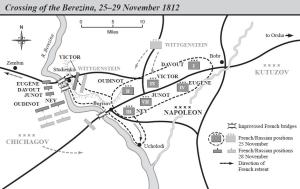
Source: http://en.wikipedia.org/wiki/File:Battle_of_Berezina_map.jpgGregory Fremont-Barnes (main editor) - The Encyclopedia of the French Revolutionary and Napoleonic Wars, page 137. Adapted from Chandler 1966, 840.

Source: http://en.wikipedia.org/wiki/File:Battle_of_Berezina_map.jpg
Gregory Fremont-Barnes (main editor) – The Encyclopedia of the French Revolutionary and Napoleonic Wars, page 137. Adapted from Chandler 1966, 840.

Napoleon had ordered General Jean Baptiste Eblé, the commander of his bridging train, to destroy his equipment in order to prevent it being captured. However, Eblé had destroyed only the actual pontoon bridge, retaining his tools, smithies and charcoal. Thus, his engineers, who were mostly Dutch, could build a pontoon bridge by tearing down local houses for their wood.The problem was that the river was wide at the site of the burnt bridge, and large blocks of ice, propelled by a strong current, were floating down it. This made construction of a replacement at the same site very difficult.

General Jean Baptiste Corbineau, one of Oudinot’s cavalry brigade commanders, then reported that he had found a ford at Studienka, eight miles north of Borisov. Napoleon initially rejected Oudinot’s suggestion of crossing there, but changed his mind after meeting Corbineau on 25 November.

Eblé was ordered to start building three bridges across the Berezina at Studienka at nightfall on 25 November. Various demonstrations were planned in order to distract Chichagov, whose army was to the west of the Berezina an south of Borisov.

A detailed plan was prepared to move the troops still under discipline across the river, starting as soon as the bridges were complete. However, it depended on the enemy being distracted by the diversionary operations and no specific plans were drawn up to allow stragglers to cross.

The first bridge, intended for infantry, was completed by 1pm on 26 November, and the crossing began immediately. The second one, capable of taking wagons, was ready by 4pm. The plan to build a third was abandoned because there were not enough materials to do so.

Lack of time and materials meant that the bridges were improvised and flimsy, and continual repairs were required. The heavier one had to be closed from 8pm  until 11pm on 27 November, from 2am until 4am the next morning and from 4pm to 6pm later that day. The breakages caused hundreds of death.

However, most of the organised and armed troops were across by the end of 27 November, leaving just Victor’s IX Corps as rearguard. The Gendarmes had so far prevented unarmed men and civilians from crossing, but they were now invited to cross. Many, having settled down beside camp fires and, seeing no immediate danger, decided to wait until morning.

The strength of the Grande Armée at this stage is uncertain, but David Chandler estimates that 25,000 men under arms, 110 guns and 40,000 stragglers left Orsha. Joining up with Oudinot and Victor’s corps increased its strength to perhaps 49,000 combatants, 250-300 guns and 40,000 stragglers. About 75,000 Russians were close enough to interfere with the crossing.[4]

Chichagov was slow to realise what was happening, and did not engage Oudinot, who was covering the southern flank on the west bank of the Berezina, until the morning of 27 November. The French had to surrender ground, but maintained their line.

On the east bank of the Berezina, Victor also gave up some ground under pressure from Wittgenstein, but his corps remained intact and Napoleon left able to withdraw one of its brigades, comprised of Germans from Baden, across the river.

The action on both banks began again early on 28 November. Chichagov’s advance guard, commanded by General Eufemiusz Czaplic, a Pole, attacked Oudinot. The position looked so bad for the French that Napoleon prepared to commit the Old Guard, but Oudinot rallied his men. He was wounded, for the 22nd time in his career, and Marshal Michel Ney took command.

Ney was outnumbered by over 30,000 to 12-14,000 men, and his troops were in a worse physical condition. Three quarters of his men, which included Poles, Italians, Wüttermbergers, Dutchmen, Croats, Swiss and Portuguese as well as Frenchmen, fought gallantly.[5]

Ney ordered General Jean-Pierre Doumerc’s cuirassier division to charge the enemy. Czaplic was wounded and 2,000 of his men were captured. This charge, described as ‘brilliant’[6] by Chandler, forced the Russians back. Fighting continued for the rest of the day, but the line had been stabilised.

On the east bank Victor’s force of 8,000 men, mostly from Baden, Hesse, Saxony and Poland, was attacked at 9am by Wittgenstein, who had numerical advantage of four to one. However, the morale of Victor’s men remained, according to Zamoyski, ‘unaccountably high’[7] and they held out.

Victor faced a crisis on his left flank because he was short of troops. One of his divisions, commanded by General Louis Partouneaux, had been ordered to withdraw from Borisov to Studienka in the early hours of 28 November. It took the wrong road and was captured.

Napoleon therefore ordered the Baden brigade that had been withdrawn the day before to cross back over the Berezina. Doing so was very difficult because of the large number of stragglers coming the other way, but the infantry managed to force their way across.

The Russians were able to bring up guns on Victor’s left, which bombarded the bridges, causing panic and great losses amongst the stragglers. Napoleon deployed guns on the west bank, and they inflicted heavy casualties on the Russians who were trying to envelop Victor’s left.

Victor and his men were ordered to retire across the river at 9pm. The bridges had first to be cleared of the dead men and horses and the wreckages of wagons. By 1am, only a small screen was left on the east bank. Victor and Eblé urged the remaining stragglers to cross, but most again decided to wait.

Victor’s last men withdrew at 6am, and the stragglers at last realised the urgency of the situation. Eblé had been ordered by Napoleon to burn the bridges at 7am, but waited until 8:30am because so many were still on the other side of the river. By then the Russians were close to the bridges, leaving him no choice to set them on fire, even though thousands had still to cross.

Chandler argues that ‘Napoleon was undoubtedly in a position to claim a strategic victory’ at the Berezina.’[8] He had extracted the survivors of the Grande Armée, albeit with heavy losses. Chandler attributes this to the inactivity of the Russian commanders and the efforts of Eblé, who he describes as ‘the true hero of the Berezina’[9], Oudinot and Victor.

Chandler also suggests that Kutuzov’s lack of urgency during this phase of the campaign is difficult to interpret as ‘anything else than a deliberate desire to allow Napoleon to escape over the Berezina’[10]

The crossing of the Berezina marked the last major combat of Napoleon’s 1812 Campaign. He had originally intended to fight Chichagov in order to clear the route to Minsk, but the losses incurred in the crossing meant that he had no choice but to retreat to Vilna.

The crossing of the Berezina did not, however, mean the end of the Grande Armée’s ordeal. It continued to suffer casualties in rearguard actions, and to the weather; the temperature was still falling.


[1] Quoted in A. Zamoyski, 1812: Napoleon’s Fatal March on Moscow (London: HarperCollins, 2004), p. 432.

[2] Ibid., pp. 435-7.

[3] Quoted in D. Chandler, The Campaigns of Napoleon (London: Weidenfeld & Nicolson, 1966), p. 834.

[4] Ibid., pp. 841-42.

[5] Zamoyski, 1812, pp. 471-73.

[6] Chandler, Campaigns, p. 842.

[7] Zamoyski, 1812, p. 473.

[8] Chandler, Campaigns, p. 845.

[9] Ibid., p. 841.

[10] Ibid., p. 846.

8 Comments

Filed under War History

The Battle of Krasny, November 1812.

The previous post in this series described Napoleon’s retreat from Moscow to Smolensk, which he reached on 9 November 1812. It took another four days until all his units had arrived. Only 41,500 of the 100,000 men who had started out from Moscow made it to Smolensk.[1]

Click here for a link to a map of Napoleon’s retreat from Moscow on Wikimedia.

There were fewer supplies in Smolensk than Napoleon had hoped, and looting meant that those that there were did not last as long as they would have done if carefully rationed. On the night of 12 November the temperature fell as low as -23.75°C (-10.75°F). Many of the troops were camped out of doors.[2]

Adam Zamoyski points out that Armand Caulaincourt, formerly Napoleon’s Ambassador to Russia, and a member of his entourage, thought that the Emperor could have turned the losses to his advantage by creating a mobile force of around 40,000 men

The wounded could have been left in Smolensk with medical attendants and supplies. Horses, by now in short supply, could have been freed up by ditching loot and the wagons carrying it and part of the artillery. The remaining field force would have been mobile enough to fight its way out of Russia and small enough to be supplied. Instead, the retreat was poorly organised, with the Emperor postponing decisions until the last moment. [3]

Napoleon ordered his army to resume the retreat on 12 November. One corps left each day, ending with the rearguard, commanded by Marshal Michel Ney, on 17 November. The army was therefore strung out along the road. The Emperor himself departed on 14 November.

On 15 November Napoleon and his Imperial Guard reached Krasny. He decided to wait for the rest of his army to catch up. It was harassed by Cossacks and skirmished with the Russian advance guard under General Mikhail Miloradovitch.

The next day Prince Eugene’s 4,000 Italians found the road from Smolensk to Krasny blocked by Miloradovitch’s far larger Russian force. The Italians managed to hold out until nightfall, but seemed certain to be destroyed the next day.

Eugene, however, took them on a night march round the Russians to Krasny. Zamoyski says that a Russian speaking Polish Colonel persuaded Russian sentries that they were acting under orders from Prince Mikhail Kutuzov, the Russian C-in-C.[4]

Napoleon now faced a problem. If he withdrew, then his remaining troops, commanded by Marshals Louis Davout and Ney, might not be able to fight their way through. If he waited for them, then he might find his own retreat cut off by Kutuzov, who was a couple of miles to the south of Krasny. He therefore decided to attack Miloradovitch.

Napoleon led his Imperial Guard forward. They were outnumbered, but Zamoyski says that ‘his bearing…seemed to have impressed not only his own men but the enemy as well.’[5]

Miloradovitch withdrew, allowing Davout’s corps to pass. Kutuzov was urged by his subordinates to attack, since the Russians were strong enough to surround and destroy the enemy, but he did nothing.

Kutuzov did, however, threaten Napoleon’s line of retreat. The Emperor withdrew with the Old Guard, leaving the Young Guard to cover Davout’s retreat. The French suffered heavily from enfilading fire and the Young Guard was almost wiped out. Kutuzov, however, would not attack Napoleon. Zamoyski says that ‘Many on the Russian side felt a deep-seated reluctance to take him on and preferred to stand by in awe.’[6]

David Chandler argues that Krasny ‘reveals the degree of moral ascendancy retained by Napoleon’[7] over his opponents. He also says that it shows that he was correct not to commit the Imperial Guard at Borodino, since events showed that he needed it at Krasny.

Napoleon reached Orsha, a reasonably well stocked supply base on 19 November. He intended to wait there for the remainder of his army. His greatest concern was whether Ney and his 6,000 organised troops, plus double that number of camp followers and stragglers, could make it through Krasny.

Ney encountered Miloradovitch on 18 November, and declined an invitation to surrender. The French tried to break through, but were beaten back with heavy casualties. Miloradovitch and General Sir Robert Wilson, a British observer with the Russian army, both commented on the courage of the French.[8]

Unable to fight his way through, Ney decided to go round the Russians. A crossing point on the Dnieper, which ran north of and roughly parallel to the road, was identified.

After leaving enough camp fires burning to persuade the Russians that his corps was staying put, he led the 2,000 survivors north to the crossing point. The river was frozen, and the ice was just thick enough to take men, provided that they crossed in small groups, but not wagons, guns or horses. Some horsemen and light wagons managed to cross, but cracks appeared in the ice when more tried to follow. In the end, 300 men and all the guns had to be left on the south bank.

The French found food at a village on the north bank that had previously escaped the ravages of war. They were harassed by Cossacks all the way to Orsha, but Ney and 1,000 men made it back to the army.

Napoleon could not linger at Orsha. On 18 November he learnt that Minsk, a major supply base, had been captured by the Russians. Prince Karl Schwarzenberg’s Austrian Corps had been supposed to protect it.

Napoleon accused the Austrians of betrayal. However, Schwarzenberg had moved south-west to support General Jean Reynier’s VIII Corps, which had been attacked by General Fabian Sacken. This left the route to Minsk open to the Russian army commanded by Admiral Pavel Chichagov.

Napoleon’s northern flank was also open. He had ordered Marshal Claude Victor to re-take Polotsk, but he was defeated at Smoliani by Prince Peter Wittgenstein on 13-14 November.

Kutuzov claimed victory at Krasny, but Chandler states that Napoleon had the better of the battle.[9] Zamoyski points out that a real Russian victory would have produced more trophies than Davout’s Marshal’s baton.[10]

However, Napoleon had no alternative but to continue to retreat towards the River Berezina.


[1] D. Chandler, The Campaigns of Napoleon (London: Weidenfeld & Nicolson, 1966), p. 828.

[2] A. Zamoyski, 1812: Napoleon’s Fatal March on Moscow (London: HarperCollins, 2004), pp. 415-16.

[3] Ibid., pp. 418-19.

[4] Ibid., p. 421.

[5] Ibid., p. 422.

[6] Ibid., p. 424.

[7] Chandler, Campaigns, p. 829.

[8] Zamoyski, 1812, pp. 426-27.

[9] Chandler, Campaigns, p. 829.

[10] Zamoyski, 1812, p. 431.

5 Comments

Filed under War History

Napoleon’s Retreat from Moscow to Smolensk

The previous post in this series described how Napoleon decided to retreat from Moscow on 18 October 1812. His intention was to make for the supply depot at Smolensk by a southerly route. This might require a battle with Mikhail Kutuzov’s Russian army, but would mean that the French were not moving through the territory that had been ravaged in their advance on Moscow.

The Grande Armée set off on 19 October, moving south west towards Kaluga. The main body took the older of the two roads to Kaluga, with Prince Eugene’s IV Corps taking the newer road, which was further to the west. Napoleon ordered Marsahl Edouard Mortier, commander of the French rearguard, to destroy the Kremlin before withdrawing on 23 October. The French demolition charges did not work properly, damaging but not destroying the Kremlin.

According to David Chandler, Napoleon had told his men that he intended to attack Kutuzov’s left flank, realising that this news would reach the Russians. He hoped that Kutuzov would consequently move to the east and allow the French to escape to Smolensk.[1]

Adam Zamoyski speculates that Napoleon may have intended to attack the Russians, with Eugene launching a flanking manoeuvre. If Napoleon did consider this, he changed his mind, since on 21 October the main French army moved to join Eugene on the new road.[2]

Kutuzov was quickly informed that the French had left Moscow, but was slow to move. General Dimitry Dokhturov learnt from prisoners that the Grande Armée corps was heading for the road junction at Maloyaroslavets. The French would threaten the flanks and supply lines of the Russian army if they took the junction, so Dokhturov moved his corps there. Control of Maloyaroslavets would give mean that Napoleon could proceed to Smolensk via either Medyn or Kaluga

General Alexis Delzons’s 13th Division reached Maloyaroslavets ahead of Dokhturov, but Delzons left only two battalions in the town. Dokhturov’s corps attacked at dawn on 24 October, taking the town and forcing Delzons to retreat back across the river.

Delzons launched a counter-attack and forced the Russians back. The Croatians of the 1st Illyrian Regiment did particularly well. Kutuzov’s leading corps, under General Nikolai Raevsky, arrived and re-captured the town. General Domenico Pino’s 15th (Italian) Division then took it back. The Russians fell back, but took up a position that covered the bridges over the river.

By 1pm most of the Grande Armée was drawn up on the north back, but Napoleon decided not to send it across the river because the well-positioned Russian artillery would have inflicted heavy casualties on it as it moved.

Fierce fighting continued in the town for the rest of the day and the Italians held it at nightfall. General Sir Robert Wilson, a British observer with the Russian army, wrote that:

The Italian army had displayed qualities which entitled it evermore to take rank amongst the bravest troops in Europe. [3]

The action had involved 27,000 soldiers and 72 guns of the Grande Armée against 32,000 Russians with 354 guns. Napoleon had lost 6,000 men, including Delzons. Russian casualties were higher, but they could be replaced. Napoleon now had only about 65,000 men with him, facing 90,000 Russians with 500 guns.

Early on the 25 October Napoleon carried out a reconnaissance of the battlefield. He was nearly captured by Cossacks, but his escort fought them off. Baron Agathon Fain, his secretary, said that the Emperor was badly affected by the sight of the corpses on the battlefield, many of whom had been burnt to death.[4]

Kutuzov had withdrawn two kilometres to a new position. Attacking it might result in a decisive French victory, but casualties would be heavy. The Russian withdrawal had opened up the route to Smolensk via Medyn, but taking this route would mean that the Grande Armée would be closely pursued by the Russians all the way to Smolensk.

Napoleon therefore decided to retire and head for Smolensk via the route that the Grande Armée had originally advanced along.

Zamoyski points out that Kutuzov, concerned about the inexperience of his troops, was reluctant to fight a pitched battle with the Grande Armée . He suggests that if Napoleon had moved boldly, he could have reached Medyn, where supplies were available, joined up with General Louis Baraguay d’Hilliers’s division and reached Smolensk by 3 or 4 November.[5]

Chandler argues that Napoleon’s plan to defeat Kutuzov before heading to Smolensk via Kaluga was the best option open to him. Changing his plan now meant that six days had been wasted. He could still have headed for Smolensk via Medyn, but reverting to the original line of advance ‘was to court disaster.’[6] Charles Esdaile calls Maloyaroslavets a ‘pointless battle’[7] for the French as it wasted a lot of time.

The Grande Armée marched along a single road, meaning that those further back had to march through ground churned up by those ahead of them. The horses were in poor condition, so it was hard for them to pull guns and wagons. Some generals wanted to speed up the column by abandoning part of the artillery, but Napoleon refused, as he argued that he was making a tactical withdrawal rather than retreating.

On 28 October the head of the column reached the battlefield of Borodino. The corpses had not been cleared away, and large numbers of French wounded had not been evacuated. Napoleon ordered that they should be taken along, against the advice of his Surgeon-General, Baron Dominique Jean Larrey and other doctors. Few survived the retreat.

Napoleon reached Vyazma on 1 November. He reached despatches that informed him that things were going badly on his flanks. In the south the Austrian Prince Karl Schwarzenberg was withdrawing towards the River Bug, exposing Napoleon’s flank. In the North a Franco-Bavarian army under Marshal Laurent St Cyr had been forced to retreat from Polotsk

St Cyr had been promoted to Marshal after the First Battle of Polotsk on 18 August 1812, in which he took over from the wounded Marshal Charles Oudinot and defeated Prince Peter Wittgenstein’s Russian army.

On 18 October Wittgenstein, who had been reinforced and now outnumbered St Cyr, launched a new attack on St Cyr at Polotsk. The Franco-Bavarians held off the attack on the first day; casualties on both sides were heavy. St Cyr realised late the next day that he was in danger of being encircled. A Bavarian counter-attack on 20 October enabled the Franco-Bavarian force to withdraw, but the road to the French supply base at Vitebsk was opened.

The retreat continued, with the column being pressured by both Cossacks and Kutuzov’s advance guard, commanded by Count Mikhail Miloradovich. On 3 November Miloradovich attacked the Grande Armée’s rearguard, Marshal Louis Davout’s I Corps, to the east of Vyazma.

Davout received support from Eugene’s IV Corps and Marshal Josef Poniatowski’s IV Corps. The French suffered heavy casualties, but were able to fall back on Marshal Michel Ney’s III Corps. It had been left at Vyazma with orders to replace the I Corps as the rearguard once it was clear of the town.

French casualties were about 6,000 dead and wounded and 2,000 prisoners. Poniatowski, crushed beneath his horse, was amongst the wounded. Russian losses were at most 1,845. As well as human casualties, the Grande Armée suffered a loss of cohesion. Zamoyski argues that the Russians could have destroyed four French corps if Kutuzov had attacked with his full army.[8]

Until 3 November the retreat had taken place in reasonable weather. The temperature fell sharply on the night of 4-5 November, and the snow began on 6 November. Armies did not then normally campaign in the winter, so the French uniforms were completely inadequate for the Russian winter. Zamoyski describes how men out on fur coats and even women’s dresses that they had plundered from Moscow to take home to their womenfolk.[9]

Troops in units that retained their discipline and cohesion coped best. Stragglers, without comrades to help and support them, fared worse. The animals fared worse; deaths amongst horses meant that wagons and thus supplies had to be abandoned. Saul David’s recent BBC TV series on logistics and war, Bullets, Bombs and Bandages, explained that the French horses had the wrong type of shoes, which made it hard for them to walk on the snow and ice.

Napoleon continued to receive bad news as he retreated. On 6 November he was told that General Claude Malet, a patient at a sanatorium, had escaped and tried to launch a republican coup in Paris on 23 October, claiming that the Emperor was dead. It was quickly suppressed, but Malet had easily fooled some local commanders and Napoleon’s infant son and heir had received little support. The Emperor therefore decided that he needed to return to Paris as soon as possible.

The next day Napoleon learnt that Marshal Louis Victor had been forced to retreat after a battle with Wittgenstein at Czasniki on 31 October. The seriousness of the situation was shown by the phrasing of the order that Napoleon sent to Victor to attack Wittgenstein and re-capture Polotsk. Victor was told to:

Take the offensive  – the safety of the whole army depends on you; every day’s delay can mean a calamity. The army’s cavalry is on foot because the cold has killed all the horses.[10]

Napoleon reached Smolensk on 9 November. It was four days before the whole of the retreating column arrived. The food stocks were lower than expected and this was compounded by looting. Chandler says that in three days the army ate supplies that could have been eked out to last a fortnight; it now comprised only 41,500 men.[11]

The Grande Armée did not stay long in Smolensk. Napoleon wanted to link up with Victor and Oudinot’s 25,000 men and considered wintering at his Vitebsk supply base. He did not know that the Russians had captured it on 7 November.


[1] D. Chandler, The Campaigns of Napoleon (London: Weidenfeld & Nicolson, 1966), p. 820.

[2] A. Zamoyski, 1812: Napoleon’s Fatal March on Moscow (London: HarperCollins, 2004), p. 369.

[3] Quoted in Ibid., p. 373.

[4] Ibid., p. 374.

[5] Ibid., pp. 375-77.

[6] Chandler, Campaigns, p. 823.

[7] C. J. Esdaile, Napoleon’s Wars: An International History, 1803-1815 (London: Allen Lane, 2007), p. 478.

[8] Zamoyski, 1812, pp. 387-88.

[9] Ibid., pp. 391-92.

[10] Quoted in Chandler, Campaigns, p. 827.

[11] Ibid., pp. 827-28.

4 Comments

Filed under War History

Napoleon Retreats from Moscow, 18 October 1812

This post leads on from this one on the Battle of Borodino on 7 September 1812.

After Napoleon’s victory at Borodino led to the French capture of Moscow, Prince Mikhail Kutuzov’s Russian army retreated to Tarutino, south and slightly to the west of Moscow. Adam Zamoyski describes this as ‘a good position.’[1] It was a sufficient distance from Moscow to be safe from a major French attack, threatened the French lines of communication and protected the routes to the south.

The French cavalry, commanded by Marshal Joachim Murat, and Marshal Josef Poniatowski’s V Corps were near Tarutino. Some Russian generals, notably Count Levin Bennigsen, wanted to attack them, but Kutuzov realised that his army needed time to rest, recuperate and receive reinforcements.

The rest of the French army was around Moscow. Much of the city was destroyed by a fire that started on 15 September and lasted for three days. City Governor Count Fyodor Rostopchin had made preparations to burn any stores useful to the French and city and had ordered Police Superintendent Voronenko to set fire to not only the stores, but to anything that would burn. Rostopchin had also withdrawn all the fire fighting pumps and their crews from the city.

Zamoyski suggests that the fires started by Voronenko and his men were further spread by local criminals and French soldiers engaged in looting, and by the wind. He contends that the fire left many French troops without shelter. Other historians who believe that the fires were started deliberately by the Russians include David Bell and Charles Esdaile.[2]

David Chandler agrees that Rostopchin ordered the fires, but says that most supplies and enough shelter for the 95,000 French troops remained intact. He argues that a complete destruction of the city would have actually been better for the French, as it would have forced them to retreat earlier. Instead, Napoleon stayed in the hope that he could persuade Tsar Alexander to come to terms.[3]

On the other hand, Leo Tolstoy claims in his novel War and Peace, the most famous book on the 1812 Campaign, that the fire was an inevitable result of an empty and wooden city being occupied by soldiers who were bound to smoke pipes, light camp fires and cook themselves two meals a day.[4]

On 5 October Napoleon sent delegations to attempt to negotiate a temporary armistice with Kutuzov and a permanent peace with Alexander. Kutuzov, who wanted to gain time to strengthen his forces, received the French delegates politely and gave them the impression that Russian soldiers wanted peace.

However, Kutuzov refused to allow the delegation to proceed to St Petersburg to meet the Tsar. He sent their letters on to the Tsar, with a recommendation that Alexander refuse to negotiate, which the Tsar accepted. According to Chandler, Napoleon refused to believe that the Tsar would not negotiate until a second French delegation also failed.[5]

The balance of power was moving against Napoleon as time passed. Chandler says by 4 October Kutuzov had 110,000 men facing 95,000 French at Moscow and another 5,000 at Borodino. The Russians had an even greater advantage on the flanks.[6]

Napoleon had been sure that Alexander would negotiate once Moscow fell and had not planned what to do if the Tsar refused to make peace. According to Zamoyski, Napoleon had studied weather patterns and believed that it would not get really cold until December, but did not realise how quickly the temperature would drop when it changed.[7]

Chandler argues that he had six options:

  1. He could remain at Moscow. His staff thought that there were sufficient resources to supply his army for another six months. However, he would be a long way from Paris, in a position that was hard to defend and facing an opponent who was growing stronger. His flank forces would have greater supply problems than the troops in Moscow.
  2. He could withdraw towards the fertile region around Kiev. However, he would have to fight Kutuzov and would move away from the politically most important parts of Russia.
  3. He could retreat to Smolensk by a south-westerly route, thus avoiding the ravaged countryside that he had advanced through. This would also mean a battle with Kutuzov.
  4. He could advance on St Petersburg in the hope of winning victory, but it was late in the year, his army was tired and weakened and he lacked good maps of the region.
  5. He could move north-west to Velikye-Luki, reducing his lines of communication and threatening St Petersburg. This would worsen his supply position.
  6. He could retreat to Smolensk, and if necessary, Poland the way that he had come. This would be admitting defeat and would mean withdrawing through countryside already ravaged by war.

There were major objections to each option, so Napoleon prevaricated, hoping that Alexander would negotiate. On 18 October Napoleon decided on the third option, a retreat to Smolensk via the southerly route, which would entail a battle with Kutuzov. He ordered that the withdrawal should begin two days later.[8]

Also on 18 October, however, Kutuzov decided to attack Murat’s cavalry at Vinkovo. An unofficial truce had been in operation, so the French were taken by surprise. Murat was able to fight his way out, and Kutuzov did not follow-up his limited success.

However, the Battle of Vinkovo, also known as the Battle of Tarutino, persuaded Napoleon to bring the retreat forward a day. Around 95,000 men and 500 cannon left Moscow after 35 days, accompanied by 15-40,000 wagons loaded with loot, supplies, wounded and sick soldiers and camp followers.[9]

In an attempt to distract Kutuzov, Napoleon sent another offer of an armistice and told his men that he intended to attack the Russian left flank, expecting this false intelligence to reach Kutuzov.


[1] A. Zamoyski, 1812: Napoleon’s Fatal March on Moscow (London: HarperCollins, 2004), p. 333.

[2] D. A. Bell, The First Total War: Napoleon’s Europe and the Birth of Modern Warfare (London: Bloomsbury, 2007), p. 259; C. J. Esdaile, Napoleon’s Wars: An International History, 1803-1815 (London: Allen Lane, 2007), p. 478; Zamoyski, 1812, pp. 300-4.

[3] D. Chandler, The Campaigns of Napoleon (London: Weidenfeld & Nicolson, 1966), pp. 814-15.

[4] L. Tolstoy, War and Peace, trans., A. Maude, Maude, L. (Chicago IL: Encyclopaedia Britannica Inc., 1952). Book 11, p. 513.

[5] Chandler, Campaigns, p. 814.

[6] Ibid., pp. 815-16.

[7] Zamoyski, 1812, p. 351.

[8] Chandler, Campaigns, pp. 817-19.

[9] Ibid., pp. 819-20; Zamoyski, 1812, pp. 367-68.

8 Comments

Filed under War History

The Battle of Borodino, 7 September 1812

This post follows on from this one on the Battle of Smolensk on 17 August 1812.

Most of French army rested near Smolensk for 6 days after the battle and Napoleon thought about wintering there. This would allow new drafts to be trained and the supply arrangements to be improved. Napoleon might obtain a large Polish army if he allowed the establishment of a Polish Kingdom. An advance on Moscow might not bring victory, and could leave the French deep in Russia in winter, with long and exposed lines of communication.

However, Napoleon needed to get Russia back into the Continental System, by which he was conducting economic warfare against Britain, as quickly as possible. The Russians would also be able to train reinforcements and might counter attack. The French already had supply problems. Setting up an independent Poland would make it hard to achieve a negotiated peace and would upset that Austrian and Prussian monarchs. Halting the offensive would be presented as a defeat by his foreign enemies and his domestic opponents would conspire against him if he stayed away from Paris for too long.

David Chandler argues that Napoleon believed the only way to win a war was to destroy the enemy army. He thought that Tsar Alexander would have to fight for Moscow:

If for logistical reasons it was dangerous to linger at Smolensk, it was even more risky to head for Moscow, but only by such a bold course could there by any possibility of a reasonably rapid conclusion to the campaign.[1]

Alexander had decided to give up his strategy of conceding ground. On 24 July he made a successful appeal for new recruits. Religious symbols were presented to the army.

On 17 August, with the battle of Smolensk about to start, a meeting of senior generals urged Alexander to replace Mikhail Barclay de Tolly as commander-in-chief of the army with the Mikhail Kutuzov, a veteran of Russia’s wars with Poland and Turkey. He had done a good job in extracting the Russian survivors of the defeat at Austerlitz; he was nominally in command there, but Alexander was present and had ignored his advice not to fight. He did not receive another field command until 1811, when he won a number of victories against the Turks.[2]

Charles Esdaile points out that the loss of Smolensk, a major centre for the Russian Orthodox Church, threatened the estates of several leading nobles. Many officers were bitter and angry that they had continually to retreat. The government was successfully trying to boost Russian patriotism. Kutuzov was the leading ethnic Russian general whilst Barclay, who had surrendered much Russian territory, was regarded as a foreigner.[3] In fact, although Barclay had a Scottish name, he had been born in modern Latvia and his Scottish ancestors had emigrated to Russia in the seventeenth century.[4]

The Tsar ‘feared and resented’[5] Kutuzov and hesitated for three days before accepting that the strength of opinion amongst his nobles and generals left him with no choice but to appoint the 67 year old veteran. Alexander, concerned over Kutuzov’s ‘possible treachery as well as his imputed incompetence’[6], appointed Count Levin Bennigsen as his Chief of Staff. Barclay retained command of the Russian 1st Army.

On 24 August Napoleon decided to advance on Moscow the next day. As before, his army was menaced by Cossacks as it moved through territory that had been subjected to a policy of scorched earth. Heavy rain made Napoleon say on 30 August that he would return to Smolensk the next day unless the weather improved, but 31 August was dry and sunny.

By 5 September the French could see the Russians digging in around the village of Borodino. There is some doubt over which was the bigger army. Chandler, Esdaile and Zamoyski all put the French one at over 130,000. Chandler has 156,000 French leaving Smolensk, but 133,000 at Borodino. Chandler and Esdaile both say that there were 121,000 Russians at the battle, but Zamoyski argues that recent Russian research estimates the Russian strength at 154,800 to 157,000 men. This includes 10,000 Cossacks and 30,000 militia, who played little role in the battle, but the French Guard, which Zamoyski  puts at 25,000 men and Esdaile at 18,000, also did not fight in the battle. Chandler gives the Russians an advantage of 640 to 587 in artillery.[7]

John Elting notes that this was the largest ratio of artillery to men that Napoleon, an artilleryman, had at any of his battles; 4.5 guns per 1,000 men compared with around two in his early battles, 3.9 at Wagram in 1809 and 3.5 at the later battles of Leipzig in 1813 and Waterloo in 1815.[8]

The Russians had taken up a naturally strong defensive position, which they had then strengthened by the construction of a series of redoubts. One was a mile in front of the main position at the hamlet of Shevardino. The main line was held by a large entrenchment called the Great or Raevski Redoubt to the north and three flèches on hills further south. The flèches were arrow-shaped redoubts fortified on three sides, but with the rear open. An earthwork at Gorki guarded the new post road to Moscow and others covered the River Kalatsha north of Borodino. See the map below:

http://en.wikipedia.org/wiki/File:Battle_of_Borodino_map.jpg. Original from Gregory Fremont-Barnes (main editor) – The Encyclopedia of the French Revolutionary and Napoleonic Wars, page 172. Adapted from Chandler 1987, 437.
Reference to Chandler is unclear, but may be The Dictionary of Battles (London: Ebury Press, 1987).

There was a fight for the Shevardino Redoubt on the afternoon and evening of 5 September, which ended when Kutuzov withdrew to the main line after the Polish General Jozef Poniatowski’s V Corps moved along the old post road.

Napoleon was ill with a heavy cold and an old bladder infection, meaning that he was far less active during the battle than normal. Both sides spent 6 September preparing for battle. Napoleon decided that the terrain north of Borodino was too difficult for an attack. A demonstration there would have tied down Russian troops, but this was not done. He made the capture of the Great Redoubt a priority, even though this would mean heavy casualties.

Marshal Louis Davout wanted to outflank the Russians to the south with 40,000 troops, but Napoleon told him ‘Ah, you are always for turning the enemy. It is too dangerous a manoeuvre.’[9] The Emperor thought that the Grande Armée was too small to detach a large flanking force and was concerned about the condition of his troops, artillery and especially horses. The Russians might avoid battle if they realised that he was planning to outflank them. Even if he succeeded in threatening their communications, his study of Frederick the Great’s campaigns convinced him that this did not greatly concern Russian armies that were about to fight a major battle.

Short of time, Napoleon decided on a frontal attack rather than a battle of manoeuvre. The attack began at 6 am and initially went well, with the French taking Borodino in the north, the flèches in the centre and Utitsa in the south. Russian counter attacks began at 7 am, forcing the French back. The open backs of the flèches made it hard for the French to defend them against counter attacks.

Kutuzov realised that there was no French threat north of Borodino, allowing him to move troops who were guarding the Kalatsha further south. Napoleon also committed new troops. By 8:30 am he had few reserves left other than the Imperial Guard.

The French launched a new attack against the Russian centre just after 10 am. Artillery caused heavy losses on both sides, including generals. Davout had been wounded earlier, and Marshal Michel Ney received four wounds during this phase, whilst the Russian Prince Piotr Bagration was killed. The Russians were forced back and Marshal Joachim Murat’s French cavalry, seeing an opportunity for victory charged, but the Russians formed square and held firm. Davout, Murat and Ney urged Napoleon to commit the Old Guard, but the Emperor refused.

The Russians had been forced back, but were able to reinforce the hardest pressed parts of their line. Chandler argues that Kutuzov did not actively command, but left most decisions to his subordinates, contenting himself with accepting or rejecting their ideas. Napoleon, tired and in poor health, did not perform well. preferring to stay at his command post and receive reports rather than going forward to see what was happening.[10]

A surprise attack by Uvarov’s Russian cavalry forced the French out of Borodino. Napoleon’s step-son Prince Eugène stabilised the situation, but this delayed his IV Corps’ planned attack on the Great Redoubt, and made Napoleon sure that he must not commit his Guard in case of further such surprises.

Eugène’s attack was carefully planned and had the support of 400 guns. Casualties were again heavy, but the French had taken the Great Redoubt by 3 pm. Eugène sent forward every available cavalryman in an attempt to exploit the success, but Barclay stopped the French advance by sending in two corps of Russian cavalry, whose horses were in far better condition than the French ones.

Eugène asked Napoleon to deploy the Guard, but the Emperor refused. Chandler notes that Marshals Murat and Louis Berthier agreed with him this time and argues that the Emperor was correct to maintain it intact, since he was 1,200 miles from home.[11] The Russians were able to retire to new positions.

The Russians launched a counter-attack, which was stopped by French artillery. In the south Poniatowski’s V Corps advanced, and by 6pm the Russians in the south had withdrawn to the line held by the rest of their army. The Russians had been forced back to an inferior position, but their army was still intact. The fighting now died down.

The most common figures for casualties (dead and wounded) are 30,000 French and 44,000 Russians, making this the bloodiest battle of the Napoleonic Wars and perhaps any until the First World War, but estimates vary from 28,000 to 50,000 French and 38,500 to 58,000 Russians. The casualties included 48 French generals, 11 of them dead, and 29 Russian generals, six of them killed. The French fired between 60,000 and 90,000 artillery rounds and 1,400,000 to 2 million musket cartridges.[12]

Chandler argues that neither Napoleon nor Kutuzov significantly contributed to the battle. The Russian generals made many mistakes; unnecessarily extending their line before the battle, leaving the southern flank open, exposing their reserves by putting them too far forward and not exploiting Uvarov’s local success. Chandler says that ‘[w]hat saved the Russian army was the dogged courage and endurance of its rank and file.’[13]

Borodino is known as La Bataille de la Moskova in France. Napoleon could claim victory on the basis of occupation of the ground, and probably casualties inflicted, but he had not destroyed the Russian army.

Kutuzov realised that his army was not capable of fighting again and retreated towards Moscow, 75 miles to the east. On 13 September he called a meeting of his eight most senior generals. Four, including Barclay, agreed with his view that the army would be destroyed if it fought again, and that it was more important to preserve it than to defend Moscow.  Bennigsen, supported by the other three, wanted to attack a French corps on the march. Kutuzov decided to withdraw and the Army abandoned Moscow early on 14 September.

Zamoyski describes Kutuzov’s decision to give up Moscow to save his army as ‘ the only brilliant decision he made during the whole campaign.’[14] He notes that Kutuzov told the Tsar that the loss of Smolensk made the loss of Moscow inevitable, thus transferring the blame to Barclay.[15] The French army, now reduced to 100,000 men entered Moscow later the same day. It was deserted as two-thirds of the population of 270,000 had left and most of the others stayed indoors.


[1] D. Chandler, The Campaigns of Napoleon (London: Weidenfeld & Nicolson, 1966), p. 792.

[2] P. J. Haythornthwaite, The Napoleonic Source Book (London: Arms & Armour, 1990), pp. 339-40.

[3] C. J. Esdaile, Napoleon’s Wars: An International History, 1803-1815 (London: Allen Lane, 2007), pp. 475-76.

[4] A. W. Palmer, An Encyclopaedia of Napoleon’s Europe (London: Weidenfeld and Nicolson, 1984), pp. 25-26.

[5] A. Zamoyski, 1812: Napoleon’s Fatal March on Moscow (London: HarperCollins, 2004), p. 25.

[6] Ibid., p. 248.

[7] Chandler, Campaigns, pp. 794, 1119; Esdaile, Napoleon’s Wars, pp. 476-77; Zamoyski, 1812, pp. 258-59.

[8] J. R. Elting, Swords around a Throne : Napoleon’s Grande Armée (London: Weidenfeld and Nicolson, 1988), p. 59.

[9] Chandler, Campaigns, p. 798.

[10] Ibid., p. 804.

[11] Ibid., pp. 805-7.

[12] Ibid., pp. 806-7; Esdaile, Napoleon’s Wars, p. 477; Zamoyski, 1812, pp. 287-88.

[13] Chandler, Campaigns, p. 808.

[14] Zamoyski, 1812, p. 287.

[15] Ibid., p. 292.

5 Comments

Filed under War History

Battle of Smolensk, 17 August 1812.

This post follows on from this one on Napoleon’s campaign in Russia up to Battle of Vitebsk on 28 July 1812.

The Russian commander, General Michael Barclay de Tolly, was reluctant to attack. The further that the French advanced into Russia, the better the odds became for the Russians. The French were being harassed by Cossacks and had to leave troops to guard their lines of supply, whilst the Russian were able to bring up more troops.

However, most Russians could not understand why they were surrendering so much territory without a fight, especially after Barclay was joined by General Peter Bagration’s Second Army on 4 August. According to David Chandler, Barclay commanded 125,000 men and Napoleon had about 185,000 in the immediate area.[1]

Barclay was under pressure both from both Tsar Alexander and from his subordinates to attack. On 6 August his generals persuaded him to concentrate against Marshal Joachim Murat’s cavalry and Marshal Michel Ney’s corps. The next day, Barclay received false reports that there was a French force at Poriechie to his north. He re-aligned his army to the north to face the supposed French threat.

General Matviei Platov, commanding the Don Cossacks. did not receive the order to move north. He encountered and defeated General Horace Sebastiani’s cavalry division at the Battle of Inkovo, taking 200 prisoners, but had to retreat when the French counter-attacked.

Barclay ordered a cautious advance on 13 August, but Bagration, angered by Barclay’s continual changes of orders, declined to co-operate. He had put himself under Barclay’s command when they united on 4 August, but he was not officially subordinate to Bagration.

Napoleon had halted his advance on Smolensk and prepared to receive a Russian attack when he learnt of Inkovo. By 10 August it was apparent that this was not going to happen and he resumed preparations for an attempt to envelop the Russians at Smolensk. Chandler says that:

Almost all commentators agree that this operational plan constitutes one of Napoleon’s masterpieces…This was a manoeuvre of strategic envelopment worthy of the one that preceded his great triumph of Jena-Auerstadt in 1806, and if it had succeeded the fruits of victory would have been no less impressive.[2]

The French manoeuvres started on 11 August. Barclay put a rearguard of 8,000 infantry and 1,500 cavalry under General Neveroski on the south bank of the Dnieper to guard the approaches to Smolensk. It held up the French cavalry, which might otherwise have reached Smolensk on 14 August. Instead, Napoleon paused for a day to re-group.

Napoleon had now lost the element of surprise and the Russians were able to withdraw to Smolensk. Barclay ordered General Raevski to occupy it with 20,000 men and 72 guns. It had a medieval wall and some more modern defences, but these were in a poor state of repair.

The French reached Smolensk on 16 August. Some fighting took place, but they did not attempt to storm the city until the next day. The Russians held on, suffering 12-14,000 casualties, but inflicting 10,000. Chandler says that it is unclear why Napoleon attacked rather than masking the city and moving to threaten the Smolensk to Moscow road.[3]

Barclay feared such a manoeuvre and evacuated Smolensk on the night of 17-18 August after destroying all his stores. Grand Duke Constantine, the Tsar’s brother, and General Bennigsen objected to this and accused Barclay of cowardice.

The French were slow to move, and their pursuit did not get properly underway until 19 August. General Junot was ordered to take his corps over the Dnieper at Prudichevo in order to cut off the Russian retreat, but took all day to find a crossing, and then did not attack. Ney and Murat were held up by the Russian rearguard under Eugen and Tutchkov at Valutino, and the main Russian

Napoleon did have some good news on 18 August; a victory at Polotsk secured his northern flank. Marshal Charles Oudinot, the French commander, was wounded, but General Laurent St Cyr took over and defeated the Russians. St Cyr was promoted to Marshal.

However, Napoleon was having to advance even further into Russia in an attempt to bring the Russians to battle.


[1] D. Chandler, The Campaigns of Napoleon (London: Weidenfeld & Nicolson, 1966), p. 782.

[2] Ibid., pp. 783-84.

[3] Ibid., p. 786.

3 Comments

Filed under War History

Napoleon’s 1812 Russian Campaign to the Capture of Vitebsk on 28 July

This post follows on from previous ones describing Napoleon’s invasion of Russia in June 1812 and the reasons why he invaded.

Napoleon was aware that his invasion of Russia presented major supply problems, describing it as ‘the greatest and most difficult enterprise that I have ever attempted.’[1] He did not expect to have to advance far into Russia, believing that he could win a decisive victory near the frontier.

Napoleon reached Vilna on June 28. He had hoped to engage Tsar Alexander I and the First Army under General Prince Michael Barclay de Tolly, but they had retreated north-east towards Drissa. This increased the distance between the First Army and the Russian Second Army, commanded by General Prince Peter Bagration.

Napoleon attempted to trap and destroy Bagration’s army between the I Corps of Marshal Louis Davout and his right flank, commanded by his brother Jerome, King of Westphalia; the 45,000 Russians would be surrounded by 110,000 troops.[2]

On 4 July, Bagration learnt that Davout had crossed his line of retreat and moved south towards Minsk. Jerome,  hampered by supply problems, poor roads and heavy rain, moved slowly, and Bagration escaped. Jerome failed to keep his brother informed of his movements. Napoleon told him that:

If you had the most elementary grasp of soldiering, you would have been on the 3rd where you were on the 6th, and several events which would have resulted from my calculations would have given me a fine campaign.[3]

Napoleon blamed Jerome for the French failure to destroy Bagration’s army. Charles Esdaile says that this is now generally regarded as being unfair; Jerome was not a good general, but he was given an impossible task by his brother. The French faced great supply problems in a country where they could not rely in the local population. The army was too big and the distances too vast to allow Napoleon to control the battle and to carry out a battles of encirclement.[4] Adam Zamoyski blames Napoleon, who had appointed his brother, who had no military experience, to high command for political reasons.[5]

Napoleon put Jerome under the command of  Davout. Jerome was angered by his brother’s criticisms and got on poorly with Davout. He left the army and returned to Westphalia.

Napoleon ordered Davout to pursue Bagration and prevent the two Russian armies joining forces. Napoleon intended to destroy Barclay de Tolly’s army, which had reached Drissa on 11 July. Its fortifications were strong, so Napoleon decided to turn its flank, forcing the Russians to retreat and fight in the open.

On 12 July Alexander accepted that Drissa was a trap for his army, and that it should withdraw to Vitebsk. Adam Zamoyski points out that this decision, whilst militarily correct, created problems for Alexander. He had made a rousing speech the day before, promising his troops a victorious battle. The army had done nothing to fight the invader, and Alexander had given up a large proportion of his empire. The Tsar was persuaded by his advisers that his place was in his capital, rallying his people and recruiting more troops. He therefore left the army.[6]

On 19 July Napoleon received a report that the Russians had left Drissa. He expected the Russian armies to meet at Polotsk, and thus moved towards Kamen. Two days later he realised that their rendezvous was to be at Vitebsk. On 23 July Bagration and Davout fought a battle, called Mogilev by the French and Saltanovka by the Russians. Bagration was unable to break through and unite with Barclay.

Engagements took place between the French cavalry under Marshal Joachim Murat and Barclay’s troops at Ostrovno on 25 and 26 July. This convinced Napoleon that Barclay was willing to give battle, and he decided to wait until 28 July to bring up more troops, rather than attacking on 27 July with the troops available.

David Chandler considers this decision to be a major error by Napoleon. Barclay abandoned his original plan to fight at Vitebsk when he learnt that Bagration could not move to support him. The day’s delay allowed the Russians to withdraw towards Smolensk. There were enough good roads for him to be sure of getting there safely.[7]

Barclay, according to Adam Zamoyski, was correct to withdraw. A Russian victory would have been highly unlikely, and would not have been decisive; Barclay commanded the main Russian army but faced only part of Napoleon’s army. The failure to win a victory damaged French morale.[8]

The French took Vitebsk on 28 July. It had been the most easterly city of Poland until 1772,  when Austria, Prussia and Russia carried out the first of their three partitions of Poland. The French had taken all of Lithuania and had a defensible position. Napoleon initially claimed that:

Here I stop! Here I must look around me, rally, refresh my army and organise Poland. The campaign of 1812  is finished.[9]

Napoleon, however, soon changed his mind.  The country to the east was more fertile and the Russian armies were only about 100 miles away. On 12 August he marched on Smolensk, intending to inflict a decisive defeat on the Russians; see the next post in this series.


[1] Quoted in C. J. Esdaile, Napoleon’s Wars: An International History, 1803-1815 (London: Allen Lane, 2007), p. 462.

[2] D. Chandler, The Campaigns of Napoleon (London: Weidenfeld & Nicolson, 1966), pp. 775-76.

[3] Quoted in A. Zamoyski, 1812: Napoleon’s Fatal March on Moscow (London: HarperCollins, 2004), p. 176.

[4] Esdaile, Napoleon’s Wars, p. 468.

[5] Zamoyski, 1812, pp. 167-68.

[6] Ibid., pp. 171-72.

[7] Chandler, Campaigns, p. 779.

[8] Zamoyski, 1812, pp. 179-81.

[9] Quoted in Esdaile, Napoleon’s Wars, p. 470.

4 Comments

Filed under War History

Why Napoleon Invaded Russia in 1812

This post follows on from this one on the military aspects of the actual invasion.

Russia and France were allied in 1807 by the Treaties of Tilsit, which also involved Prussia. Tsar Alexander I of Russia agreed to comply with the Continental System, Napoleon’s attempt to wage economic war on Britain. Alexander supported Napoleon when he went to war with Austria in 1809, sending an army to threaten Austria’s eastern frontier. His foreign minister, Nikolay Rumiantsev, thought that the alliance was in Russia’s interests.

Charles Esdaile argues that Napoleon damaged Franco-Russian relations by making too many demands of his ally. He wanted Russia to send troops to the West, and away from Serbia and the Danube, where Russia was fighting the latest in a long series of wars with the Ottoman Empire. Napoleon ignored Russia’s interests and left Alexander feeling that he was regarded as the junior partner in the Alliance.[1]

The Poles under Marshal Joseph Poniatowski, unlike the Russians, gave great support to Napoleon in 1809. Poland had been first weakened and then destroyed after its territories were partitioned by Austria, Prussia and Russia in 1772, 1793 and 1796. The Treaty of Tilsit between France and Prussia in 1807 had established the Grand Duchy of Warsaw as a French satellite; it consisted of most of the former parts of Poland annexed by Prussia. In 1809 it was expanded by the addition of territory taken over by Austria.

Alexander, wanting to retain the lands that Russia had acquired when Poland was partitioned, saw the growth of the Duchy of Warsaw as a threat. It was not called Poland but used Polish symbols and the Polish language. He tried to negotiate a treaty under which Austria, France and Russia guaranteed the Duchy’s current borders and agreed that it could not call itself a kingdom. Napoleon refused to sign on the grounds that this meant that the actions of another state could force France into a war. Esdaile points out that, whilst this was true, Napoleon’s real motivation was to allow himself freedom of action in Eastern Europe.[2]

Many Russian were also concerned by King Charles XIII of Sweden’s adoption of Jean-Baptiste Bernadotte, one of Napoleon’s marshals, as his son and heir in May 1810. The Russo-Swedish War of 1808-9 resulted in Sweden losing Finland to Russia. King Gustavus IV, who was considered to be insane, was deposed and replaced by Charles, who was childless and in poor health. Sweden still controlled over half the Baltic coast, including Pomerania, and many Russians feared that Napoleon was trying to encircle Russia.

In fact, although Bernadotte had served with Napoleon for many years and he and Joseph Bonaparte were married to sisters, he was not close to the Emperor. Bernadotte was jealous of Napoleon’s success, whilst the Emperor had been angered by Bernadotte’s failure to move his corps to the action at the Battle of Jena-Auerstadt and by his attempt to claim credit for the victory at Wagram. According to Zamoyski, Napoleon once said that he would have had Bernadotte shot three times had they not been related by marriage.[3]

A further source of dispute was Napoleon’s desire for an heir. He and the Empress Josephine had failed to have children. Since she had a son and a daughter by her previous marriage, it appeared that this was the fault of the Emperor until he had a son by Maria Walewska, his mistress. Determined to produce a legitimate heir, he decided to divorce the 46-year-old Josephine and marry a younger and royal woman.

Napoleon’s first choice was Alexander’s teenage sister, Grand Duchess Anna. Their mother, the Dowager Empress, opposed the intended marriage, as did many leading nobles, who did not want to strengthen ties with France. Alexander was not keen and in February 1810 asked for a two-year postponement because Anna was too young. Napoleon immediately turned his attentions to the Archduchess Marie-Louise, daughter of the Austrian Emperor France I, marrying her on 1 April 1812.

Napoleon managed to offend both the Russians by his quick change of target, and the Austrians by the speed and lack of courtesy with which he pursued Marie-Louise. According to both Esdaile and Zamoyski, he was not playing a double game; Anna was his first choice, but he wanted to marry a young princess and father an heir as soon as possible. There were some complaints in France about Napoleon breaking his ties to the Revolution by marrying an Austrian archduchess, but this had little political impact.[4]

One strong reason for Russian anger with France was the impact of the Continental System. Russia had little industry and had to import many manufactured goods. Alexander wanted to expand Russian trade, but exports fell by 40 per cent in 1806-12, customs revenue from 9 million roubles in 1805 to under 3 million in 1808, the paper currency halved in value in 1808-11 and prices of coffee and sugar rose by as much as five times in 1802-11.[5]

Alexander did not leave the Continental System, but he ceased to enforce it. In December 1810 he opened Russian ports to US ships and made tariffs on imports by land, such as French goods, much higher than those on goods, mostly British, coming by sea.

Also in December 1810, Napoleon annexed the free ports of Hamburg, Bremen and Lübeck in order to give him greater control over imports into Europe. The next month he took over the Duchy of Oldenburg. Its ruler, Grand Duke Peter, was Alexander’s uncle, and Peter’s heir was married to one of Alexander’s sisters, Grand Duchess Catherine.

By 1811, Alexander was preparing for war with France. He offered to restore the Kingdom of Poland, but the Poles did not want a war that would take place mainly on their territory, and many of them preferred Napoleon to Alexander. Attempts to sign military alliances with Austria, Prussia and Sweden failed. Alexander decided that Russia would not start a war with France.

It was Napoleon who decided to go to war. The best explanation for the reason why is that given by Charles Esdaile:

‘One is left, then, with one explanation, and one explanation alone: frustrated by the long war in Spain and Portugal, and the failure of the Continental Blockade to bring the British to heel, Napoleon was simply bent on flexing his military muscle and winning fresh glory’[6]


[1] C. J. Esdaile, Napoleon’s Wars: An International History, 1803-1815 (London: Allen Lane, 2007), pp. 401-4.

[2] Ibid., pp. 406-7.

[3] A. Zamoyski, 1812: Napoleon’s Fatal March on Moscow (London: HarperCollins, 2004), p. 66.

[4] Esdaile, Napoleon’s Wars, pp. 408-10; Zamoyski, 1812, pp. 56-57.

[5] Esdaile, Napoleon’s Wars, p. 414.

[6] Ibid., p. 458.

14 Comments

Filed under War History

June 1812 – Napoleon Invades Russia

In June 1812, Napoleon invaded Russia. On 22 June, 139 years to the day before Hitler’s invasion of the USSR, he issued a proclamation to his soldiers, telling them that ‘The second Polish war has opened; the first ended at Friedland and Tilsit.’[1] Europe, apart from the Iberian Peninsula, had been at peace since 1809. See this post for the situation in the  Napoleonic War in June 1812.

On 22 June Napoleon’s Polish lancers reconnoitred the west bank of the River Niemen for any sign of Russian troops on the far bank. At night Napoleon, wearing a Polish uniform, personally led a small party across the river, looking for the best place to cross. He was thrown from his horse after a hare caused it to shy.

Marshal Louis-Alexandre Berthier, his chief of staff,  told General Armand Caulaincourt, formerly Napoleon’s ambassador to Tsar Alexander I, that ‘We would do well not to cross the Niemen. This was a bad omen.’ Caulaincourt, who had advised Napoleon against attacking Russia, commented that the Emperor ‘remained very serious and preoccupied for the rest of the day.’[2]

The rest of 23 June was taken up with preparations for the crossing. Light infantry crossed by boat at 10 pm in order to screen the construction of three pontoon bridges by engineers. They were briefly fired on by a Russian cavalry patrol, but this was the only resistance offered to the crossing; the Russian army had withdrawn. The bridges were completed  by dawn and the Grande Armée crossed on 24 and 25 July.

The Grande Armée was a huge, multi-national force. David Chandler puts its strength at 614,000, including 302,000 Frenchmen, 190,000 from Austria, Prussia, Switzerland and other German states, and 90,000 Poles and Lithuanians. The remaining 32,000 were Italians, Illyrians, Spaniards and Portuguese.  The enthusiasm of many, other than the French and the Poles, was questionable.

Three armies, totalling 449,000 men formed the main invasion force. The other 165,000 men were intended mainly to provide replacements. Napoleon had previously commanded armies of no more than 200,000 men.

He had 1,422 cannons, pulled by 30,000 horse, and 80,000 cavalry. The supply train included 25,000 vehicles and a further 90,000 animals. Supplying such a large army was a major problem, and Napoleon timed the invasion for the point at which the grass crops would provide the most animal feed. [3]

The invading force heavily outnumbered the Russian forces facing it. Chandler says that the Russian Army had 409,000 soldiers in early 1812, of whom 211,000 were in front-line armies, 45,000 in the second line and 153,000 in garrisons and reserve units. By June 1812, transfers from the quiet Turkish and Persian fronts and from garrisons and reserves had allowed the formation of three Russian field armies in the west with 218,000 men by June 1812.[4]

Napoleon had, by invading Russia, launched an enormous enterprise. Charles Esdaile notes that the ‘”The great proof of madness”, Napoleon is once supposed to have said, “is the disproportion of one’s designs to one’s means.” If so, then the Emperor stands condemned from his own mouth.’[5]

The next post in this series will consider the reasons why Napoleon decided to invade Russia, which had been his ally since the Treaty of Tilsit in 1807.


[1] Quoted in D. Chandler, The Campaigns of Napoleon (London: Weidenfeld & Nicolson, 1966), p. 739.

[2] Both quoted in A. Zamoyski, 1812: Napoleon’s Fatal March on Moscow (London: HarperCollins, 2004), pp. 146-47.

[3] Figures in this and the two previous paragraphs are from Chandler, The Campaigns of Napoleon, pp. 753-59.

[4] Ibid., pp. 750, 764.

[5] C. J. Esdaile, Napoleon’s Wars: An International History, 1803-1815 (London: Allen Lane, 2007), p. 401.

3 Comments

Filed under War History

United States Declares War on Britain – in 1812

On 18 June 1812 US President James Madison signed a declaration of war on Britain. Madison had made a speech to Congress on 1 June, listing a series of American objections to British policy. This was followed by votes for war of 79 to 49 in the House of Representatives and 19 to 13 in the Senate.

The Americans had grievances against Britain because of the impact of Britain’s economic warfare against France on American commerce and because the Royal Navy impressed [often shortened to press] US sailors into service. Under British law, the RN was entitle to impress , or conscript, British merchant sailors. These included men who it considered to be British, but who were US citizens in American eyes.

According to N. A. M. Rodger, the problem was that most countries then defined nationality by birth, but the USA allowed it to be earned by residence. He notes that Albert Gallatin, the US Treasury Secretary, estimated that half of the 18,000 seamen serving on the deep sea US merchant fleet were British subjects. The US government did not issue official documents of citizenship. US Consuls issued unofficial ones, but they had to depend on a man’s word that he was a US citizens, and there was scope for corruption. This gave the British, short of seamen, an excuse to ignore these documents. Rodger says that recent research shows that about 6,500 US citizens were pressed into the RN, with around 3,800 of them being released. Older sources give higher numbers.[1]

France had introduced  the Continental System in November 1806, banning its allies and conquests from trading with Britain. The flaw in this strategy was that Britain controlled the seas, so British goods could be smuggled onto the Continent. Britain responded with Orders in Council in 1807, which imposed a blockade on France. Click here for copies of the documents that established these two systems.

Ironically, the British government under Lord Liverpool abolished the Orders in Council on 23 June 1812. Because of the slow speed of communication, it did not know that the USA had declared war on Britain five days earlier. Liverpool had become Prime Minister after the assassination of Spencer Perceval a month previously.

Charles Esdaile says that US exports declined by 40% between 1808 and 1812. This reduced the prices of cotton, tobacco and land. The USA had fought the undeclared Quasi-War at sea with France in 1798-1800 over the actions of French privateers. Problems returned under Napoleon’s rule, but British control of the seas meant that the British Orders in Council had far more impact on the USA than the French Continental System.

In 1807, the Americans attempted to retaliate with a trade embargo on Britain. This was replaced in 1809 with a Non-Intercourse Act that effectively allowed trade with Britain and France via third parties. Thomas Jefferson, Madison’s predecessor as President, had hoped to force British concessions by economic means. The failure of this policy led to the election of many proponents of war to Congress in 1811.

As well as the US grievances with Britain, many wanted to expand into Canada, Florida, which was controlled by Britain’s ally Spain and the Indian territories to the West. Tecumseh, the American Indian leader, was allied to Britain.

The US Army had fallen to 3,000 men in 1807, but 13 new regiments were authorised in January 1812, along with 12 ships of the line and 24 frigates for the USN. In February, State militias of 50,000 men were authorised; the number was increased to 100,000 in April. However, the US Army still had, according to Esdaile, only 7,000 men at the outbreak of war. [2]

Britain was now at war with France and the USA, but the two wars were separate conflicts. The only impact of each on the other was that British soldiers and ships could be in only one place at a time.

Russell Weigley points out that there were just 7,000 British and Canadian regulars guarding a 900 mile frontier. Reinforcements could not be sent because the Peninsular War with Napoleon was more important to Britain. The USN had only 16 ships, excluding gunboats. US defence against seaborne invasion depended on harbour fortifications and gunboats. The RN had over 600 warships, including 120 ships of the line and 100 frigates, in 1812. Around 100 were in the western Atlantic, but only one ship of the line and seven frigates were in US  .[3]


[1] N. A. M. Rodger, The Command of the Ocean: A Naval History of Britain, 1649-1815 (London: Allen Lane, 2004), pp. 565-66 and note 9 on p. 743.

[2] C. J. Esdaile, Napoleon’s Wars: An International History, 1803-1815 (London: Allen Lane, 2007), pp. 480-85.

[3] R. F. Weigley, The American Way of War: A History of United States Military Strategy and Policy (New York: Macmillan, 1973), p. 46-49.

9 Comments

Filed under War History