Tag Archives: Napoleon

The Battles of Dresden and Kulm 26-30 August 1813

The Coalition opposing Napoleon based their strategy for the Autumn 1813 campaign in Central Europe on the Trachenberg Plan, which stated that their armies should retreat if faced by the main French army under his personal command. They should attempt to defeat detached French corps and to cut Napoleon’s lines of supply.

Napoleon, however, was not worried about being cut off from France provided that he retained control of Dresden. He had established a large supply base there during the period between the signing of the Truce of Pläswitz on 4 June 1813 and the recommencement of hostilities on 16 August.

At the start of the Autumn campaign Napoleon moved eastwards with the intention of defeating Prince Gebhardt Blücher’s Army of Silesia, which was advancing towards Saxony. On August 21 Blücher learnt that he faced Napoleon, so retreated in accordance with the Trachenberg Plan.

Napoleon continued to advance for another day, but then received a message from Marshal Laurent St Cyr warning him that Dresden was threatened by Prince Karl Philip zu Schwarzenberg’s Army of Bohemia. Napoleon saw an opportunity to defeat the Army of Bohemia, the largest of the three Coalition armies in Central Europe: the other was Bernadotte’s Army of Northern Germany.

Napoleon therefore turned the bulk of his army back towards Dresden, taking the Imperial Guard (Marshal Adolphe Édouard Mortier), I (General Dominique Vandamme), II (Marshal Claude Victor) and VI Corps (Marshal Auguste Marmont) and the 1 Cavalry Corps. The Army of Bober under Marshal Jacques MacDonald was left to guard his eastern flank.

Napoleon planned to attack Schwarzenberg’s communications on 26 August and inflict a decisive defeat on the Army of Bohemia, which was spread out and vulnerable. This meant that his troops would have to march 120 kilometres between 22-26 August. This was beyond the capabilities of the Austrian Army, so Schwarzenberg did not consider the possibility that he might find himself facing Napoleon at Dresden.

Late on 25 August, however, Napoleon was informed by General Gaspard Gourgaud, who he had sent to inspect the defences of Dresden, that it would fall within a day unless St Cyr’s XIV Corps was reinforced. Napoleon called off the attack early the next day and ordered most of his army to march to Dresden. Vandamme’s corps was to attack the Army of Bohemia’s rear.

This was a decisive mistake by Napoleon. He sent more troops to Dresden than were needed to hold it, and fewer with Vandamme than were required to carry out his plan of destroying the Army of Bohemia by attacking its rear.

David Chandler says that ‘[t]he decision to switch practically the whole army to Dresden cost Napoleon the campaign.’[1]

Dominic Lieven, commenting on Napoleon’s original plan, argues that:

‘Had Napoleon carried out this plan it is very possible that he could have ended the campaign within a fortnight with a victory on the scale of Austerlitz or Jena.’[2]

St Cyr had established a line of improvised outposts on the outskirts of Dresden, based on the cover provided by walled gardens, houses and barricades. Five earthen artillery redoubts were constructed behind this line, but three of them could not support each other, and another had a restricted field of fire. Further back were the fortifications of the Altsadt, or old town, which had been partly rebuilt after the French captured the city earlier in the year.
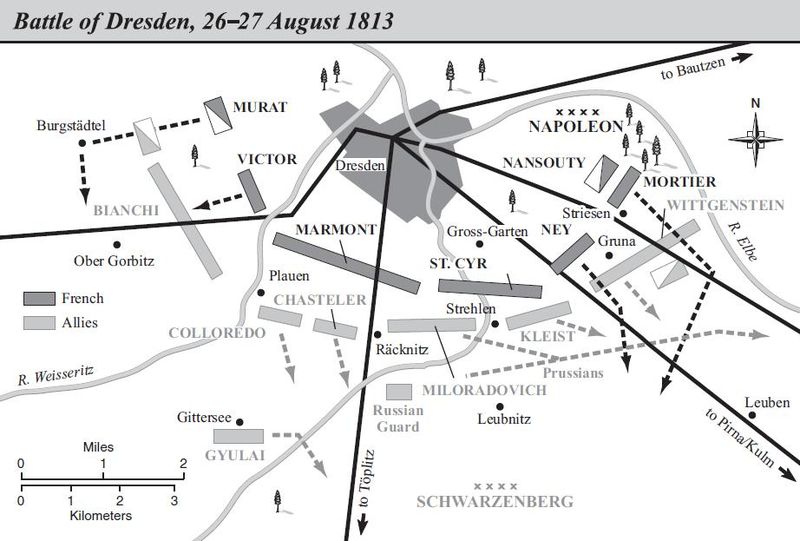
Battle of Dresden 26-27 August 1813

Battle of Dresden 26-27 August 1813

The Army of Bohemia attacked Dresden on the morning of 26 August. Fighting died down by noon, by when the French had been pushed back to the redoubts.

By 11am the Coalition commanders, including the Russian, Austrian and Prussian monarchs, had taken up a position on the Räcknitz Heights, from where they could see French reinforcements arriving. Shouts of ‘Vive l’Empereur’ were heard by the Coalition troops, revealing that Napoleon was present.

The main attack by the Coalition was planned for 4pm. Tsar Alexander I of Russia wanted to call it off in accordance with the Coalition strategy of avoiding battle with Napoleon himself. Emperor Francis I of Austria declined to offer an opinion, but King Friedrich Wilhelm III of Prussia wanted to fight on, since the Coalition had a numerical advantage of 158,000 to 70,000.[3]

Schwarzenberg was ordered to postpone the main assault until the monarchs could agree, but the new orders were transmitted slowly, and the attack went ahead. Napoleon left St Cyr in charge of the defence, which held, and formed three counter-attacking forces under Marshal Joachim Murat, Marshal Michel Ney and Mortier.

Napoleon launched his counter-attack at 5:30pm. By dark the French had retaken almost all of the line of outposts that they had held at the start of the day.

Napoleon was reinforced by Marmont and Victor’s corps overnight, taking his force to 120,000. The Army of Bohemia’s strength also increased, but only to 170,000 as potential reinforcements did not arrive.

Vandamme had crossed the Elbe with 40,000 men, forcing the 12,500 men of Eugen of Württemberg back. They were reinforced by 26,000 troops under General Alexander Ostermann-Tolstoy, preventing Vandamme from threatening the Army of Bohemia’s flank.

The Coalition plan for 27 August was to put 120,000 troops in the centre, with only 25,000 on each flank. The left flank was to be reinforced by 21,000 more men under General Johann von Klenau, but they failed to reach Dresden in time to take part in the battle

Napoleon, however, intended to hold the centre with 50,000 troops under Marmont and St Cyr, and to carry out a double envelopment, with 35,000 men on each flank. Murat commanded on the right and Ney and Mortier on the left.

Both French flank attacks went well: on their right the French took 13,000 prisoners from the Coalition’s left flank force. The French were hard pressed in the centre where they were considerably outnumbered. However, the Coalition cancelled an attack intended to create a gap between the French centre and left flank because the rain had created mud that made it impossible to bring up artillery.

Faced with defeat on both flanks and a threat from Vandamme to their rear, the Coalition commanders decided to withdraw overnight. Their morale cannot have been helped by a cannonball that nearly hit the Tsar. They had suffered 38,000 casualties and inflicted only 10,000.

An aggressive French pursuit could have turned a major victory into a rout that would have ended the campaign. If Vandamme could had beaten the Army of Bohemia to Teplitz it would have been trapped.

However, Napoleon was not well, and he had now received news of French defeats at Gross Beeren on 23 August and the Katzbach on 26 August. Marmont had told his Emperor at the start of the campaign that it was a mistake to divide his forces, saying that:

‘I greatly fear lest on the day which Your Majesty gains a great victory, and believes you have won a decisive battle, you may learn you have lost two.’[4]

The prediction had taken less than a fortnight to come true.

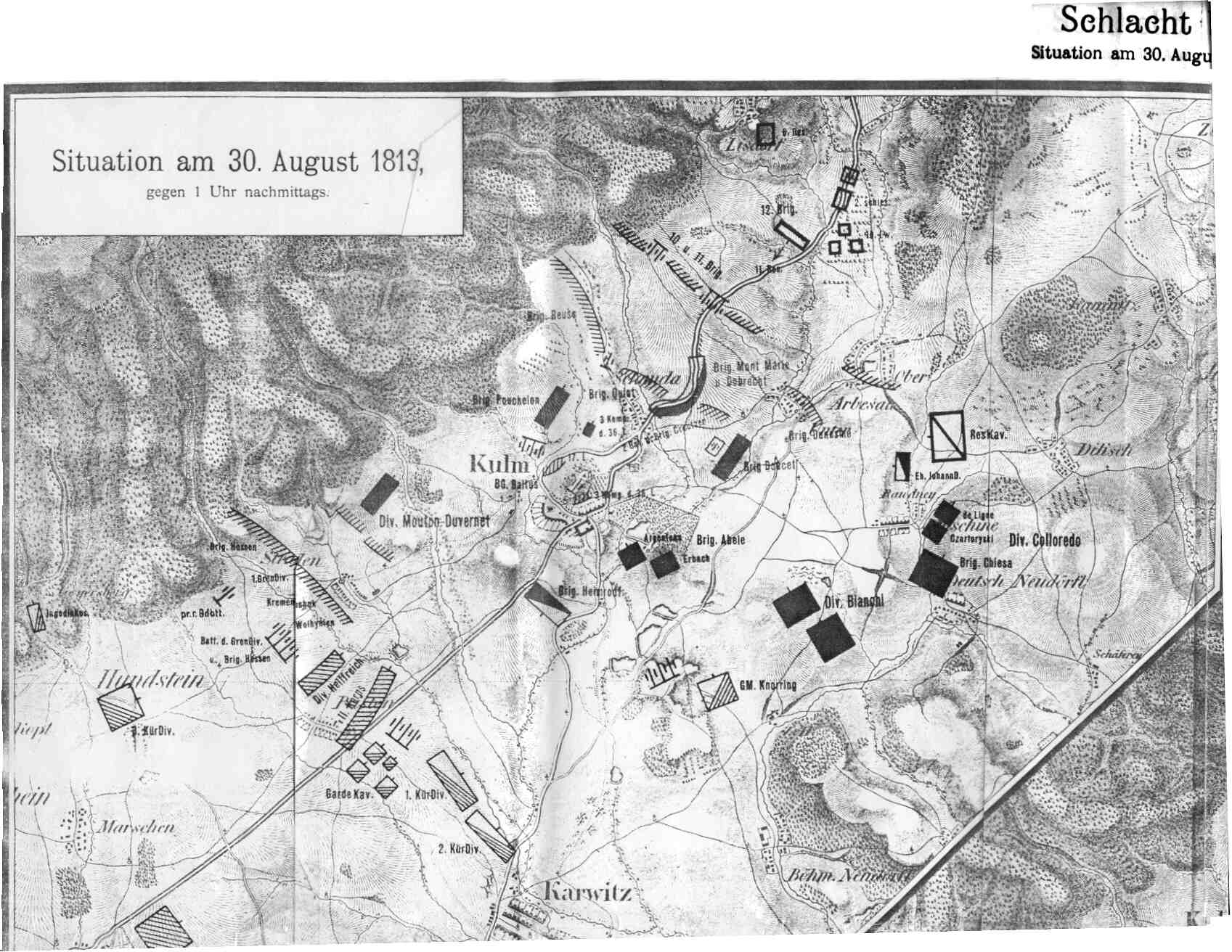
Napoleon left the pursuit to his subordinates, which meant that it was not well co-ordinated. Vandamme became isolated, and on 29 August was forced by Ostermann, who now commanded 44,000 troops, to fall back to Kulm. The next day the Coalition enveloped Vandamme by chance, when 12,000 retreating troops under General Friedrich von Kleist stumbled into the rear of I Corps. The majority of its troops managed to escape, but 13,000, including Vandamme, were captured.
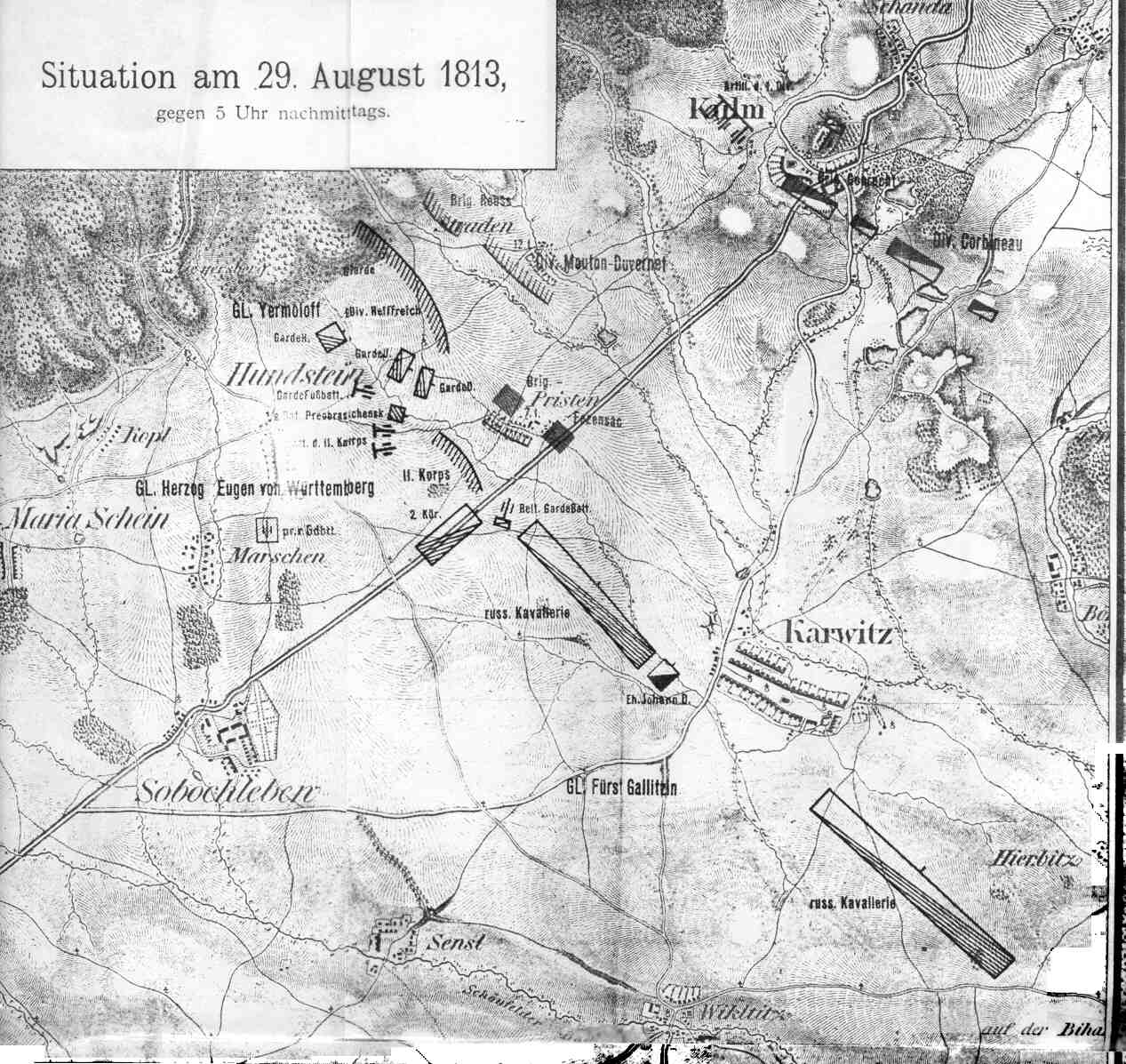
Battle of Kulm, 29 August 1813
Battle of Kulm, 29 August 1813

Battle of Kulm, 30 August 1813

Battle of Kulm, 30 August 1813


Napoleon won a great victory at Dresden, but the changes to his original plan, a tardy pursuit and defeats elsewhere meant that it was not a war winning victory. The Coalition plan of avoiding battle with Napoleon, but seeking it with his subordinates was working: Napoleon had won the only battle in the campaign so far at which he been present, but the Coalition had won the other three.


[1] D. Chandler, The Campaigns of Napoleon (London: Weidenfeld & Nicolson, 1966), p. 906.

[2] D. C. B. Lieven, Russia against Napoleon: The Battle for Europe, 1807 to 1814 (London: Penguin, 2010), p. 395.

[3] Troop numbers are from Chandler, Campaigns, pp. 906-12.

[4] Quoted in Ibid., p. 903; M. V. Leggiere, Napoleon and Berlin: The Franco-Prussian War in North Germany, 1813 (Norman: University of Oklahoma Press, 2002), p. 136; and F. L. Petre, Napoleon’s Last Campaign in Germany, 1813 (London: Arms and Armour Press, 1974, first published 1912), p. 178.
2 Comments

Filed under War History

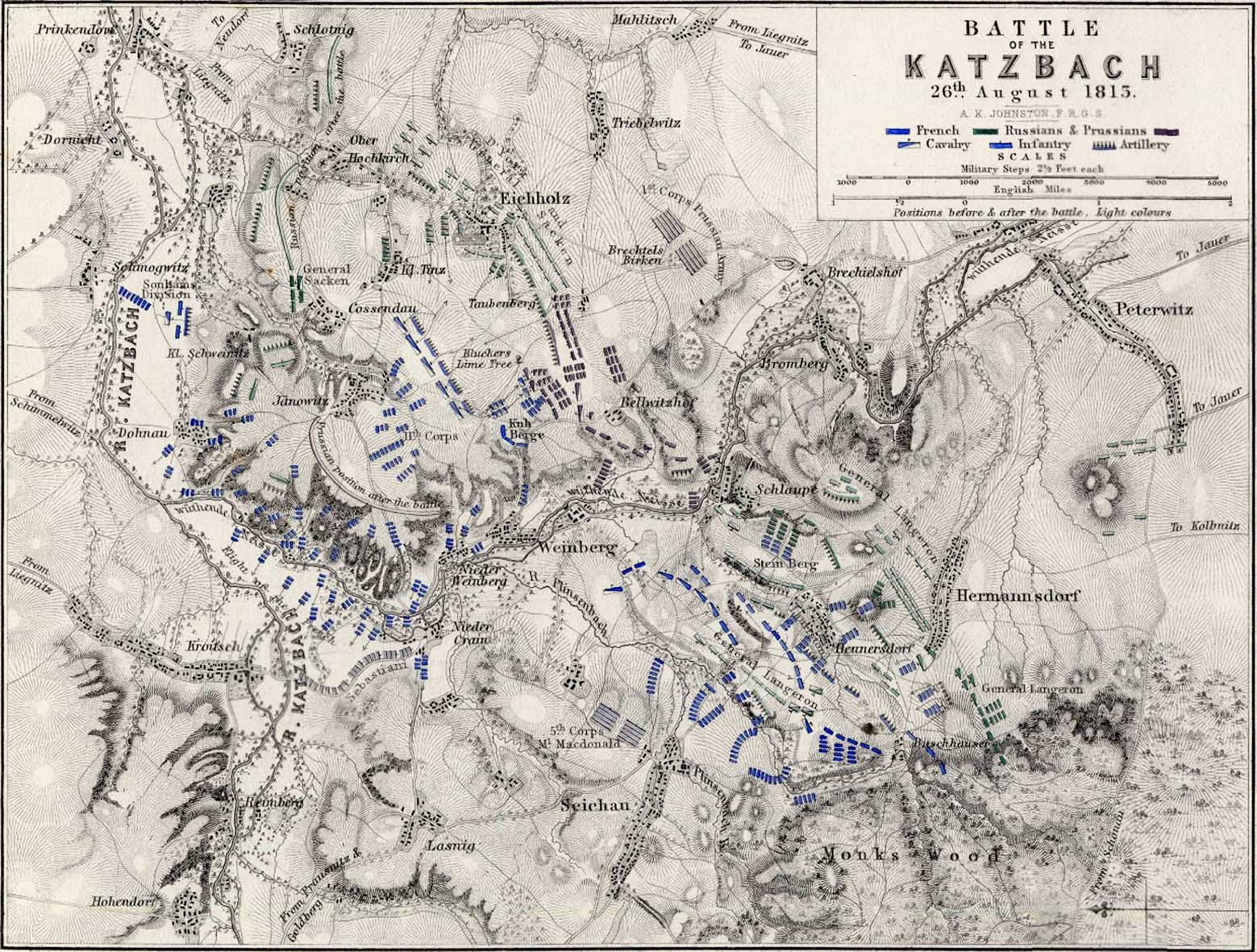
The Battle of Katzbach 26 August 1813

Prince Gebhardt Blücher’s Army of Silesia, comprising Prussian and Russian troops, began to advance towards Saxony on 13 August 1813, three days before the armistice between France and the Coalition of Austria, Prussia, Russia and Sweden expired. Blücher justified his move into the neutral zone established by the Truce of Pläswitz on the grounds that the French had committed several minor breaches of the armistice

The Coalition’s Trachenberg Plan stated that its armies should avoid battle with the main French body, commanded by Napoleon, but should seek battle with isolated enemy corps. By August 21 Blücher realised that he was advancing on Napoleon, so withdrew.

Napoleon had created the Army of the Bober, commanded by Marshal Jacques MacDonald to guard his left flank. MacDonald’s orders were to push Blücher back to Jauer, and then pin his army in Silesia.

On 26 August MacDonald, believing that Blücher was still retreating, crossed the River Katzbach in pursuit. Blücher, however, realising that he was not facing the main French army, had decided to take the offensive in accordance with both his natural desire to attack and the stipulations of the Trachenberg Plan. The two armies both thought that the other was on the defensive, so both were surprised when they encountered each other advancing.

MacDonald’s army, consisting of III, V and XI Corps and II Cavalry Corps, was widely spread, and poor roads slowed down its advance. MacDonald detached 12,000 men from V and XI Corps to cover his right flank, which was not threatened, and ordered his largest force, III Corps, to cross the Katzbach at Liegnitz and attack the enemy’s right flank at Jauer. The rest of his army was supposed to pin the Coalition forces in place.[1]

General Joseph Souham, who had taken over III Corps from Marshal Michel Ney because Napoleon did not want to have two Marshals with the same army, claimed that the Liegnitz crossing was impassable because of heavy rain, although General Fabian von Osten-Sacken’s Russian corps managed to cross there two days later.

Souham decided to move back towards the rest of MacDonald’s army, but found itself in a traffic jam. Only one of its four divisions managed to cross the river in time to play a role in the battle, and it had to leave its artillery behind.

Once the French had crossed the Katzbach they had to climb about 75m up a steep and heavily wooded slope to a featureless plateau. Dominic Lieven notes that they had to use a path that is still difficult by car in muddy or icy conditions.[2]

On the plateau the French encountered the 55,000 Coalition troops of Count Johann Ludwig Yorck’s Prussian Corps and Sacken’s Russians, who were also advancing. Only about 27,000 out of 67,000 French troops available made it to the plateau by 2pm, when the fighting began.

The heavy rain obscured visibility. Blücher sent Karl von Müffling, his quartermaster-general, forward on a reconnaissance mission. Müffling later wrote that:

‘I was mounted on a mouse-coloured horse, and had on a grey cloak, so that in the pouring rain I was not visible at 100 paces.’[3]

The rain meant that muskets could not be fired and had to be used as clubs, so the fighting was mainly hand to hand. The French were forced to retreat, with many being drowned as they tried to cross the Katzbach, which had risen because of the rain.

Further south French troops under General Jacques-Alexander-Bernard Lauriston attacked Coalition forces under Count Alexandre de Langeron, a French emigré in Russian service. Langeron had fewer infantry  but more cavalry, and was in a strong defensive position. However, he initially gave ground, until he was sent reinforcements at 4pm. He then counter-attacked and recaptured most of the ground lost.

F. Lorraine Petre says that the Coalition captured at least 12-14,000 prisoners and 36 guns. Their own casualties were not recorded, but were heavy.[4] Wikipedia gives casualties of 15,000 French and 4,000 Coalition troops. Lieven notes that the French defeat at the Katzbach was turned into ‘catastrophe’ by the pursuit.[5]  It lasted until the first week in September, by when MacDonald’s army was back in Saxony and had lost 35,000 men.[6]

Langeron, who had been dilatory in the battle, performed well in the pursuit. Blücher gave great credit to Sacken for the victory at the Katzbach. He was promoted by the Tsar and cheered by Yorck’s Prussian troops.


[1] Troops strengths are from F. L. Petre, Napoleon’s Last Campaign in Germany, 1813 (London: Arms and Armour Press, 1974, first published 1912), pp. 252-53.

[2] D. C. B. Lieven, Russia against Napoleon: The Battle for Europe, 1807 to 1814 (London: Penguin, 2010), p. 379.

[3] Quoted in Ibid., p. 381.

[4] Petre, Napoleon’s Last Campaign, p. 256.

[5] Lieven, Russia, p. 385.

[6] Ibid., p. 388.

3 Comments

Filed under War History

The Battle of Gross Beeren 23 August 1813

The truce signed by France with Prussia and Russia at Pläswitz on 4 June 1813 expired on 16 August 1813. Both sides had spent most of the intervening period planning and preparing for war, with Austria and Sweden joining the Coalition against France.

Napoleon’s initial plan was to capture Berlin, which he believed would demoralise the Prussians and force the Russians to withdraw to the east and away from the Austrians. It would encourage his German allies to remain loyal, reduce the odds against him and relieve besieged French garrisons on the Oder and Vistula.

Napoleon wanted to punish both his former ally Prussia and his former subordinate Bernadotte for turning on him. Bernadotte, now the Crown Prince of Sweden, commanded the Army of North Germany of 110,000 North Germans, Prussians, Russians and Swedes

Marshal Nicolas Oudinot was ordered to advance on Berlin from Saxony with 67,000 men and 216 guns. A further 37,500 men and 94 guns under Marshal Louis Nicolas Davout would march from Hamburg to Berlin. The two forces would be linked by 9,000 troops under General Jean Baptiste Girard at Magdeburg and General Jan Dombrowski’s 5,000 Poles and Wittenberg.

Oudinot had concentrated his army at Baruth by 18 August. His advance started well, and he won an minor engagement at Trebbin on 21 August. There was now a gap between two of Bernadotte’s corps, Friedrich von Tauentzien’s 4th Prussian Corps and Friedrich von Bülow’s 3rd Prussian Corps, and the road to Berlin appeared to be open.

Michael Leggiere notes that Bernadotte feared that he was facing Napoleon himself and lacked confidence in his troops, many of whom were inexperienced, had been retreating and wanted to abandon Berlin.[1] Bülow refused to give up his country’s capital.

After a discussion on the morning of 22 August Bernadotte agreed to remain south of Berlin until he was certain that he faced Napoleon, and redeployed his army accordingly. The Coalition’s Trachenberg Plan was to avoid battle with Napoleon, but to try to defeat detached French corps.

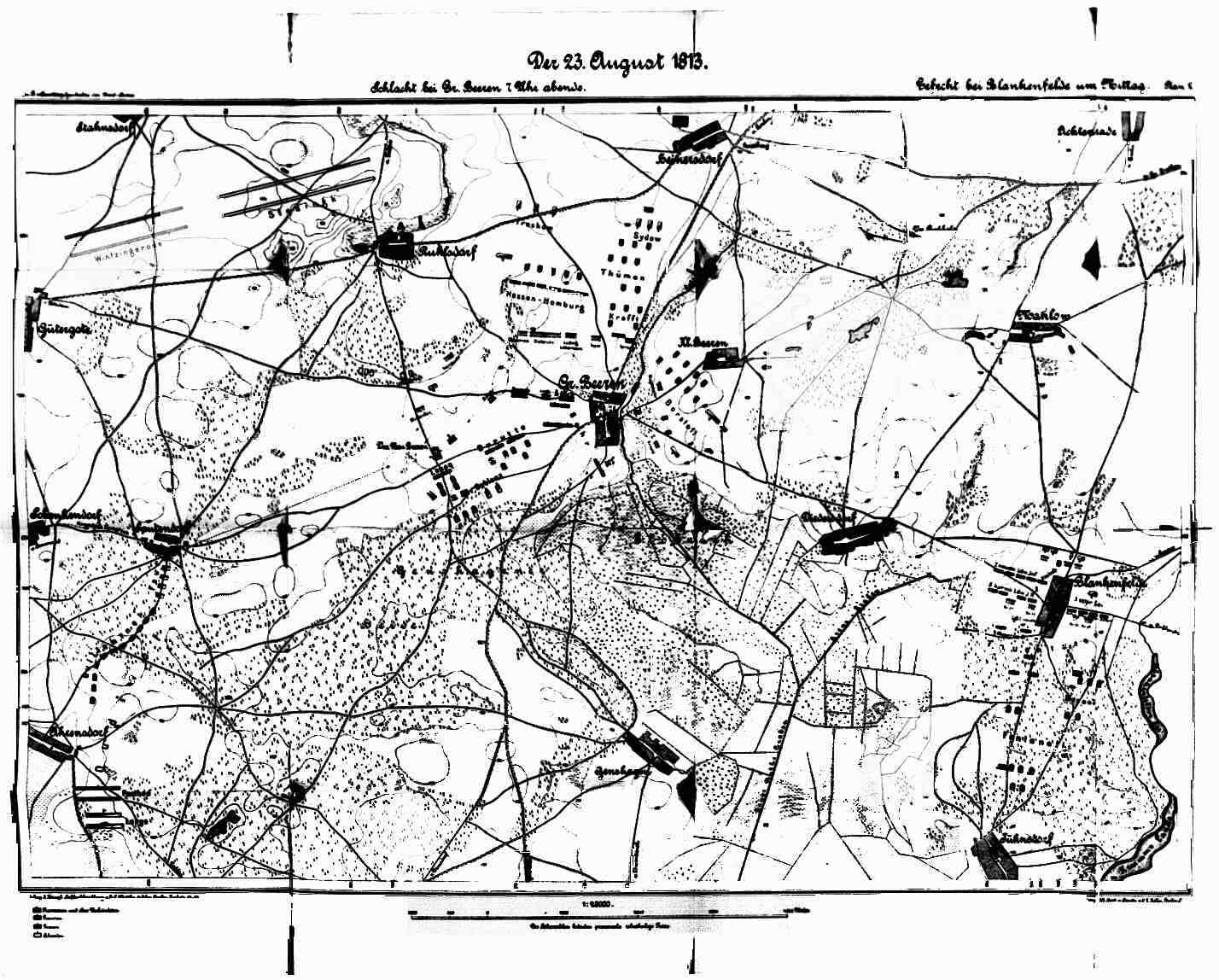
Oudinot’s army was moving along three roads: his own 12th Corps to the west, General Jean-Louis-Ebénézer Reynier’s 7th Corps and General Jean-Toussaint Arrighi’s 3rd Cavalry Corps in the centre and General http://www.1911encyclopedia.org/Henri_Gratien,_Comte_Bertrand4th Corps in the east. They could not easily reinforce each other because of the swamps and forests that separated the three, but the roads along which the 12th and 7th Corps were travelling met at Gross Beeren.

On 22 August Oudinot’s troops forced their way across the Nuthe Canal. There were four crossing points, so Oudinot pinned Thyrow, the strongest, with one of his divisions and sent the rest of the corps against Wilmersdorf. Wietstock was attacked by Reynier’s corps and Jühnsdorff by Bertrand’s corps. The plan, according to Leggiere, ‘worked brilliantly’, and the French took all four crossings.[2]

However, Tauentzien followed Bülow’s advice to retreat from Jühnsdorff to Blankenfelde. Leggiere argues that, although this meant the loss of a crossing over the canal, it ‘proved to be a far more decisive position’ the next day.[3]

Early on August 23 Bertrand advanced on Blankenfelde. After an initial combat between skirmishers Bertrand’s artillery forced Tauentzien’s raw Landwehr troops to withdraw. Bertrand also fell back, as he believed that the advance of Reynier on his left would force the Prussians to withdraw, thus allowing the French to win by manoeuvre rather than a frontal assault. Tauntzien did not follow up because of the inexperience of his troops, and both corps were back at their start points by 2pm.

Early on 23 August Bernadotte had ordered Bülow to move his corps further west to Ruhlsdorf. This recreated a gap between Bülow and Tauentzien’s corps that the French could break through and advance to Berlin.

By 10am Bülow could hear the sounds of battle to his east, so sent a messenger to Bernadotte asking permission to close the gap. Bernadotte eventually agreed, but then ordered one of Bülow’s brigades, the 3rd, to hold its position because of reports that the French were advancing on Ruhlsdorf. Reports from Blankenfelde convinced Bernadotte that the threat was to his left flank, and he released the 3rd Brigade to join Bülow.

Reynier reached Gross Beeren around 3pm and took it easily, before ordering his two Saxon and one French divisions, comprising 27,000 men, to camp for the night. Bülow, who had 38,000 troops, decided to attack.[4]

The battle began with an artillery duel that lasted from 5pm to 6pm. It started with 62 Prussian and Russian guns against 44 French and Saxons ones, rising to 80 and 69 respectively as reinforcements arrived. Both sides had therefore suffered significant casualties before Bülow launched his attack against General Sahr’s Saxon division on Reynier’s right. Rain made it impossible for the Saxons to fire their muskets at the advancing French.

The Saxons, heavily outnumbered, were forced to retreat. Reynier ordered General Pierre-François-Joseph Durutte’s French division to counter-attack, but it retreated when it encountering the fleeing Saxons. General Lecoq’s Saxon division was also unable to retake the lost ground, and Reynier used it to cover the retreat of his corps, which by 10pm was back where it started the day.

The French and Saxons lost 3,000 men and 13 guns and the Prussians 1,000 men. F. Lorraine Petre says that the ‘fight was of no real importance to either side.’[5] Leggiere, however, argues that it showed that the reforms of the Prussian Army that had taken place over the previous five years had been successful and that it ‘silenced critics who still questioned the combat-efficiency of the Prussia troops, especially the Landwehr.’[6] He also notes that there was not ‘the slightest hint of pan-German nationalism’ in the attitude of the Saxons.[7]

Bülow’s suggestion that Tauentzien retreat to Blankenfelde probably prevented Bertrand from enveloping Bülow’s corps, which would probably have led to Bernadotte retreating and the French capturing Berlin. The loss of both Prussia’s capital and its new army’s first battle would have had dire consequences for Prussian morale.

Oudinot retreated his army back to Wittenberg, whilst Davout retired to Hamburg. The Coalition might have routed Oudinot’s army if Bernadotte had pursued it, but he did not. Bernadotte, concerned about the threat from Oudinot to his own corps, had dismissed an appeal by Bülow for support on his right flank with the words that ‘the enemy is before me, each must defend his own front.’[8]

Napoleon blamed Oudinot for the failure to take Berlin and replaced him with Marshal Michel Ney. Napoleon’s orders to Ney said that Oudinot ‘never attacked the enemy, and he has been so clever as to let one of his corps attack separately.’[9] However, Napoleon must take his share of the blame for giving an independent army command to a man who was, as Petre says, ‘at most qualified for the subordinate command of an army corps.’[10]


[1] M. V. Leggiere, Napoleon and Berlin: The Franco-Prussian War in North Germany, 1813 (Norman: University of Oklahoma Press, 2002), p. 153.

[2] Ibid., p. 157.

[3] Ibid., p. 156.

[4] Strengths and casualties are from F. L. Petre, Napoleon’s Last Campaign in Germany, 1813 (London: Arms and Armour Press, 1974, first published 1912), pp. 261-63.

[5] Ibid., p. 262.

[6] Leggiere, Napoleon and Berlin, p. 173.

[7] Ibid., p. 174.

[8] Quoted in Ibid., p. 166.

[9] Quoted in Petre, Napoleon’s Last Campaign, p. 264.

[10] Ibid.

2 Comments

Filed under War History

The End of the Truce of Pläswitz, 16 August 1813

Napoleon signed a truce with Prussia and Russia at Pläswitz on 4 June 1813. Negotiations failed to produce peace terms acceptable to both sides, and by the end of June it was clear that hostilities would resume once the armistice expired on 16 August. By then Austria and Sweden had joined the Sixth Coalition against France.

Both sides spent the brief period of peace preparing for war. The Coalition decided at Trachenberg to divide their forces into three armies, which would be positioned in an arc round Napoleon’s centre of operations in Saxony. Each would attempt to attack detached French corps, but would retreat if approached by Napoleon’s main army. The other two armies would then threaten the French flanks and lines of communication. The objective was to divide and wear the French down without fighting a major battle.

The three armies were the Army of Bohemia under the Austrian Prince Karl Philip zu Schwarzenberg, with 230,000 Austrians, Prussians and Russians; the 95,000 Prussians and Russians of the Prussian General Gebhard von Blücher’s Army of Silesia; and the Army of North Germany of 110,000 North Germans, Prussians, Russians and Swedes under Bernadotte, the Crown Prince of Sweden. A fourth, the Army of Poland, with 60,000 men under the Russian General Count Levin August Bennigsen was being formed. [1]

Each army contained a mixture of nationalities in order to stop Napoleon knocking one country out of the war by concentrating on it and to be sure that all acted in the interests of the Coalition.

Smaller forces took the Coalition field army to a total of 512,000 soldiers, and there were another 143,000 troops in reserve and conducting sieges and 112,000 garrisoning fortresses. It was opposed by a French field army of about 450,000, with 77,000 more in garrisons.[2]

It is not clear who was responsible for this plan. Michael Leggiere attributes it to Count Josef Radetzky von Radetz, Schwarzenberg’s chief of the staff, but notes that several other claimed the credit.[3]

Dominic Lieven claims that it was mainly the work of General Karl von Toll, a close adviser to the Tsar Alexander I of Russia, although he had discussed it at length with Radetzky and Schwarzenberg.[4]

F. Loraine Petre says that the original version was the work of Toll, Bernadotte and Colonel Karl von dem Knesebeck, a close adviser to King Friedrich Wilhelm III of Prussia, with some input from others. It required only the Army of Silesia to automatically avoid a major battle. This was necessary because of its small size and Blücher’s impetuosity. Toll wanted to take the offensive against Napoleon.

Petre states that Radetzky modified it by making it require all of the armies to refuse a major battle. This, Petre argues, shows that the Austrians were still trying to conduct an 18th century war of manoeuvre rather than trying to win a decisive victory.[5]

Schwarzenberg was the Coalition commander-in-chief, but Lieven notes that his powers were limited. He lacked confidence in his military skills, especially in comparison to Napoleon. Alexander and Friedrich Wilhelm were at his headquarters, meaning that Russian and Prussian generals, including Blücher, could go over his head and appeal to their monarch. Bernadotte, effectively a head of state because of the Swedish king’s poor health, paid little heed to Schwarzenberg.

Despite this, Lieven argues that Schwarzenberg was the best choice for the job. The C-in-C had to be Austrian, because of geography and the size of its contribution to the Coalition army. Lieven compares him to General Dwight Eisenhower in World War II in that both had the diplomatic skills to smooth over disputes between their egotistical subordinates.[6]

Napoleon’s initial plan was to capture Berlin, which he believed would demoralise the Prussians and force the Russians to withdraw to the east and away from the Austrians. It would encourage his German allies to remain loyal, reduce the odds against him and relieve besieged French garrisons on the Oder and Vistula.

Napoleon wanted to punish both his former ally Prussia and his former subordinate Bernadotte for turning on him. Marshal Frederic-Auguste Marmont said that:

‘Passion prompted him to act quickly against Prussia. He desired the first cannon shots to be fired against Berlin, and that a startling and terrible vengeance should immediately follow the renewal of hostilities.’[7]

Marshal Nicolas Oudinot was ordered to advance on Berlin from Saxony with 67,000 men and 216 guns. A further 37,500 men and 94 guns under Marshal Louis Nicolas Davout would march from Hamburg to Berlin. The two forces would be linked by 9,000 troops under General Jean Baptiste Girard at Magdeburg and General Jan Dombrowski’s 5,000 Poles and Wittenberg.

Napoleon ordered Oudinot to capture Berlin by 22 August. Oudinot was not an obvious choice for the job, and tried to refuse the command on the grounds of ill health, but the Emperor declined his request. Leggiere suggests that Napoleon chose him over better generals on the grounds of loyalty.[8] David Chandler contends that Marshal Nicolas Soult was first choice, but had to be sent to Spain after the disastrous French defeat at Vitoria.[9]

Napoleon originally intended to keep his other 300,000 men around Dresden, but he later decided to form 100,000 into the Army of the Bober under Marshal Jacques MacDonald. It was to operate in Silesia in order to prevent Blücher threatening Oudinot’s flank or Napoleon’s lines of communication.[10]

Dresden was Napoleon’s centre of operations and main supply base. He stated that:

‘What is important to me is to avoid being cut off from Dresden and the Elbe. I will care little if I am cut off from France.’[11]

David Chandler argues that the French had better officers and artillery. Both sides had multi-national forces, but Napoleon’s infantry, unlike that of his enemy, had homogeneous training and equipment. The main French disadvantage was the poor quality of their cavalry, which had not recovered from the huge horse casualties of the Russian Campaign of 1812.[12]

When Napoleon his marshals of his plan Marmont objected to the division of forces into two separate groups. He told the Emperor that:

‘I greatly fear lest on the day which Your Majesty gains a great victory, and believes you have won a decisive battle, you may learn you have lost two.’[13]

Leggiere notes that Marmont would soon be proved to be correct.[14]


[1] D. Chandler, The Campaigns of Napoleon (London: Weidenfeld & Nicolson, 1966), pp. 900-1.

[2] F. L. Petre, Napoleon’s Last Campaign in Germany, 1813 (London: Arms and Armour Press, 1974, first published 1912), p. 170.

[3] M. V. Leggiere, Napoleon and Berlin: The Franco-Prussian War in North Germany, 1813 (Norman: University of Oklahoma Press, 2002), p. 126.

[4] D. C. B. Lieven, Russia against Napoleon: The Battle for Europe, 1807 to 1814 (London: Penguin, 2010), p. 369.

[5] Petre, Napoleon’s Last Campaign, pp. 181-84.

[6] Lieven, Russia, pp. 367-69.

[7] Quoted in Leggiere, Napoleon and Berlin, p. 135.

[8] Ibid., pp. 135-36.

[9] Chandler, Campaigns, p. 902.

[10] Petre, Napoleon’s Last Campaign, p. 189.

[11] Quoted in Chandler, Campaigns, p. 902.

[12] Ibid., p. 901.

[13] Quoted in Ibid., p. 903; Leggiere, Napoleon and Berlin, p. 136; and Petre, Napoleon’s Last Campaign, p. 178.

[14] Leggiere, Napoleon and Berlin, p. 137.

6 Comments

Filed under War History

The Truce of Pläswitz 4 June 1813

Napoleon defeated the Russo-Prussian army at Lützen on 2 May and Bautzen on 20-21 May 1813, but neither battle was decisive. He lacked the cavalry to pursue the defeated enemy and turn a victory into a rout, and mistakes by his subordinates, notably Marshal Michel Ney, allowed the Allies to escape a trap at Bautzen.

On 22 May the pursuing French engaged the Allies at Reichenbach.  General Géraud Duroc, who had been Napoleon’s Grand Marshal of the Palace since he became Emperor, was killed. Napoleon, upset at the loss of Duroc and others close to him, ordered the combat to be broken off.

The French, harassed by Cossacks and losing more men to straggling and sickness, were unable to win a decisive victory. The high commands of both sides were arguing amongst themselves. Ney offered his resignation, which was rejected.

The Allied commander, Prince Ludwig Pyotr Wittgenstein, unhappy that Tsar Alexander had passed orders over his head, also offered his resignation, which Alexander accepted on 29 May. The new commander was  Prince Mikhail Barclay de Tolly; he promptly upset the Prussians by proposing to withdraw into Poland.

The Tsar came up with a compromise. The Allies would withdraw to Schweidnitz, which was inside Prussia and allowed them to maintain contact with Austria, which they hoped would join them. However, it meant that they risked being outflanked and trapped against the Austrian border. Schweidnitz had once been strongly fortified, but its defences had not been repaired after being destroyed in 1807.

Napoleon then made what he later described as ‘one of the worst decisions of his life’ when he accepted an Austrian proposal for an armistice.[1] It was signed at Pläswitz on 4 June and would last until 20 July. Peace negotiations would take place during this period.

Napoleon said that he accepted the armistice in order to build up his cavalry and to prepare for a possible Austrian intervention into the war. Additionally his troops were tired and many of them were sick, and he needed to set up fortified supply depots to secure his supplies against enemy action. However, the Allied army was in worse shape. As Dominic Lieven says:

‘In all probability had [Napoleon] continued the spring 1813 campaign for just a few more weeks he  could have secured a very favourable peace…Barclay could not believe his luck.’[2]

David Chandler, whilst noting that the French army was in poor shape , agrees that the Allies were in a worse situation. Napoleon had reached Breslau (now Wroclaw) on 1 June. It was to the north east of Schweidnitz, where the Allies had decided to give battle, so the Emperor was close to a decisive victory when he accepted the armistice. The Allies were even worse off than he realised, and benefitted more than the French did from the armistice.[3]

On 15  June Britain paid Prussia £666,666 and Russia £1,333,334 and offered Austria £500,000 if it would enter the war. On 7 July Sweden agreed to join the Allies. Twelve days later Austria said that it would do the same if Napoleon rejected the proposed terms.

Charles Esdaile notes that Klemens von Metternich, the Austrian Foreign Minister, wanted to maintain a balance of power in Europe between Russian and France as he believed that a decisive victory for either would be disastrous for Austria.[4]

Metternich wanted to arrange a meeting between Napoleon and Alexander, but had to settle for separate meeting with each. Austria, Prussia and Russia, but not Britain, set out their terms in the  Reichenbach Convention on 27 June. They wanted the Duchy of Warsaw and the Confederation of the Rhine to be dissolved, Austria to regain her Illyrian provinces and Prussia to be restored to her 1805 borders,

Metternich put these to Napoleon at Dresden on 30 June, but the Emperor angrily rejected them. F. Loraine Petre contends that neither side expected the negotiations to lead to peace; their ideas of what would be constitute acceptable terms were too far apart.[5] Chandler agrees, suggesting that the terms relayed by Austria ‘smacked of a peace dictated to a vanquished foe’, not a proposal for peace with an enemy that had won two recent victories.[6]

Esdaile takes issue with those who consider the terms offered to Napoleon to be ‘intolerable’, arguing that ‘they were by no means so bad.’[7] He would have retained control over Spain, Switzerland, the Netherlands, the Kingdom of Italy and Naples. Esdaile contends that the big loser from a peace agreement along these lines would have been Britain, which would have achieved none of its war aims.

Esdaile points out that Austria, Prussia, Russia and even Britain were willing to let Napoleon keep his throne. Only Jean-Baptiste Bernadotte, the Crown Prince and Regent of Sweden, wanted to remove the Emperor. His motivation was personal, as he thought that he might replace Napoleon on the French throne. Napoleon fought on because he preferred risking all on a military victory to compromise.[8]

Bernadotte had previously been one of Napoleon’s Marshals, before being adopted as heir to the elderly and heirless King Karl XIII of Sweden in 1810. In 1813 he was properly named Crown Prince Karl Johan, but most histories of the Napoleonic Wars call him Bernadotte.

Certainly, Napoleon rejected terms that would have left him as head of a very powerful state; fighting on left him in exile on Elba less than a year later. However, there was little chance of a man who had come to power because of military successes and had won two recent battles accepting such terms.

The Allies requested that the armistice be extended to 16 August, supposedly to allow negotiations to continue, but actually to permit Austria to complete its mobilisation. Napoleon agreed because the French also needed time to be ready to restart hostilities. Talks continued at Prague, but both sides were just playing for time.


[1] D. C. B. Lieven, Russia against Napoleon: The Battle for Europe, 1807 to 1814 (London: Penguin, 2010), p. 327.

[2] Ibid.

[3] D. Chandler, The Campaigns of Napoleon (London: Weidenfeld & Nicolson, 1966).

[4] C. J. Esdaile, Napoleon’s Wars: An International History, 1803-1815 (London: Allen Lane, 2007), p. 504.

[5] F. L. Petre, Napoleon’s Last Campaign in Germany, 1813 (London: Arms and Armour Press, 1974, first published 1912), p. 160.

[6] Chandler, Campaigns, p. 160.

[7] Esdaile, Napoleon’s Wars, pp. 507-8.

[8] Ibid., p. 510.

5 Comments

Filed under War History

The Battle of Bautzen 20-21 May 1813.

Following Napoleon’s victory at Lützen on 2 May 1813 Prince Ludwig Pyotr Wittgenstein’s Russo-Prussian army retreated to Bautzen, where it was reinforced by 13,000 Russians commanded by Prince Mikhail Barclay de Tolly.

Napoleon had received reinforcements from France, including a Young Guard division, four Old Guard battalions and two cavalry divisions, and also now had the support of the Saxon Army. He replaced the previous split of his force into separate Armies of the Elbe and Main with a single Army of the Elbe.[1]

It consisted of two wings. The northern one under Marshal Michel Ney contained 79,500 infantry, 4,800 cavalry and 26 artillery batteries. The main body, under the Emperor’s personal command, consisted of 107,000 infantry, 12,000 cavalry and 53 artillery batteries; 19,000 of the infantry and 4,000 of the cavalry were Guards.. His step-son Prince Eugène, who had performed poorly in this campaign, was sent to command in Italy.[2]

Napoleon’s main problem was that his lack of cavalry meant that he was uncertain of the location and strength of the enemy. He deduced that the bulk of the Allied army would fall back on Bautzen, with a portion covering Berlin.

On 12 May the Emperor sent forward a strong reconnaissance force under Marshal Jacques MacDonald in order to find the enemy. Ney’s wing was to prepare to move on Berlin.

Diplomatic negotiations continued. Prince Klemens von Metternich, the Austrian Foreign Minister, offered to mediate, sending delegates to both sides in order to discover what they would offer Austria. Dominic Lieven points out that the Austrian aims of restoring their lost provinces and of restoring the balance of power in Europe were supported by Austria and Russia, but opposed by France.[3]

Napoleon planned to send Armand Caulaincourt, one of his closest diplomatic advisers, to negotiate directly with Tsar Alexander rather than talking via Austria, but Caulaincourt had not departed by 16 May, when MacDonald discovered the enemy at Bautzen.

The Emperor ordered IV (General Henri-Gatien Bertrand, VI (Marshal Auguste Marmont) and XI (MacDonald) Corps to pin the Allies whilst Marshal Charles Nicolas Oudinot’s XII Corps out-flanked them to the south. Ney was ordered to bring his own III Corps and General Jacques Lauriston’s V Corps south. His II and VII Corps were supposed to continue to advance on Berlin, but Ney misunderstood his orders and brought them south; F. Loraine Petre argues that this error was to the French advantage, as it meant that more troops were concentrated against the main enemy force.[4]

Ney’s orders were complicated. On 18 May he was told to march on 20 May as if he were joining MacDonald, but on 21 May to move eastwards towards the enemy rear. Napoleon hoped that this would enable him to force the Allies back towards the neutral Austrian frontier, meaning that they would be either destroyed or forced to surrender.

Napoleon spent 19 May reconnoitring the enemy. They were in a strong defensive position, but he overestimated their strength, thinking that they had 150,000 men rather than the actual 96,000.[5] As Ney was not in position, he decided to fight a battle of attrition on 20 May, before enveloping the enemy the next day. The Allies intended to stand on the defensive at first, before counter-attacking on their right. They expected the French to attack their left, in order to force them away from Austria.

The French artillery bombardment began at noon on 20 May, with the main infantry attack starting at 3 pm. By 6 pm they had captured the city of Bautzen and the Allied front line. The Allies continued to reinforce their left. They knew that Ney was approaching from the north, but greatly underestimated his strength, so ignored him. David Chandler says that ‘Napoleon could hardly have hoped for anything better.’[6]Napoleon’s plan for 21 May was that VI, XI and XII Corps would pin the enemy, Ney’s III Corps would attack the Allied right and Lauriston’s V Corps would block their retreat. This should force them to strip their centre to strengthen their right flank.Bertrand’s IV Corps would deliver the main attack under the supervision of Marshal Nicolas Soult, who had carried out a similar manoeuvre on the Pratzen Heights at Austerlitz in 1805. A reserve consisting of three infantry divisions, one of them Old Guard and the others Young Guard, and three cavalry division, including a Guard one, supported by 80 guns was established.

The pinning attacks were successful. Oudinot’s XII Corps was forced back a little way, but this drew the Allies out of their prepared positions. IV Corps began its attack at 2 pm, supported by a Young Guard division and all available artillery. Prince Gebhard von Blücher’s Prussians were forced back, but he skilfully extracted them. The French attack lost momentum because the terrain made it difficult to move the artillery forward

The only explicit order given by Napoleon to Ney was that he should be at the village of Preititz by 11 am. His chief of staff, Baron Antoine-Henri Jomini, advised him to screen it and advance into the enemy rear, but Ney launched a series of frontal attacks. Lauriston also moved slowly.

The French attacks in the centre was held up until by a gallant Russian defence, but increasing casualties induced the Tsar to allow limited withdrawals from 4 pm. Napoleon, noting that the enemy resistance was weakening, committed his Imperial Guard against the Prussians.

The Allies were now forced to retreat, but Ney and Lauriston’s failure to advance into their rear meant that they were able to do so safely, extracting all their guns, apart from some that had been disabled.  A heavy rain storm stopped any pursuit.

Napoleon had again won a battle, but failed to rout the enemy because of the failure of his subordinates to block the enemy retreat and a lack of cavalry to pursue the defeated foe. Both sides suffered about 20,000 men dead and wounded.


[1] D. Chandler, The Campaigns of Napoleon (London: Weidenfeld & Nicolson, 1966), pp. 888-90.

[2] F. L. Petre, Napoleon’s Last Campaign in Germany, 1813 (London: Arms and Armour Press, 1974, first published 1912), pp. 100-2.

[3] D. C. B. Lieven, Russia against Napoleon: The Battle for Europe, 1807 to 1814 (London: Penguin, 2010), p. 317.

[4] Petre, Napoleon’s Last Campaign in Germany, 1813, p. 107.

[5] Chandler, Campaigns, p. 890.

[6] Ibid., p. 893.

3 Comments

Filed under War History

The Battle of Lützen 2 May 1813

By April 1813 Napoleon had rebuilt his army, but was at war with Prussia and Russia. His field forces in Germany consisted of the 121,000 strong Army of the River Main, 58,000 men in the Army of the Elbe, 20,000 troops in the detached I Corps, command by Marshal Louis Nicolas Davout, and 14,000 cavalry under General Horace Sebastiani. On 25 April they were faced by only 110,000 Russians and Prussians.[1]

However, the French were weak in cavalry. The shortage of light cavalry meant that Napoleon lacked intelligence about the enemy’s strength, positions and manoeuvres. Advancing French columns were harassed by enemy light cavalry because there were not enough French horsemen to protect them.

Napoleon’s initial plan was to advance on Berlin. His northern flank would be protected by the fortresses of Torgau, Wittenberg, Magdeburg and Hamburg and the southern one by the Army of the Elbe and I Corps.

He would turn the flank of the enemy army and relieve the besieged fortresses of Danzig, Thorn and Modlin on the Vistula. This would release 50,000 more troops for his field army, threaten the Russian line of communication and intimidate the German princes into supporting France.

David Chandler notes that Napoleon did not implement this plan for a number of reasons: it would require 300,000 men; he was doubtful of the quality of the troops that he did have; his German allies, Bavaria and Saxony, were reluctant; and he did not have enough troops to protect his communications against an enemy advance in the Dresden area.[2]

The Allies concentrated on the Leipzig-Dresden area of Saxony. This covered their communications back to Russia and to Austria, but left Prussia exposed. They had too few troops to protect both, so concentrated on the more important area.

Some Prussians wanted to attack, but Prince Mikhail Kutuzov, the Russian commander was cautious. Dominic Lieven comments that even the ‘ever-aggressive [Gebhard von] Blücher’ remembered that in 1805 the Austro-Russians had attacked before the Prussians were ready and had been defeated at Austerlitz.[3]

Kutuzov died on 28 April. He was replaced by Prince Ludwig Pyotr Wittgenstein, described by Lieven as being ‘[i]n many ways the most suitable candidate.’[4] He had won more victories than any other Russian general in 1812, spoke German and French and was popular with the Prussians. However, he was junior to two of the Russian corps commanders, Alexander Tormasov and Mikhail Miloradovich.

Consequently Wittgenstein was appointed to command only Blücher’s Prussians and Ferdinand Wintzingerode’s Russian corps. Tormasov and Miloradovich received their orders from Tsar Alexander, ‘sometimes without [Wittgenstein’s] knowledge’ according to F. Loraine Petre.[5]

Napoleon ordered his troops to cross the River Saale on 1 May. They encountered opposition, notably at Weissenfels, where Marshal Jean-Baptiste Bessiéres was killed, but the crossing was completed. Marshal Michel Ney’s III Corps occupied Lützen in order to protect the southern flank of an advance on Leipzig.

At 4 am on 2 May Napoleon told Ney to send out strong patrols towards Zwenkau and Pegau, and to occupy Lützen and the villages of Kaja, Rahna, Gross Görschen and Klein Görschen, which lay along a ridge. Ney did not send out the patrols, which would have found the enemy army, and kept three divisions at Lützen.Wittgenstein, learning that there was only a weak French force at Kaja, decided to attack it. His troops were supposed to start moving at 1 am and be in position by 7 am. Their columns became mixed up in the dark, and were not in position until 11 am.

The Allies could see only 2,000 French troops, so Wittgenstein ordered the Blücher’s Prussian cavalry to charge them at 11:45 am. However, they were shocked to find themselves faced by two divisions. The French were also surprised, because they had not sent out patrols.

Blücher  waited until artillery could be brought up, allowing the French time to deploy.  General Jean-Baptiste Girard’s division occupied and held the village of Starsiedl, but General Joseph Souham’s division was forced to withdraw from Gross Görschen.

Napoleon and the main French army were marching on Leipzig. Ney had been with Napoleon, but hurried back to his command on hearing the gunfire. He ordered a counter-attack , which led to a desperate action around the villages and along the ridge.

Napoleon quickly devised a plan to envelop the enemy. Ney’s III Corps should hold, with Marshal Auguste Marmont’s VI Corps coming up to support its right flank. Further to the French right, General Henri-Gatien Bertrand’s IV Corps would threaten the Allied left flank. Marshal Jacques MacDonald’s XI Corps would attack the Allied right. The Imperial Guard would reinforce the centre.

Napoleon reached the battlefield at 2:30 pm. He rode amongst his troops, encouraging them, boosting their morale and leading them back into the attack. Chandler quotes Marmont as saying that ‘[t]his was probably the day, of his whole career, in which Napoleon incurred the greatest personal danger on the field of battle.’[6]

Despite appeals from his commanders, Napoleon refused to commit the Guard too soon. The Allies were hampered by a wound to Blücher and the slow arrival of Russian reserves. The Tsar held back his Guards, apparently thinking that the battle was going well and wanting to personally lead them in the decisive attack.

The French flanking  forces were in position by 5:30 pm. At 6:00 pm the attack was launched by XI Corps on the French left, the Imperial Guard and VI Corps in the centre and IV Corps on the right. The assault, with heavy artillery support, threw the Allies back.

The French won the battle, but Chandler notes that Napoleon needed two more hours to make his victory complete. He lacked the cavalry to pursue the enemy in order to turn a victory into a rout.[7]

Petre and Lieven both argue that the delay in the initial Allied attack in the end disadvantaged the French. An earlier start to the battle would have meant that Napoleon and his main body of troops were closer to the action when it began. They would have arrived earlier and would have had more time to complete their victory. Better reconnaissance by Ney would also have allowed Napoleon to move earlier.[8]

The battle showed that Napoleon and his command system could still react far more quickly and flexibility to battlefield developments than his enemies. He had won a victory, but lack of time and cavalry meant that it was not a decisive one, and the French suffered heavy casualties.

Chandler estimates that there were 115,000 French and 97,000 Allied troops in the vicinity, altthough not all of them engaged in combat. He reckons that 20,000 French and 18,000 Allied troops were killed or wounded.[9] Charles Esdaile argues that the French casualties were high because the inexperience of their troops meant that they had to use ‘clumsy and unsophisticated’ tactics.[10]

The Allies retired towards Dresden. An action took place at Colditz on 5 May between French troops under Prince Eugène and the Russian rearguard, commanded by Miloradovich. The Allies did not stop in Dresden and failed to destroy its bridges. Napoleon reached it on 8 May. Two days later the King of Saxony declared for Napoleon.

The Allied retreat ended on 13 Mat at Bautzen, a strong defensive position. They were reinforced by another 13,000 Russian troops under Prince Mikhail Barclay de Tolly.


[1] D. Chandler, The Campaigns of Napoleon (London: Weidenfeld & Nicolson, 1966), pp. 874-75.

[2] Ibid., p. 875.

[3] D. C. B. Lieven, Russia against Napoleon: The Battle for Europe, 1807 to 1814 (London: Penguin, 2010), p. 311.

[4] Ibid., p. 313.

[5] F. L. Petre, Napoleon’s Last Campaign in Germany, 1813 (London: Arms and Armour Press, 1974, first published 1912), p. 58.

[6] Chandler, Campaigns, p. 884.

[7] Ibid., pp. 886-87.

[8] Lieven, Russia against Napoleon: The Battle for Europe, 1807 to 1814, p. 315; Petre, Napoleon’s Last Campaign in Germany, 1813, p. 85.

[9] Chandler, Campaigns, p. 1120.

[10] C. J. Esdaile, Napoleon’s Wars: An International History, 1803-1815 (London: Allen Lane, 2007), p. 501.

5 Comments

Filed under War History

The Start of Napoleon’s 1813 German Campaign

Napoleon had to rebuild his army following the failure of his 1812 campaign in Russia. The 1813 class of conscripts had already been called up, meaning that 137,000 men were nearing the end of their training at the start of 1813.[1]

More men were found from the National Guard, a home defence militia, the navy and Italy. Troops were also transferred from Spain to the German front. Others were found by calling up the 1814 class of conscripts early, along with men who had managed to evade the draft for health or other reasons in earlier years.

The new army was large and would fight bravely, but many of the infantry were either young and inexperienced or else old. It was harder to replace the horses than the men lost in Russia. The lack of cavalry would prove to be a major problem for Napoleon in 1813.

The French Empire managed to replace the cannons lost in Russia, but they needed horses to pull them, as did supply wagons, creating logistical difficulties.

Napoleon also had problems with the quality of his generals. According to David Chandler, the mid-ranking officers were still good, but the marshals were tired and past their best, whilst the junior ones were inexperienced.[2]

Whilst rebuilding his army, Napoleon left Marshal Joachim Murat in command in Germany. The Emperor had hoped that Murat would be able to hold the Russians along the River Vistula, but he was forced to retreat to Posen (now Poznan). He then handed over command to Napoleon’s step-son Prince Eugène, and returned to his kingdom of Naples.

Eugène had too few troops to fight, and the frozen rivers were no help to the defender. Despite orders from Napoleon to hold, he was forced to withdraw his forces, apart from some isolated garrisons, behind the River Elbe.

Tsar Alexander I of Russia was, according to Dominic Lieven, effectively his own foreign minister. He was with his army, whilst the official foreign minister, Nikolai Rumiantsev, was in St Petersburg. Alexander’s aim was to force France behind its natural frontiers. Rumiantsev thought that the Tsar was too focused on Napoleon, paid too little attention to the Ottoman Empire and Persia and was too keen to satisfy the Austrians and British. [3]

Prussia had been forced to contribute a corps to Napoleon’s invasion of Russia, but on 30 December 1812 its commander, General Ludwig Yorck, signed the Convention of Tauroggen with Russia, making his troops neutrals. He acted without the consent of King Friedrich Wilhelm III, but the news was received enthusiastically in Prussia.

Friedrich Wilhelm, according to Lieven, ‘detested Napoleon and…liked and admired Alexander…[but] was a great pessimist.[4] He hesitated until the Russian had reached Prussia, but on 28 February 1813 Russia and Prussia signed the Treaty of Kalisz. Five days later the Russian entered Berlin.

The main sticking point in the negotiations was Poland. Friedrich Wilhelm did not want to lose any of the territory that Prussia had gained from the 18th century partitions of Poland. Alexander, however, thought that the only way to deal with Polish nationalism without weakening Russian security was to have a Polish kingdom whose monarch was the Russian Tsar. The agreement was that Prussia would be restored to its 1806 size, receiving northern German territory and population to compensate it for any losses in Poland.

The treaty required both parties to attempt to bring Austria into their alliance. The Austrians, however, were cautious for now.

On 16 March Prussia declared war on France. Napoleon had limited the size of its army to 42,000 after defeating it in 1806, but allowed it to recruit more in late 1812. The Prussians had also secretly created a reserve by forcing a proportion of their soldiers to retire each year. They were therefore able to field 80,000 well trained troops, backed by the Landwehr, a conscript militia and volunteer units.

Charles Esdaile argues that only a ‘very small number’ joined because of German nationalism, but Prussia did have 270,000 troops by the summer.[5]

Defensive manoeuvring continued until early April. By then Eugène had withdrawn from the Elbe because the Prussians were massing near Dresden, and had deployed his troops in a strong defensive position with his right flank on the River Saale.


[1] D. Chandler, The Campaigns of Napoleon (London: Weidenfeld & Nicolson, 1966), p. 866.

[2] Ibid., p. 868.

[3] D. C. B. Lieven, Russia against Napoleon: The Battle for Europe, 1807 to 1814 (London: Penguin, 2010), pp. 285-90.

[4] Ibid., p. 293.

[5] C. J. Esdaile, Napoleon’s Wars: An International History, 1803-1815 (London: Allen Lane, 2007), p. 494.

1 Comment

Filed under War History

Why Napoleon’s 1812 Russian Campaign Failed

This is the last post the series on Napoleon’s 1812 Russian Campaign. It discusses the reasons why it failed, which relate mainly to logistics.

David Chandler argues that the enterprise was beset with problems from the start. [1] Tsar Alexander I was not persuaded to come to terms by the threat of invasion, meaning that he was unlikely  to negotiate once the fighting had started. Defeats made the Russians more, not less, determined to resist; the size of Russia made it hard to conquer.

Napoleon was fighting on two fronts. A successful end to the Peninsular War would have released 200,000 troops. Without them, he was forced to turn to allies to supply him with troops. Some of them, including Austria and Prussia, were very reluctant to co-operate. The different languages and equipment of the various nationalities involved created discipline, communications and supply problems.

Napoleon was unwilling to restore the Kingdom of Poland because he needed Austrian and Prussian aid. Consequently, he did not receive full support from the Poles and Lithuanians. However, he gave them enough encouragement to make the Austrians and Prussians suspicious.

Chandler believes that the main reason for the campaign’s failure was logistics. The French over-estimated the traffic capacity of the roads, meaning that supply convoys were always late. There was less grain and fodder available than they had forecast. The depots were too far to the rear and the Russian scorched earth policy meant that the army could not find supplies locally.

The retreating army found large amounts of supplies at Smolensk, Vilna and Kaunas, whilst the Russians captured more at Minsk and Vitebsk. The problem was not the quantity of supplies, but the ability to move them to the front line.

Napoleon should, in Chandler’s view, have spent the winter of 1812-13 at Smolensk. The Emperor had not originally intended to go as far as Moscow. His plan was to win a decisive victory as soon as possible, but the Russians evaded a series of traps intended to force them to fight at Vilna, Vitebsk, Drissa and Smolensk. The French supply system could not cope with the demands of the advance from Smolensk to Moscow.

The need to protect the lines of communication and flanks meant that Napoleon did not have enough troops to win a decisive victory by the time that he managed to bring the Russians to battle at Borodino.

Napoleon then stayed too long in Moscow, allowing the Russians to rally after Borodino. Chandler points out that the Emperor had captured Vienna in 1805 and 1809 and Berlin in 1806 without the enemy immediately coming to terms, so why did he think that taking Moscow in 1812 would induce Alexander to surrender?

Finally, Napoleon  took the wrong route from Moscow to Smolensk. In order to avoid fighting Kutuzov, he switched from the southern route through the fertile and unspoilt Kaluga province to the northern route, which had been ravaged in his advance. He did this after the Battle of Malojaroslavets, but this was a French victory. Chandler doubts that the cautious Russian commander Prince Mikhail Kutuzov would have risked repeating the heavy casualties of Borodino to defend Kaluga.

Chandler argues that Napoleon was already beaten by the time that the Russian winter set in. He also notes that the French suffered as much from the heat of the summer, which caused many men to drop out and killed many horses. The cold made the disaster worse, but did not cause the French defeat.

Chandler praises the endurance and skill in combat of the Russians, and says that the strategy of trading space for time in order the blunt Napoleon’s offensive was correct. However, he wonders whether or not this was the intention from the start, suggesting that the Russians retreated because of weakness rather than a deliberate plan. He contends that it is difficult to see a clear Russian plan until after Napoleon reached Moscow.

In summary, he argues that Napoleon’s military abilities had declined. He was less energetic than in the past.  He failed either to supervise his subordinates, or to take charge himself at the decisive point. He over-estimated the ability of his army and under-estimated the Tsar. Finally, the enterprise was simply too big.

Martin van Creveld devotes a chapter of Supplying War: Logistics from Wallenstein to Patton, in his seminal work on importance of logistics in the history of warfare, to Napoleon’s campaigns.[2]

Van Creveld says that the Emperor increased his supply train ahead of the invasion, and stockpiled large amounts of artillery ammunition. He notes that the operational plans for the campaign have not survived, but argues that the logistical arrangements imply that he expected a short war.

The French supply train was inadequate to sustain an advance on Moscow. An army of 200,000 men that took 60 days to reach Moscow (the Grande Armée actually took 82 days) would have required 18,000 tons of supplies. The French supply train had a capacity of half that, and would also have had to supply troops protecting the flanks and lines of communication.

Once in Moscow, 300 tons of supplies per day would have been needed. It was 600 miles from the supply depots, so the required transport capacity would have remained at 18,000 tons, assuming that supplies moved at an optimistic 20 miles per day.

The invading force carried four days of rations in their packs and 20 days in their battalion supply wagons. Van Creveld argues that a 12 day campaign is implausibly short. He therefore contends that Napoleon expected to win within 24 days, whereupon he would have required his defeated opponent to supply his troops, as he had done previously. This would have allowed him to advance up to 200 miles into Russia.

According to van Creveld, logistics played a major role in the planning of the campaign. The invasion had to begin in June so that the 250,000 horses could be fed from the grass crops. It was impossible to provide fodder for so many animals from base depots. The invasion route was determined by supply considerations; the roads were too poor further north and the River Niemen could not have been used to supply a more southerly advance.

He believes that the Russian plan was also based on logistics. His contention is that all the Russian commanders agreed that ‘only the factors of distance, climate and supply could defeat the French army.’[3] The only dispute was over the speed of retreat; some were afraid that too quick a withdrawal would cause a revolt by the serfs. It was also necessary to ensure that Napoleon followed the Russians into the interior.

Mistakes by his subordinates, notably his brother Jerome, prevented Napoleon from defeating even part of the Russian army at Vitebsk, which van Creveld says is the furthest into Russia that the French logistic system could sustain the army.

Napoleon chose to head for Moscow because the land became richer after Smolensk, so it was easier to live off the land the further east he moved. His army was strong enough to defeat the Russians at Borodino.

Van Creveld believes that the Grande Armée’s biggest problem was ill discipline rather than lack of supplies, citing as evidence the fact that the Imperial Guard reached Moscow almost intact.

My view is that Napoleon’s first mistake was to invade Russia whilst he was still at war in the Iberian Peninsular. He should have concentrated on first winning that war. His dispute with Alexander over the Continental System, the French attempt to wage economic war with Britain, would have mattered less if the British had been expelled from the Continent.

Victory in the Peninsular would at best have meant that there was no need to invade Russia. At worst it would have released a large number of French troops for the invasion of Russia, reducing Napoleon’s dependence on allies.

Having made this initial mistake, he planned to win a quick victory. He failed to do so because the enemy did not play into his hands, and because of mistakes by his subordinates. He did not supervise them as closely as in the past, probably because his army was now too big for his old, personal style of command to work.

After failing to win an early victory, he should have wintered at Smolensk. There was no reason for him to assume that he could win a decisive victory by heading deeper into Russia, or that he would force the Russians to surrender by taking Moscow. The Russians had only to survive to win, so there was no point in them risking a catastrophic  defeat.

Napoleon made the losses from his defeat worse by making a number of errors after reaching Moscow: he stayed there too long; he retreated by the ravaged route that he had advanced across; and he should have taken only as much loot and as many guns as he had horses to pull.

Overall, Napoleon took on an enterprise that was both unnecessary and too big to succeed when he invaded Russia. It was an example of the importance of logistics in warfare; see the blog entry on Bullets, Bombs and Bandages, a BBC TV series on logistics.


[1] D. Chandler, The Campaigns of Napoleon (London: Weidenfeld & Nicolson, 1966). The analysis of the reasons for the failure of the campaiign is on pp. 854-61.

[2] M. Van Creveld, Supplying War: Logistics from Wallenstein to Patton, 2nd ed. (Cambridge: Cambridge University Press, 2004). The chapter on Napoleon is on pp. 40-74, with the 1812 Russian Campaign analysed on pp. 61-70.

[3] Ibid., p. 65.

5 Comments

Filed under War History

The End of Napoleon’s Russian Campaign

After a fierce action, the rearguard of Napoleon’s Grande Armée crossed the River Berezina on 29 November. It seemed to the 55,000 men who had made it over the Berezina that the worst was over. Armand Caulaincourt, formerly Napoleon’s Ambassador to Russia, and a member of his entourage, wrote that ‘After the crossing of the Berezina all faces brightened.’[1]

In fact, although the Berezina was the last major action of Napoleon’s Russian Campaign, his army continued to lose men in rearguard actions and to the weather. The temperature was still falling and was recorded as being -30° C (-22° F) on 30 November and -37.5° C (-35.5° F) on 6 December by Dr Louis Lagneau.[2]

Napoleon’s original plan had been to defeat Admiral Pavel Chichagov’s army in order to clear the route to Minsk, but the losses incurred in the crossing meant that he had no choice but to retreat to Vilnius.

He reached Smorgoni on 5 December. He then informed his marshals that he intended to return to Paris. He would take only a small entourage and escort, posing as Caulaincourt’s secretary. He reached Paris late on 18 December.

David Chandler notes that the marshals and most subsequent commentators agree that Napoleon’s decision to return to Paris was correct. His subordinates could handle the rest of the retreat, and he was needed in Paris to recruit new troops and to rally public opinion.[3]

The Emperor left Marshal Joachim Murat in command. Adam Zamoyski says that he would have preferred to appoint Prince Eugène but feared that Murat would mutiny if put under Eugène’s command.[4]

Chandler argues that Murat was more suited to pursuing a defeated enemy than to carrying out a retreat. He attributes Napoleon’s decision to appoint Murat instead of Eugène to the influence of Marshal Louis Berthier, his chief of staff.[5]

Murat’s orders were to make for the supply base at Vilnius. About 20,000 of the men who had crossed Berezina failed to make it; the survivors reached it between 8-10 December. It contained four million rations of biscuits, nearly as much meat and plenty of clothes and weapons. However, the starving troops rioted. Many drank themselves into a stupor and died of exposure. [6]

Many of the Grande Armée’s losses were caused by typhus. In 2001 a mass grave was found by construction workers in Vilnius. It was initially assumed that it contained either Jews murdered by the Nazis or victims of Stalin’s terror.

However, the grave contained French coins and belt buckles from the Napoleonic era, showing that the corpses were of some of Napoleon’s soldiers. A scientific analysis showed that they died of typhus. See this article from Slate.com for more details.

Napoleon had ordered Murat to allow the army to rest and recuperate in Vilnius for at least eight days. Murat, however, was concerned by the threat from Cossacks and ordered the retreat to resume on the night of 9 December; 20,000 men wounded earlier in the campaign were left behind in the hospitals.

The army crossed the River Niemen and left Russia on 14 December. The pursuing Russians, by now reduced to 40,000 men, stopped at the frontier. [7]

The forces on the flanks of the main force also withdrew from Russia. General Ludwig Yorck, commanding 17,000 Prussians and 60 guns, was surrounded on 25 December. After five days of negotiations  he signed the Convention of Tauroggen, making his troops neutrals. He acted without the consent of his king, but the news was received enthusiastically in Prussia.

Prince Karl Schwarzenberg, commanding the Austrians also signed an armistice with the Russians. Austria and Prussia would fight against France in 1813.

According to Chandler, Napoleon took 655,000 troops into Russia, including reinforcements. Only 25,000 out of the 450,000 in the central army group, commanded by Napoleon himself, crossed back over the Niemen. Losses in the flanking forces were high, but not quite as bad; 68,000 of them returned, making a total of 93,000 who retreated out of Russia.

Of the approximately 570,000 who did not, 370,000 died in action or of illness or exposure. The other 200,000, including 48 generals, were captured; about half of them died in captivity.

Napoleon also lost 200,000 horses and 1,050 of the 1,300 guns that he took into Russia. The Russians captured 929, the others being destroyed. New guns were built and new soldiers recruited, albeit inexperienced ones. The horses were the hardest to replace

Russian casualties were 150,000 killed and at least twice as many wounded or frost bitten. Chandler says that the impact of the campaign on Russian civilians cannot be calculated.[8]

Click here for a link to a graphic created by Charles Minard in 1869. It shows the routes taken by the Grande Armée to and from Moscow, with the thickness of the lines indicating its strength at each point. This is then compared with the temperatures throughout the campaign, shown in the chart at the bottom. The temperature is given in Reamurs. Multiply by 1.25 to obtain the temperature in Celsius.

The next and final post on this campaign will discuss why it failed.


[1] Quoted in A. Zamoyski, 1812: Napoleon’s Fatal March on Moscow (London: HarperCollins, 2004), p. 481.

[2] Ibid., pp. 482, 504.

[3] D. Chandler, The Campaigns of Napoleon (London: Weidenfeld & Nicolson, 1966), p. 849.

[4] Zamoyski, 1812, pp. 495-96.

[5] Chandler, Campaigns, p. 850.

[6] Ibid.

[7] Ibid., pp. 850-51.

[8] Ibid., pp. 852-53.

4 Comments

Filed under War History